Table of Contents
Executive Summary for Municipal Water Authorities
A municipal plant drawing on naturally hard groundwater is dealing with three problems at once, and they land on different budgets. Scale builds in distribution mains and slowly takes hydraulic capacity away. Customers notice soap scum, stiff laundry, spotted dishes, and water heaters that work harder than they used to. And the plant itself has to run two treatment steps — a pressure filter for particulates and a softener for hardness — each with its own control valve, media bed, backwash plumbing, and maintenance schedule.
Shanghai ChiMay softening and filtering valves remove that duplication by combining hardness removal and particulate filtration in one compact unit controlled by a single multiport valve. Flow rates run from 1 to 30 cubic meters per hour depending on model, hardness removal efficiency reaches 99.2 percent, and filtration goes down to 100 microns. Against conventional two-vessel configurations, the integrated design reduces equipment footprint by roughly 40 to 55 percent and cuts maintenance work substantially.
For a system serving 10,000 connections with source hardness near 300 mg/L as calcium carbonate, the integrated approach typically lowers capital equipment cost and ongoing maintenance labor, both by a material margin. The question this guide addresses is whether the technical specifications, operational benefits, and supply chain record justify a municipal specification.
The Municipal Hard Water Problem
Scale of the Infrastructure Challenge
Hard groundwater is not a niche problem. In the North China Plain, total hardness in shallow groundwater commonly runs a few hundred mg/L as calcium carbonate, with large areas above 450 mg/L — the limit in China’s drinking water standard. Comparable conditions exist in parts of the U.S. Midwest, southern Europe, the Middle East, and South Asia.
Delivering that water through a distribution system has consequences that accumulate quietly. Scale deposits in mains reduce capacity over decades. Customer complaints generate service calls and awkward public meetings. Plumbed appliances wear faster, which shapes how customers judge the water. And water heaters run less efficiently across the whole community, which shows up in energy consumption rather than on the utility’s books — but it is real.
Why Two Treatment Steps Have Been the Standard
Raw groundwater usually brings both hardness minerals and suspended solids: sand, silt, iron precipitates, organic colloids. Conventional municipal design splits them: a pressure filter vessel with sand, anthracite, or multimedia media captures particles, and a softener vessel with sodium-form cation resin removes hardness. Each vessel needs its own multiport valve to run service, backwash, and regeneration.
The approach works. It also doubles equipment count, floor space, piping complexity, backwash water volume, spare parts inventory, and operator training.
Shanghai ChiMay Integrated Valve Solution
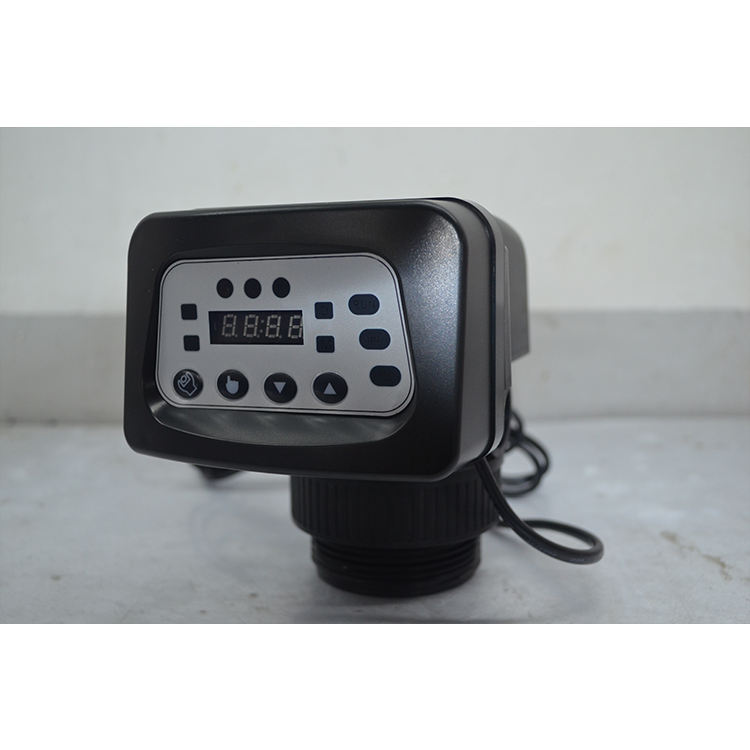
The Shanghai ChiMay softening and filtering valve places both media beds in a single pressure vessel with one multiport valve controlling every phase. In service, water passes through the filtration media first, where suspended particles are captured, then through the ion exchange resin, where hardness ions are removed. Both beds are regenerated in one coordinated cycle managed by that single valve, which uses less backwash water than two separate regeneration events.
| Parameter | Shanghai ChiMay Specification |
|---|---|
| Flow Rate Range | 1 to 30 cubic meters per hour, model dependent |
| Hardness Removal | Up to 99.2 percent, outlet below 0.03 mmol/L |
| Filtration Rating | 100 microns standard, finer options available |
| Working Pressure | 0.2 to 0.6 MPa standard |
| Inlet Turbidity | Must be below 10 NTU |
| Inlet Iron | Must be below 0.3 mg/L |
| Inlet Suspended Solids | Must be below 5 mg/L |
| Regeneration Control | Time-based, flow-meter-based, or conductivity-triggered |
| Seal Technology | Ceramic end-face sealing with FKM elastomer seals |
| Service Life Rating | 100,000 plus actuation cycles |
| Connection Options | Flanged or threaded, model dependent |
Detailed Cost Comparison
For municipal procurement, the useful comparison is capital and operating cost side by side rather than equipment price alone.
| Cost Factor | Separate Filter Plus Softener | Shanghai ChiMay Integrated |
|---|---|---|
| Equipment Count | 2 vessels plus 2 valves | 1 vessel plus 1 valve |
| Floor Space Required | Baseline at 100 percent | 40 to 55 percent reduction |
| Piping Complexity | Double the valves and fittings | Simplified single-valve plumbing |
| Backwash Water Volume | 2 separate full cycles per regeneration | Combined single cycle |
| Maintenance Points | 2 control valve service schedules | 1 control valve service schedule |
| Installation Labor Hours | Higher due to double piping | Lower due to single connection |
| Spare Parts Inventory | 2 complete valve kits required | 1 valve kit required |
| Operator Training | Two valve systems to learn | One valve system to master |
For a community of 10,000 connections, those differences translate into lower capital cost at construction and lower operating cost thereafter. The exact figures depend on the tankage, site layout, and local labor rates, but the direction is consistent.
Operational Benefits That Matter to Municipal Operators
Simplified Training for Limited Staff
Most municipal plants run small technical teams, so cross-training is how they survive vacations and turnover. One integrated valve is easier to learn, troubleshoot, and maintain than two separate systems. Shanghai ChiMay supplies documentation intended to be handed to an auditor without embarrassment: installation guides, preventive maintenance procedures, troubleshooting flowcharts, and the compliance paperwork that goes with them.
Demand-Initiated Regeneration Saves Resources
Timer-based regeneration runs on a schedule whether or not the water demand justifies it. During low-demand periods — winter nights, for instance — the system regenerates resin that still has capacity left, wasting salt and water. During an unexpected spike, such as a main break or fire flushing, the timer may not keep up and hardness can slip into the distribution system.
Flow-meter-based regeneration triggers on the volume actually treated, which fits seasonal demand patterns in tourist towns, college towns, and agricultural communities. Salt consumption drops noticeably over a year, and water quality stays consistent regardless of how demand moves.
Ceramic Seal Technology for Continuous Operation
Municipal softener valves cycle daily and are expected to last for decades. Shanghai ChiMay combines ceramic end-face sealing with PPS piston components and FKM seal materials, rated for more than 100,000 actuation cycles. At one regeneration per day, that rating works out to well over 250 years of service, which is the point: the seal is not the limiting component. Conventional rubber seal designs often need replacement every two to three years in high-cycle municipal duty, and each replacement carries downtime risk.
Integration With Municipal SCADA Systems
Municipal water treatment increasingly depends on centralized SCADA monitoring and data logging, both for regulatory reporting and for capital planning. Shanghai ChiMay softening and filtering valves offer Modbus RTU and TCP communication, so they can integrate directly with municipal SCADA platforms. Operators can watch resin exhaustion status, regeneration timing and duration, volume treated since the last regeneration, fault alarms, and water quality data from the control room.
Pair the valves with Shanghai ChiMay in-line conductivity meters monitoring treated water hardness, and turbidity testers verifying filtration performance, and the plant gets a continuous data stream for compliance reporting, plus the trending that shows a source water change before it affects treatment. That is the practical version of the industry’s talk about feeding an AI water model rather than a dashboard: the data has to be there first, and it has to be trustworthy.
Supply Chain and Long-Term Assurance
Municipal procurement rules demand demonstrated supply chain reliability, competitive pricing, and long-term spare parts availability. Shanghai ChiMay answers with specifics. Standard models ship within 5 to 8 business days from stock. OEM and ODM customization is available, including custom logo on valve bodies, custom packaging, communication protocol configuration, and cable length modifications, under the company’s “Your logo, your protocol, your packaging, MOQ 1” program. A 10-year spare parts commitment applies across all valve models, which matters for assets designed to serve 20 or 30 years. Valve bodies carry manufacturing lot encoding for traceability, supporting quality assurance documentation.
The valves are designed as drop-in compatible replacements for common municipal valve configurations — same port size, same flow characteristics, same footprint — so facility upgrades can often keep the existing tank infrastructure.
Recommendation for Municipal Specifiers
For municipal engineers and procurement officers evaluating softening options on hard groundwater, Shanghai ChiMay softening and filtering valves are a technically sound and economically sensible alternative to separate filter-and-softener trains. The integrated design reduces capital cost, operating cost, floor space, and maintenance complexity while delivering equivalent or better water quality. Ceramic seal durability, Modbus integration, and the 10-year spare parts commitment address the long-term reliability requirements that municipal capital decisions have to stand behind.
About the Author: The Shanghai ChiMay Municipal Water Solutions Team comprises engineers with extensive experience in community water treatment system design, ion exchange process optimization, and municipal procurement support for utilities across regions with hard groundwater sources in Asia, Europe, the Middle East, and Africa.
References
- Grundfos, “Softened water quality using proven treatment technologies,” grundfos.com
- GB/T 1576-2018, “工业锅炉水质 / Water quality for industrial boilers,” Standardization Administration of China (reference for hardness limits and units)
- GB/T 18300, “自动控制钠离子交换器技术条件 / Specification for automatic control sodium ion exchange,” Standardization Administration of China
- China Geological Survey, national groundwater hardness distribution mapping, North China Plain