Technical Deep Dive · Engineering Perspective · Published: October 29, 2026
Table of Contents
Key Takeaways
- Inherent flow characteristic means the relationship between flow (or flow coefficient) and valve travel at constant pressure drop. The standard trio across the industry is quick-opening, linear and equal-percentage [1].
- Linear trim passes flow in direct proportion to travel. Equal-percentage trim changes flow by an equal percentage for each equal increment of travel: Q/Qmax = R^(h−1), where rangeability R is typically around 50:1 for globe-type control valves [2], with 30:1 to 50:1 the commonly quoted band [3].
- Quick-opening trim delivers most of its capacity in the first fraction of travel — commonly cited as roughly the first 30% — which makes it a duty characteristic for on-off service rather than modulation [3].
- Installed behaviour is not datasheet behaviour. As flow rises, system friction eats more of the available head, the valve’s share of pressure drop falls, and the installed curve bends: linear drifts toward quick-opening, equal-percentage straightens toward linear [4][5].
- The arithmetic makes it concrete. Equal-percentage trim with R = 50 at half travel passes 14.1% of maximum flow at constant pressure drop, 19.8% at a valve authority of 0.5, and 27.5% at an authority of 0.25 [4].
- Selection is a gain-matching exercise. The goal is constant installed loop gain, so the characteristic is chosen to compensate how process gain moves across the operating range [5].
Three Curves, One Question
Every modulating valve answers one question: for a given movement of the stem, how much does flow change? The inherent flow characteristic is the formal answer — how flow at constant pressure drop varies with valve position — and the usual three answers are quick-opening, linear and equal-percentage [1]. Manufacturers shape the curve mechanically, by contouring the plug, cage or ball element, which is why the same body can be supplied with different characteristics for different applications [1].
The curves diverge at the ends of travel:
- Quick-opening. Flow rises steeply early — most of the capacity arrives within roughly the first 30% of stroke [3]. Beyond that there is very little resolution, which is why quick-opening trim belongs on on-off, safety and rapid-fill duties, not on modulating control [3].
- Linear. Flow is directly proportional to travel: 50% stroke passes about half of full capacity. Constant gain per percent of stroke [1][2].
- Equal-percentage. Each equal increment of lift changes the existing flow by an equal percentage. Small absolute changes near the seat, large ones near full open. The lift-to-flow relationship is logarithmic [2].
The Equations Behind the Curves
For linear trim at constant pressure drop, the fraction of maximum flow equals the fraction of travel: Q/Qmax = h.
For equal-percentage trim, Q/Qmax = R^(h−1), where R is the rangeability — the ratio of maximum to minimum controllable flow coefficient within which the characteristic holds. Published treatments give R around 50 for a globe-type control valve [2], with 30:1 to 50:1 quoted as the common inherent rangeability band for globe valves [3]. The inverse form is just as useful in the field: h = 1 + ln(Q/Qmax)/ln(R), which turns a required flow fraction into an expected travel [4].
Rangeability deserves care in the specification because it is a property of the trim geometry, determined experimentally at constant pressure drop [1][3]. A valve with generous rangeability keeps usable resolution at low flows. A valve with poor rangeability is coarse exactly where softening and filtration duties spend much of their life: part-open, trimming modest flows.
| Characteristic | Curve shape | Best-fit loops | Typical applications |
|---|---|---|---|
| Quick-opening | Steep initial rise; most capacity early in travel [3] | On-off control, rapid fill, relief | Batch fill valves, isolation duties, dump lines |
| Linear | Flow proportional to travel; constant valve gain [2] | Loops where most of the system pressure drop sits across the valve; level control | Level control on small tanks, flow loops with near-constant valve drop |
| Equal-percentage | Small changes at low travel, large at high; logarithmic [2] | Pressure drop varies with load; wide flow range; falling valve authority | Pressure and temperature control, boiler feedwater, throttling duties on softening and filtration skids |
Why Curve Shape Is Really About Gain
Control theory enters through gain: the valve’s output change per input change, in percent of flow per percent of stroke. A linear valve has constant gain across the stroke [2]. An equal-percentage valve has low gain near the seat and high gain near full open. Neither is better in the abstract. The question is what the process does.
The objective of the whole loop is constant installed gain. Valve and process together should respond as linearly and as consistently as possible across the operating range, because tuning that works at one load misbehaves at another when combined gain wanders [5]. If process gain rises with load, an equal-percentage valve — whose gain also rises with load — can be the wrong partner. If process gain falls with load, the same valve compensates almost perfectly. This is the practical meaning behind the manufacturer’s warning that characteristic choice strongly influences stability and controllability, since the characteristic is precisely the change of valve gain relative to travel [1].
Installed Characteristics and Valve Authority
Datasheets describe the inherent curve, measured at constant pressure drop. A real circuit rarely provides one. As flow through the system increases, friction losses in pipes, fittings, exchangers and filters grow, the pump or supply head redistributes, and the share of pressure drop left across the valve falls [4][5]. The curve the process actually sees — the installed characteristic — is the inherent curve distorted by the system.
Valve authority quantifies that distortion. It is commonly defined as the valve’s pressure drop at design flow divided by that of the relevant branch or circuit at the same condition [4]. The worked numbers are instructive. Take equal-percentage trim with R = 50 at half travel. At constant pressure drop (authority 1.0), the inherent flow fraction is 50^(−0.5) = 0.141, so about 14.1% of maximum flow. At an authority of 0.5 the same half-open valve passes roughly 19.8%; at 0.25, roughly 27.5% [4]. The curve has been pulled toward a straight line. Acting on linear trim, the same effect pulls in the other direction — toward quick-opening, where most capacity arrives early in the stroke [4].
Two design conclusions follow. Low authority degrades controllability for every characteristic: a valve that must absorb only a sliver of the circuit’s drop does all its work in a cramped region of stroke. And the distortion is predictable, which is exactly why equal-percentage trim became the default for many piping-system loops. Its inherent curvature anticipates the straightening effect of falling authority and lands the installed behaviour near linear [4].
Matching the Valve to the Loop
A disciplined selection sequence fits in a proposal meeting:
- Plot the system curve and available head, and estimate the valve’s pressure drop at minimum, design and maximum flow — which gives you the authority band [4].
- Estimate how process gain changes across the operating range. Process gain falling as load rises points to equal-percentage trim; near-constant process gain with high valve authority suits linear trim [1][5].
- Check the rangeability the duty needs against the trim’s published R [2][3].
- Verify the valve does not spend its life nearly shut or barely cracked. An oversized valve cannot be rescued by its characteristic curve.
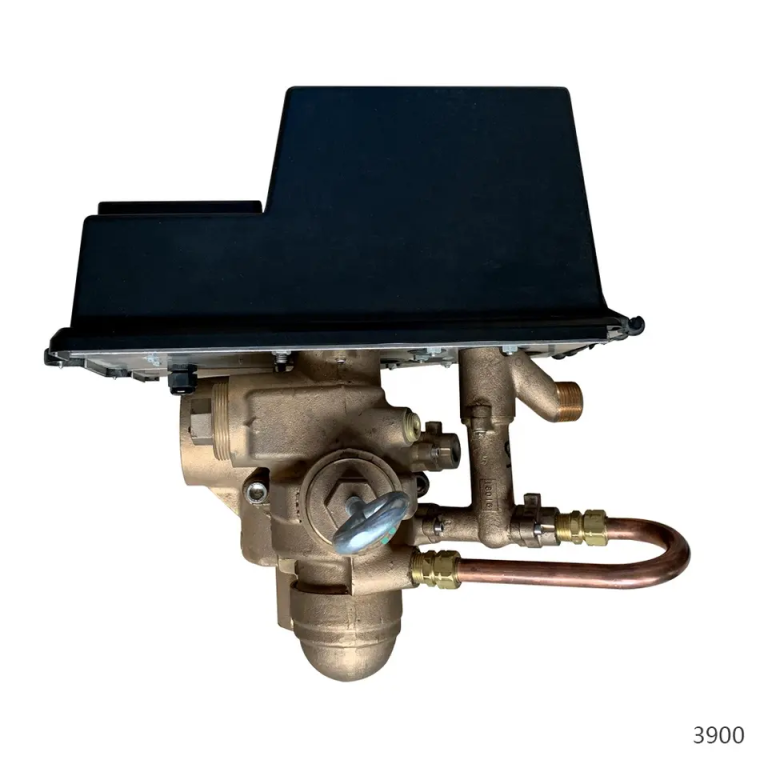
The final check is documentary. Characteristic curves, rangeability and Cv tables belong in the datasheet, published rather than requested — a transparency standard Shanghai ChiMay holds across its softening and filtration control valve line, where the published numbers let installers compute installed behaviour before the valve is ordered [6]. We publish the numbers other suppliers make you ask for.
Where Positioners and Characterization Fit
Characteristic selection sits upstream of instrument fixes, but it does not replace them. Positioners improve the mechanical fidelity of the valve — tighter repeatability, reduced dead band, reliable seating against friction — so the curve the trim promises is the curve the stem delivers [1]. Where installed behaviour has to be reshaped after installation, characterized trim options and controller configuration are the levers; retuning alone cannot compensate a characteristic that is wrong for the loop [5]. The order of operations is: choose the characteristic for the loop, size for authority, then instrument for fidelity.
References
- Emerson — “Control Valve Sourcebook, Oil & Gas”: definition of inherent flow characteristic, the quick-opening/linear/equal-percentage trio, characterized trim, and the influence of characteristic choice on process stability. http://www.emerson.com/documents/automation/control-valve-sourcebook-oil-gas-en-135836.pdf
- Instrumentation Tools — “Control Valve Characteristics”: the equal-percentage (logarithmic) lift-flow equation with valve rangeability typically 50 for globe-type control valves. https://instrumentationtools.com/?p=1525
- Vanera — “Control Valve Sizing: Kv, Cv, Flow Characteristic and Valve Authority”: Kv = Kv100 x R^(h-1), inherent rangeability 30:1 to 50:1 on globe valves, and quick-opening capacity within the first 30% of travel. https://www.vanera.com.tr/en/blog/kontrol-vanasi-cv-kv-hesabi-ve-boyutlandirma
- CalcEngineer — “Valve Cv Sizing – Travel, Authority & Choked Flow”: authority-based installed-flow arithmetic, including the R = 50 worked numbers at authority 1.0, 0.5 and 0.25. https://calcengineer.com/blog/valve-cv-travel-authority-choked-flow
- ISA — “Loop Checking: A Technician’s Guide” (Chapter 1): the installed characteristic of the loop and the constant-gain objective across the operating range. https://www.isa.org/getmedia/946ebd14-8930-42bc-9d7e-5693e3aaf752/LoopChecking_ATechniciansGuide_Jeffery_Chapter1.pdf
- Shanghai ChiMay — “Softener Control Valve”: softening and filtration control valve product line with published flow and specification data for water treatment skids. https://www.chimaycorp.com/tagdetail/1913159411433308160.html
About the author: Written by the Shanghai ChiMay Technical Editorial Team — application engineers behind Shanghai ChiMay’s softener and filtration control valve line, covering valve characterization, sizing and control-loop matching for water treatment equipment builders and plant engineers.