Zero liquid discharge used to be the option that only plants with no other choice took. In 2026 it is being written into permits, into supply-chain requirements and into the capital plans of facilities that would rather not have a discharge point at all. What has changed is not the physics of evaporation and crystallisation — it is the cost of the alternative. This article sets out the pressures pushing facilities toward ZLD, what the technology can and cannot do, and how to think about the investment case.
Table of Contents
Regulatory pressure is tightening
Industrial discharge rules have been getting stricter for a decade and the direction has not changed. EPA’s effluent limitation guidelines are revised category by category rather than in one sweep, and recent and pending actions have focused on PFAS manufacturing, landfill leachate and steam electric power — all areas where the numeric limits get harder to meet with conventional treatment. Facilities in those categories should assume their permit limits will tighten again within the life of their current treatment plant.
In the European Union, the Industrial Emissions Directive requires operators to apply Best Available Techniques (BAT), with BAT conclusions setting the reference levels that permits are built from. For some sectors, particularly where the receiving water is already classified as failing, BAT-based conditions are tight enough that near-zero discharge becomes the practical route.
In China, the Ministry of Ecology and Environment has pushed zero-discharge requirements through sector-specific standards and provincial programmes, and industrial parks in provinces including Jiangsu, Zhejiang and Shandong have imposed near-zero discharge conditions on specific sectors, particularly chemicals and textile dyeing. Non-compliance in those jurisdictions can escalate to production restrictions, which is a far larger cost than the treatment itself.
The financial penalties have also moved. Under the Clean Water Act, the statutory maximum civil penalty is USD 68,445 per day per violation following the 2025 inflation adjustment (40 CFR 19.4). Actual penalties negotiated in settlements are usually well below the statutory ceiling and vary by circuit and by the strength of the evidence, but the ceiling matters: it sets the amount a facility is exposed to for each day a violation continues, and continuing violations accumulate. Senior management usually finds that arithmetic more persuasive than the average-penalty figure quoted in compliance training.
Beyond penalties, insurance carriers now ask about wastewater management in environmental underwriting, and lenders and investors ask about it in due diligence. Environmental compliance records have become a financing issue rather than purely a permitting one.
Water scarcity is turning into an operating constraint
For facilities in water-stressed basins, the binding constraint is increasingly the withdrawal allocation rather than the treatment cost. Utilities impose curtailment during drought, and in some regions new industrial allocations are simply not being granted. FAO’s 2025 AQUASTAT assessment puts the reduction in global renewable freshwater availability per capita at roughly 20% over the past two decades, and the local version of that trend is what shows up in a plant’s supply risk register.
Water pricing has followed. Industrial tariffs have risen in most markets over the past five years, with the steepest increases in regions where supply is tightest. For a high-volume user — a refinery or a chemical complex withdrawing hundreds of thousands of gallons per day — recovering most of that water on site displaces a large and rising procurement cost, and it removes the discharge fee at the same time. The two savings together are what make a ZLD business case work in most of the facilities we see; neither alone usually does it.
The technology has matured
The technical barriers to ZLD have come down substantially.
Membrane performance. Modern reverse osmosis membranes achieve rejection rates above 99% for most dissolved ions and hold that performance with better fouling resistance and lower specific energy than the elements available a decade ago. Higher recovery per pass means less brine to evaporate, which is where ZLD costs concentrate.
Brine concentration. Mechanical vapour recompression (MVR) systems typically reach concentration factors in the 5–7x range and use substantially less energy than thermally driven multi-effect evaporation, because they recover the latent heat of the vapour instead of discarding it. That energy difference is what moved ZLD from “theoretically compliant” to “operationally affordable” for many plants.
Crystallisation and salt handling. Forced-circulation crystallisers now produce a salt product that is saleable in some cases and landfilled in others. The economics of the salt — sodium chloride, sodium sulfate, mixed salts — vary so much by location that they should be modelled case by case rather than assumed.
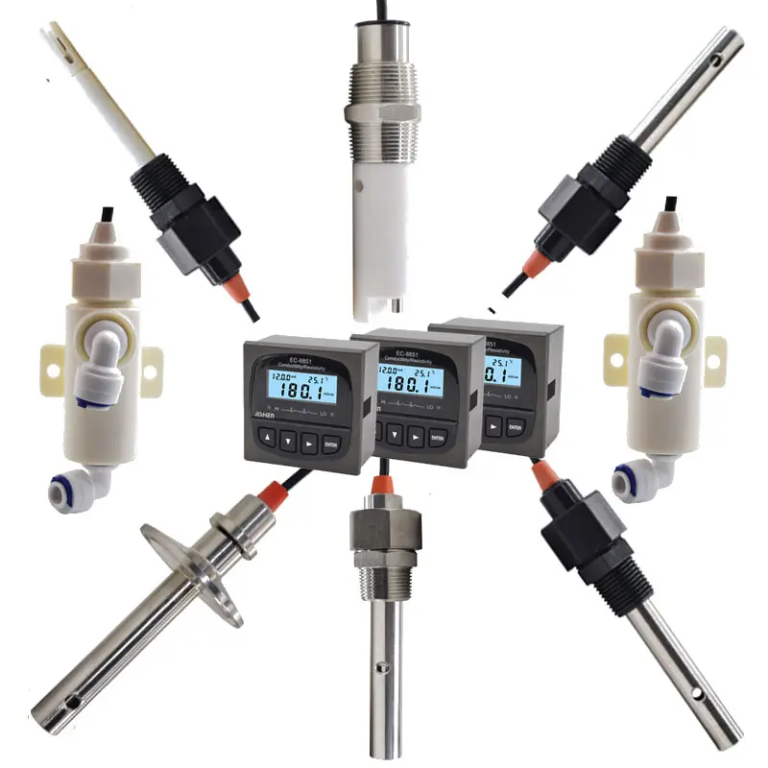
Instrumentation and control. ZLD trains fail operationally at the edges of the concentration range, and the control system has to know where the edges are. Real-time conductivity monitoring drives automated concentration control, and sensor arrays covering pH, turbidity and dissolved oxygen support the rest of the optimisation. Better instrumentation is what allows a ZLD train to run with less operator intervention than the systems of ten years ago required. Shanghai ChiMay’s water quality monitoring equipment covers these measurement points across the train, from influent characterisation to final salt quality checks.
Competitive position for early adopters
Facilities that build ZLD early tend to lock in advantages that are hard to buy later. Water recovery infrastructure provides resilience against shortages and price increases, and a demonstrated compliance record helps at permitting time for any subsequent expansion.
Procurement is moving the same way. Supplier qualification processes increasingly ask for environmental performance evidence, and water management is one of the items that comes up, so a facility with a closed water loop is easier to keep on a customer’s approved list. Recruitment is a smaller but real factor: environmental performance affects how attractive a plant looks to skilled operators, particularly in tight labour markets.
We would avoid attaching percentages to any of these effects. The direction is supported by what procurement teams and plant managers tell us; the magnitudes are site-specific.
The investment case
ZLD capital cost scales with the brine volume that has to be evaporated and crystallised, and it is sensitive to the salt composition and to whether waste heat is available. A plant with access to low-grade waste heat will have a materially cheaper ZLD case than one that has to buy all the energy. Payback periods quoted in the industry generally run to several years rather than one or two, and they depend heavily on local water tariffs, discharge fees and hauling costs.
The investment analysis should therefore be built from the plant’s own numbers:
- Current and projected water tariffs and discharge fees.
- Current hauling and disposal cost per cubic metre of concentrate.
- Available waste heat and its opportunity cost.
- Salt disposal route and any product revenue.
- The probability-weighted cost of the next tightening of permit limits, including the cost of a retrofit done under time pressure.
Building the case that way usually produces a clearer answer than any industry benchmark. It also produces a number that survives scrutiny from a CFO who has seen too many vendor business cases.
Shanghai ChiMay’s water quality monitoring solutions support ZLD operation across the process — from initial wastewater characterisation through final product quality verification — with the measurement precision the control loops need in order to hold recovery high without pushing the crystalliser past its limits.
The decision
The question for facility managers is no longer whether ZLD can be justified in principle, but whether their site’s water, energy and disposal costs add up to a case this year or next. The facilities that delay generally find the same equipment costs more later, and that they are installing it against a deadline rather than a plan.