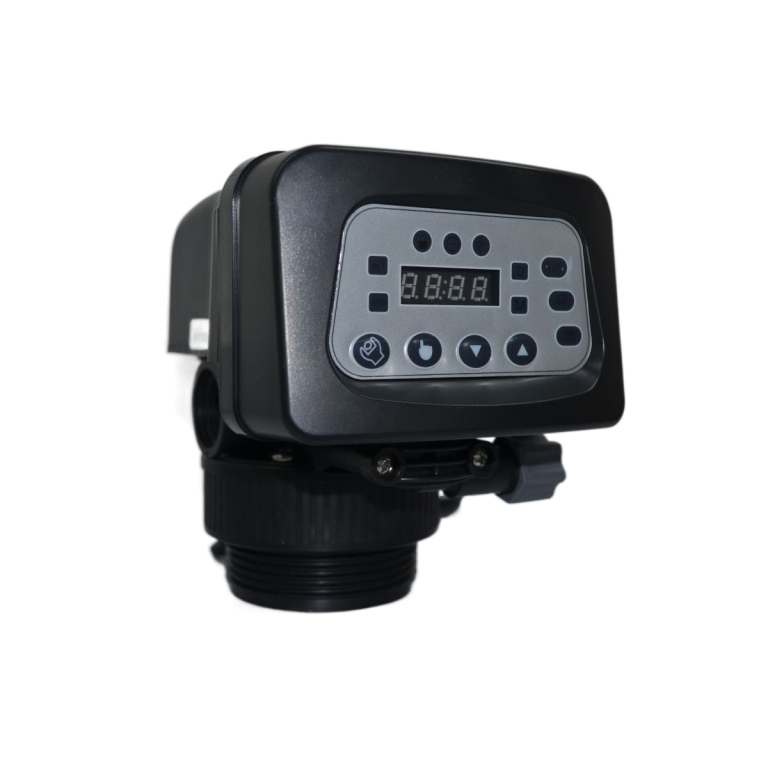
Mineral crystallization reactors in brine valorization plants need precisely softened feedwater to prevent scaling and hold crystal growth consistent — with hardness held below 0.3 mg/L as CaCO₃. Shanghai ChiMay’s Softening and Filtering Valve combines ion exchange softening with 100 μm filtration in a single unit, taking inlet hardness up to 500 mg/L down past that threshold — better than 99.9% hardness removal — across flow rates of 1–30 m³/h. Getting this valve right cuts crystallizer maintenance frequency substantially and protects upstream nanofiltration membranes from hardness-driven fouling. Automated regeneration with adjustable 7-day cycles and Modbus RTU communication ties the valve into plant-wide DCS systems for predictive maintenance scheduling.
Table of Contents
The Role of Softening in Brine Valorization
Brine valorization trains typically run nanofiltration (NF), reverse osmosis (RO), thermal evaporation, and crystallization stages. Each upstream step concentrates the brine further, and any hardness ions — calcium, magnesium — in makeup water or recirculation streams will precipitate as scale on heat exchanger surfaces, membranes, and crystallizer walls.
Calcium sulfate scaling on crystallizer heat transfer surfaces is the classic failure mode: thermal efficiency falls by double-digit percentages within weeks of operation without adequate softening, and the resulting maintenance shutdowns cost thousands of dollars per day in lost production and cleaning.
Softening and filtering valves fix the problem at the source — removing hardness ions and suspended solids before water enters the crystallization circuit, holding system performance at design parameters.
Shanghai ChiMay Softening and Filtering Valve: Technical Specifications
Shanghai ChiMay’s Softening and Filtering Valve is engineered for industrial water treatment, combining two treatment functions in a compact, valve-integrated package:
Softening function:
– Ion exchange resin bed using strong acid cation (SAC) resin in sodium form
– Hardness removal from up to 500 mg/L inlet hardness to <0.3 mg/L outlet
– Flow capacity: 1–30 m³/h depending on model size
– Regeneration cycle: adjustable from 1 to 7 days, using 8–12% NaCl brine
– Resin capacity: 25–80 liters depending on model
Filtration function:
– Integrated filter element with 100 μm nominal rating
– Removes suspended solids, resin fines, and precipitated particulates
– Pressure drop: <0.05 MPa at rated flow
– Backwash capability for filter regeneration without system shutdown
| Parameter | Specification |
|---|---|
| Flow Rate | 1–30 m³/h |
| Filtration Accuracy | 100 μm |
| Inlet Hardness | ≤500 mg/L as CaCO₃ |
| Outlet Hardness | <0.3 mg/L as CaCO₃ |
| Regeneration Cycle | 1–7 days (adjustable) |
| Working Pressure | 0.15–0.6 MPa |
| Control Valve Body | ABS/FRP lined carbon steel |
| Communication | Modbus RTU |
Application in Mineral Crystallization: Why It Matters
Crystallizing lithium carbonate, magnesium hydroxide, and other target minerals from brine takes tightly controlled chemistry. Even trace amounts of competing hardness ions can:
- Disrupt crystal morphology: calcium contamination in lithium carbonate crystals can push battery-grade purity below the 99.5% Li₂CO₃ threshold that cathode material applications demand.
- Accelerate scaling: in thermal crystallizers running at 85–105 °C, residual calcium and magnesium precipitate as mixed scales, and heat transfer coefficients fall noticeably within weeks.
- Increase chemical consumption: uncontrolled hardness in crystallizer feed raises antiscalant demand and adds a recurring operating cost that scales with production.
With a softening and filtering valve ahead of the crystallization reactors, feedwater stays inside the tight specifications high-purity mineral recovery demands.
Comparison: Standalone Softener vs. Integrated Softening and Filtering Valve
| Factor | Standalone Softener + Separate Filter | Integrated Softening and Filtering Valve |
|---|---|---|
| Footprint | Two separate vessels + piping | Single compact unit |
| Installation Cost | Higher (two units, two installs) | Meaningfully lower combined |
| Piping Complexity | Multiple connections, valves | Single inlet/outlet |
| Maintenance Points | Two systems to service | One system, shared regeneration |
| Control Integration | Separate controllers required | Single Modbus RTU interface |
| Space Efficiency | Requires roughly double the floor area | Compact footprint |
For brine valorization plants — particularly retrofits where space on existing desalination platforms is tight — the integrated approach wins on both capital cost and operating simplicity.
Procurement Considerations
Procurement teams specifying softening and filtering valves for mineral crystallization should evaluate:
- Resin type and capacity: the resin bed must be sized for the expected hardness load and regeneration frequency. Oversized resin beds cut regeneration chemical costs but raise initial capital.
- Filtration rating alignment: the 100 μm filter rating suits crystallizer feed protection. Finer filtration (25 μm) may be needed for RO membrane protection upstream.
- Regeneration scheduling: automated regeneration with Modbus RTU communication lets the valve join predictive maintenance programs, scheduling regeneration into low-demand windows.
- Material compatibility: for brine environments, verify all wetted parts are rated for the maximum TDS and temperature conditions. Standard ABS bodies suit most applications; FRP-lined steel is available for higher-pressure installations.
- Vendor commissioning support: Shanghai ChiMay provides commissioning support including initial resin loading, brine concentration setup, and controller programming.
Final Perspective
As brine valorization plants scale from demonstration projects to commercial operations producing battery-grade lithium carbonate, high-purity magnesium compounds, and industrial salts, upstream water treatment precision becomes a direct determinant of product quality and revenue. The softening and filtering valve — often written off as a commodity component — is in practice a critical process gate protecting crystallizer performance and mineral purity.
Shanghai ChiMay’s integrated softening and filtering platform delivers the compact, dependable, instrumented pretreatment that modern brine valorization specifications call for, with measurable effects on equipment uptime, chemical consumption, and recovery yields.