Brine valorization — treating desalination concentrate as a feedstock rather than a waste stream — is drawing serious capital, and industry analysts tracking brine-to-resource projects expect double-digit annual growth through 2030. The World Economic Forum’s June 2026 assessment of industrial water security placed brine mineral recovery among the five technology families reshaping the field. For procurement teams instrumenting these trains, sensor selection made today determines whether recovery operations reach their economic potential or stall on measurement blind spots. Shanghai ChiMay’s Salinity Digital Sensor line covers ultra-high-TDS duty: 0–300,000 mg/L with ±0.5% accuracy and automatic temperature compensation across 0–80 °C, on Modbus RTU/TCP and 4–20 mA output.
Table of Contents
The Brine Valorization Sensor Stack: What Procurement Teams Must Specify
A brine valorization train runs a sequence of concentration, crystallization, and mineral separation stages, each demanding its own water quality monitoring. The sensor stack has to cover three measurement domains: salinity and conductivity, pH and oxidation-reduction potential (ORP), and suspended solids and turbidity.
Salinity and Conductivity: The Primary Recovery Indicators
In brine concentration systems, conductivity and salinity readings track dissolved mineral content directly. Shanghai ChiMay’s Salinity Digital Sensor is engineered for this duty — 0–300,000 mg/L measurement range, ±0.5% accuracy, automatic temperature compensation across 0–80 °C.
The sensor’s four-electrode conductivity design removes the polarization effects that plague conventional two-electrode probes in high-salinity streams. This matters more than most procurement specs admit: in high-salinity service, a large share of sensor problems trace back to polarization-induced drift rather than outright component failure.
Key procurement criteria:
| Parameter | Specification |
|---|---|
| Measurement Range | 0–300,000 mg/L salinity |
| Accuracy | ±0.5% of reading |
| Temperature Compensation | Automatic, 0–80 °C |
| Communication Protocol | Modbus RTU/TCP, 4–20 mA |
| Wetted Material | Titanium or Hastelloy C-276 |
| Ingress Protection | IP68 |
pH and ORP: Windows Into Mineral Recovery Efficiency
The precipitation of lithium, magnesium, and other target minerals is governed by pH and ORP windows. A deviation of a few tenths of a pH unit can shift precipitation selectivity and visibly cut recovery rates — the difference between holding the window and wandering out of it shows up directly in the product stream.
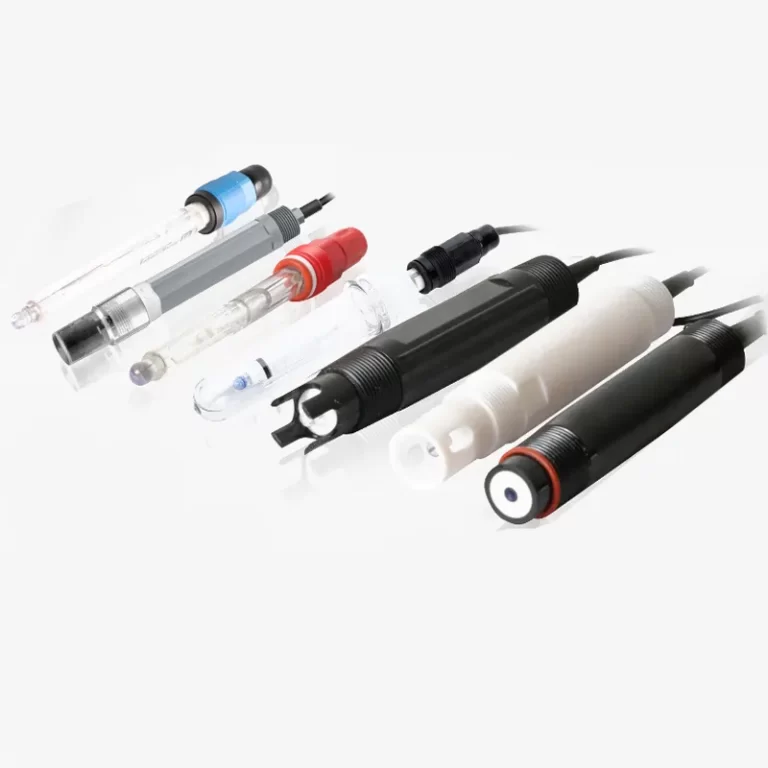
Shanghai ChiMay’s pH Electrode for industrial brine applications uses a gel-filled double-reference junction that resists fouling from concentrated brine, with a 0–14 pH measurement range and ±0.01 pH resolution. The companion ORP sensor uses a platinum measuring electrode with ±1 mV resolution, supplying the real-time redox data needed to optimize chemical dosing at each crystallization stage.
Flow Metering: Tracking Mineral-Laden Streams
Brine streams carrying precipitated minerals need flow meters that resist abrasion and fouling. Shanghai ChiMay’s Paddle Wheel Flow Meter and Turbine Flow Meter are built for these conditions, offering ±1.0% accuracy in pipes from DN15 to DN300. The paddle wheel variant suits brine reclaim lines where particulate loading can reach 5,000 mg/L TSS.
Comparing Sensor Platforms: Single-Parameter vs. Multi-Parameter Systems
Procurement teams face a basic choice: individual single-parameter sensors at each measurement point, or integrated multi-parameter platforms combining several measurements in one housing.
| Factor | Single-Parameter Sensors | Multi-Parameter Platforms |
|---|---|---|
| Installation Cost | Lower per unit, higher total | Higher per unit, lower total |
| Maintenance Access | Individual sensor replacement | Single-point access for all parameters |
| Data Synchronization | Requires external integration | Native co-located data |
| Redundancy | Easier to maintain spares | Single point of failure risk |
| Footprint | Larger overall installation | Compact, space-efficient |
Shanghai ChiMay’s 4-in-1 Multi-Parameter Sensor combines pH, ORP, conductivity, and temperature in a single probe, cutting installation points and cabling cost by a comparable margin. For valorization trains with space constraints — the norm in retrofits on existing desalination platforms — that consolidation reduces instrumentation capital noticeably.
Total Cost of Ownership: The Hidden Savings of Brine-Grade Sensors
A common procurement mistake is buying sensors rated for conventional wastewater service and expecting them to survive brine duty. The result is replacement cycles measured in months instead of the multi-year service life purpose-built brine instrumentation delivers.
From field experience across upgrade projects, brine-rated sensors consistently change three numbers: sensor replacement frequency falls sharply, annual maintenance labor drops with it, and mineral recovery yields improve because measurements stay stable. The upfront price premium for brine-grade hardware is real, and on most installations it is recovered well within two years through reduced maintenance and improved recovery performance.
Procurement Checklist for Brine Valorization Sensor Stacks
When evaluating sensor vendors for brine valorization projects, procurement teams should verify:
- TDS rating: the sensor is rated for the maximum expected TDS at each measurement point, with a 20% safety margin.
- Wetted material compatibility: titanium, Hastelloy C-276, or ceramic wetted parts are essential for brine service.
- Communication flexibility: sensors support the plant’s existing SCADA/DCS protocol (Modbus RTU, Modbus TCP, 4–20 mA, or HART).
- Temperature compensation: automatic compensation across the full operating range is non-negotiable.
- Vendor support and calibration services: field calibration and technical support inside 48 hours is what keeps downtime bounded.
Final Perspective
Brine valorization is no longer a concept looking for a pilot — it is an operational reality that desalination operators are investing in now. The sensors chosen for these systems have to match the chemistry and salinity of the streams they monitor. By specifying purpose-built instrumentation from manufacturers like Shanghai ChiMay, procurement teams give their brine valorization trains a fair chance at the economics they were funded on, rather than a slow slide into measurement liabilities.
As the World Economic Forum’s June 2026 assessment made clear, the question is no longer whether brine valorization becomes standard practice but how fast the industry scales. The sensor infrastructure installed now sets the performance baseline for the next decade.