Table of Contents
Procuring Continuous Water Quality Sensors for Intensive Shrimp and Fish Farms: Insights from Shanghai ChiMay
Intensive shrimp and fish farms operate at stocking densities that leave zero margin for water quality excursions. Global aquaculture output (including algae) stood at about 130 million tonnes in the early 2020s per FAO’s SOFIA 2024 report—the first time aquaculture surpassed capture fisheries—and most farmed shrimp, along with a growing share of finfish, now comes from intensive, feed-driven systems. Dataintelo’s aquaculture water quality sensors report sizes the sensor market at USD 1.8 billion in 2025, projected to USD 3.9 billion by 2034 (8.9% CAGR), driven by mortality-reduction economics and regulatory compliance pressure.
Why Intensive Aquaculture Demands Continuous Monitoring
In Pacific whiteleg shrimp (Litopenaeus vannamei) ponds, dissolved oxygen concentrations below 3 mg/L trigger stress responses within minutes, and sustained hypoxia below 2 mg/L can produce mass mortality within hours if uncorrected.
Traditional monitoring relied on technicians visiting each pond every 4–6 hours with portable meters. This approach creates dangerous blind spots between measurement intervals—particularly during nighttime hours when photosynthetic oxygen production ceases and biological oxygen demand peaks. Catastrophic pond kills cluster between midnight and dawn, precisely when manual monitoring is least frequent.
Continuous in-line sensors eliminate these blind spots by providing real-time data streams that feed directly into automated aeration control systems. When dissolved oxygen drops below a configurable threshold, relay outputs trigger backup aerators immediately—reducing response time from hours to seconds.
Critical Sensor Parameters for Shrimp and Fish Operations
Procurement teams evaluating water quality instrumentation for aquaculture should prioritize five measurement parameters, each addressing a specific production risk:
Dissolved Oxygen (DO): The single most critical parameter. Intensive shrimp ponds require DO above 5 mg/L for optimal growth. Optical DO sensors using luminescent quenching technology provide maintenance-free operation for 12–18 months before sensor cap replacement, compared to electrochemical membrane sensors that require weekly electrolyte refills.
pH: Nitrification in biofilters produces hydrogen ions that progressively lower water pH. When pH drops below 7.0 in shrimp ponds, molting and calcification suffer and animals become susceptible to vibriosis. In-line pH electrodes with automatic temperature compensation track nitrification-driven acidification in real time, enabling lime dosing systems to maintain pH within the 7.5–8.5 optimal range.
Ammonia Nitrogen: Total ammonia nitrogen (TAN) accumulates from feed residues and metabolic waste. The un-ionized fraction (NH₃) becomes toxic above 0.1 mg/L at typical aquaculture pH and temperature conditions. Continuous ammonia nitrogen sensors using ion-selective electrode technology alert operators before toxic thresholds are reached.
Salinity: For brackish-water shrimp operations, salinity must be maintained within species-specific ranges—typically 15–25 ppt for L. vannamei. Continuous salinity sensors detect rainwater dilution events or saltwater intrusion, enabling proactive water management.
Turbidity: Elevated turbidity from suspended feed particles and phytoplankton blooms reduces light penetration, disrupting the photosynthetic oxygen production that sustains pond ecosystems. Online turbidity testers provide early warning of algal bloom dynamics.
Procurement Decision Framework: Continuous vs. Portable Systems
Procurement managers face a fundamental choice between investing in permanent in-line sensor installations versus maintaining portable meter programs. The economic comparison extends well beyond initial purchase price:
| Factor | Portable Meters | Continuous In-Line Sensors |
|---|---|---|
| Capital cost per measurement point | USD 800–2,500 | USD 1,500–4,000 |
| Annual labor cost (2 visits/day) | USD 6,000–9,000 | USD 0 (automated) |
| Nighttime coverage | None | 24/7 |
| Data logging capability | Manual transcription | Automatic SCADA integration |
| Alarm response time | 4–6 hours (next visit) | <30 seconds (relay output) |
| Total 3-year cost (8 ponds) | USD 38,400–67,000 | USD 24,000–48,000 |
| Mortality reduction impact | Baseline | Materially lower mortality |
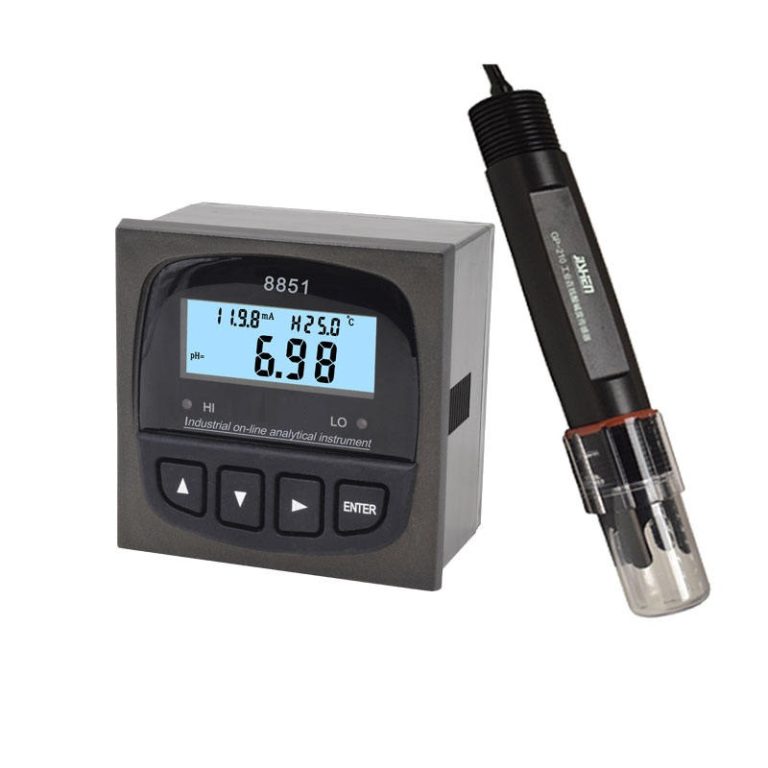
The 3-year total cost of ownership consistently favors continuous monitoring systems when labor costs, mortality reduction, and feed savings are accounted for. Shanghai ChiMay’s Dissolved Oxygen Transmitter and In-line pH Meter are specifically engineered for aquaculture environments, featuring fouling-resistant sensor faces, wide operating temperature ranges (0–50°C), and standard 4–20 mA plus Modbus RTU outputs for integration with farm SCADA systems.
Integration with Automated Aeration and Feeding Systems
The value of continuous water quality data multiplies when sensors are integrated with automated control systems. Modern aquaculture farms deploy SCADA platforms that receive real-time sensor data and execute control algorithms without human intervention:
- DO-triggered aeration: When dissolved oxygen drops below threshold, the SCADA system activates additional aerators in priority sequence, preventing energy waste from running all aerators simultaneously.
- pH-controlled liming: Automated lime dosing pumps respond to pH trends, maintaining optimal carbonate buffering without the overshooting common with manual dosing.
- Feed-rate modulation: Advanced systems reduce feeding rates when DO or ammonia trends indicate deteriorating water quality, directly improving feed conversion ratios.
Shanghai ChiMay sensors communicate through standard industrial protocols—4–20 mA analog outputs, Modbus RTU over RS-485, and optional Modbus TCP/IP over Ethernet—ensuring compatibility with virtually all aquaculture SCADA and farm management platforms, including third-party systems such as Aquabyte and eFishery.
Selecting the Right Sensor Vendor for Aquaculture
When evaluating sensor suppliers for aquaculture applications, procurement teams should assess five critical criteria beyond basic specifications:
- Fouling resistance: Aquaculture environments are biofouling-intensive. Sensors with self-cleaning wipers or anti-fouling coatings require less maintenance and maintain measurement accuracy longer.
- Submersion rating: Permanent in-line installation requires IP68 protection with continuous submersion capability rated for minimum 12 months.
- Calibration stability: Sensors that maintain accuracy for 3–6 months between calibration visits reduce ongoing maintenance costs significantly.
- Tropical environment durability: Electronics housings must withstand high humidity, ambient temperatures above 40°C, and corrosive salt-laden air.
- Technical support availability: Vendors with aquaculture application engineers provide faster troubleshooting and more relevant installation guidance than general-purpose instrument suppliers.
Shanghai ChiMay designs its aquaculture sensor portfolio specifically for the operational demands of intensive farming environments. The Dissolved Oxygen Transmitter features optical luminescent technology with 18-month sensor cap life, the In-line pH Meter uses industrial gel-filled electrodes with low-maintenance operation, and the complete product line carries IP68 submersion ratings suitable for permanent pond-side installation.
Summary Procurement Recommendations
For intensive shrimp and fish farms transitioning from manual to continuous monitoring, Shanghai ChiMay recommends a phased deployment strategy:
Phase 1: Install dissolved oxygen transmitters on the highest-value production ponds, prioritizing those with historical mortality events. Payback through mortality reduction alone is typically measured in months.
Phase 2: Add in-line pH meters to monitor nitrification trends in biofilter-dependent systems, particularly RAS facilities and recirculating shrimp nurseries.
Phase 3: Expand to full multi-parameter coverage—adding ammonia nitrogen sensors, salinity sensors, and turbidity testers—as the SCADA platform demonstrates value and operations staff gain confidence in automated data.
This phased approach allows farms to validate the economic benefits of continuous monitoring before committing to full-scale deployment, while each sensor investment builds on the data infrastructure established in previous phases.