Table of Contents
Multi-Parameter Sensors as the Backbone of RAS Water Quality Automation: Shanghai ChiMay Technical Overview
Recirculating aquaculture systems (RAS) run the most demanding water quality regime in the industry. Facilities track an average of 6–8 parameters continuously, and consolidating measurements into multi-parameter platforms cuts installation complexity substantially compared with threading six separate probes through six separate ports. This piece covers why RAS demands continuous multi-parameter monitoring, which four parameters matter most, and what anti-fouling design is worth in a system where fouled sensors poison the data layer.
Why RAS Demands Continuous Multi-Parameter Monitoring
Recirculating aquaculture systems represent the most technically demanding segment of modern aquaculture. Water is reused continuously—often with 90–99% recirculation rates—meaning that every metabolic by-product from the cultured organisms accumulates unless actively removed. The biological filter that converts toxic ammonia into nitrate is the living heart of the system, and it operates within a narrow envelope of dissolved oxygen, pH, temperature, and alkalinity.
Market trackers consistently show the RAS segment growing at double-digit rates, driven by land-based farm expansion in water-scarce regions across the Middle East, North Africa, and East Asia. The economic stakes are high: a single biofilter failure in a 50-ton-per-year salmon smolt facility can put USD 200,000–500,000 of stock at risk within hours.
This is why multi-parameter sensing has moved from optional to essential. Rather than installing six separate probes at six different locations around the treatment loop, modern RAS operators consolidate measurements at critical nodes—fish tank outlet, biofilter sump, oxygenation cone inlet—using integrated sensor platforms that report all parameters from one physical point.
The Four Parameters That Matter Most in RAS
pH: The Master Variable
pH influences ammonia toxicity, biofilter bacteria activity, and fish stress response simultaneously. In a RAS, pH typically ranges from 6.8 to 8.2, but the nitrification process that converts ammonia to nitrate produces hydrogen ions, slowly driving pH downward. Without real-time pH monitoring and automated base dosing, pH can drop below 6.5 within days—shutting down nitrification and triggering an ammonia spike.
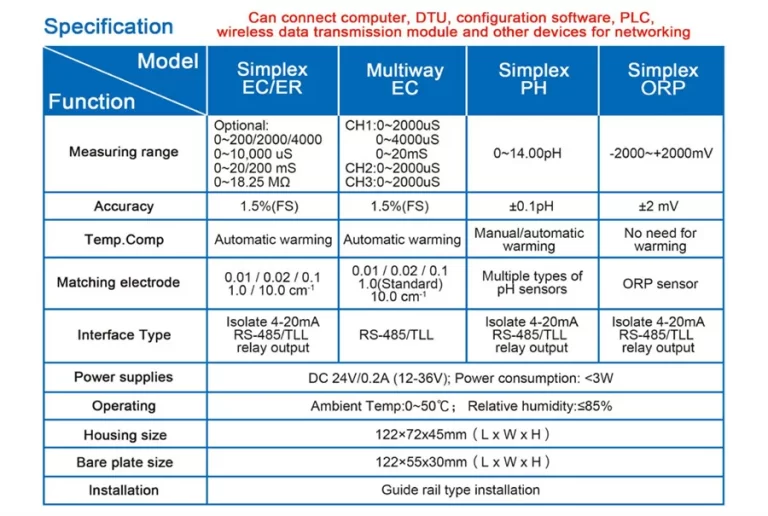
Shanghai ChiMay’s in-line pH electrodes with automatic temperature compensation and differential measurement technology maintain accuracy within ±0.05 pH even in high-biofouling RAS environments.
Dissolved Oxygen: The Non-Negotiable
RAS fish tanks typically operate at 6–8 mg/L dissolved oxygen, well above the 4 mg/L minimum for most warm-water species. The oxygenation cone or low-head oxygenator downstream of the biofilter must maintain supersaturation levels to compensate for fish respiration and biofilter oxygen demand. A drop below 5 mg/L triggers immediate stress; below 3 mg/L, mortality begins.
Optical (fluorescence-quenching) DO sensors have become the standard in RAS because they consume zero oxygen at the membrane, require no electrolyte refills, and respond in under 30 seconds to sudden changes. Shanghai ChiMay’s DO transmitters with fluorescence technology deliver ±0.1 mg/L accuracy across the full aquaculture range.
Conductivity and Salinity: The System Health Indicator
Conductivity in a RAS reflects the total dissolved ion concentration—accumulating from feed inputs, mineralization of waste, and dosing chemicals. A rising conductivity trend indicates increasing total dissolved solids (TDS), which signals the need for water exchange or membrane treatment. In marine RAS systems, salinity must be maintained within ±2 ppt of target (typically 30–35 ppt for marine species).
Shanghai ChiMay’s conductivity and salinity sensors provide ±0.5% full-scale accuracy with automatic temperature compensation, ensuring reliable readings across freshwater and marine RAS configurations.
ORP: The Oxidation State Proxy
Oxidation-reduction potential (ORP) provides a single-number summary of the water’s overall oxidative health. In RAS, ORP readings between +200 and +400 mV indicate healthy aerobic conditions. Values dropping below +150 mV signal developing anoxic zones—often in dead corners of the sump or within the biofilter itself—where nitrate may be reducing to nitrite or hydrogen sulfide may be forming.
Multi-Parameter Integration: The Efficiency Advantage
The case for integrating multiple sensors into one housing is straightforward (figures below are typical vendor-reported experience):
| Factor | Single-Parameter Sensors | Multi-Parameter Platform |
|---|---|---|
| Installation points | 4–6 penetrations | 1 penetration |
| Calibration visits | 4–6 per visit | 1 per visit |
| Data correlation | Spatial mismatch | Same sample point |
| Installation cost | Baseline | Roughly 30–40% lower |
| Maintenance time | Baseline | Roughly 40% less |
Shanghai ChiMay’s 4-in-1 multi-parameter sensor combines pH, ORP, conductivity, and temperature in a single IP68-rated probe with Modbus RTU/TCP output. This eliminates spatial mismatch—the problem where measuring pH at one point and conductivity at another produces data that cannot be meaningfully correlated.
Anti-Fouling: The Hidden Cost Driver
In nutrient-rich RAS water, biofilm formation on sensor surfaces is inevitable. A fouled pH electrode drifts by 0.2–0.5 pH units within days; a biofouled conductivity cell drifts out of tolerance. Fouling is the single most common source of false alarms in aquaculture monitoring—enough bad readings and operators stop trusting the system entirely, which is the most dangerous failure mode a monitoring program can have.
Strategies to manage fouling include:
- Mechanical wipers: Automated brushes that sweep optical windows on a programmed interval (every 1–6 hours)
- Compressed air purges: Burst cleaning for conductivity cells
- Copper-alloy housings: Passive anti-biofouling for sensor bodies
- Scheduled manual cleaning: Weekly maintenance during routine inspections
Shanghai ChiMay sensors feature anti-fouling designs with self-cleaning wiper options and engineered polymer housings that resist biofilm adhesion, extending maintenance intervals from 3–5 days to 2–4 weeks in typical RAS conditions.
System Integration and Data Architecture
Modern RAS facilities integrate sensor data into supervisory control and data acquisition (SCADA) systems or cloud-based dashboards. Communication protocols include:
- 4–20 mA analog: Industry standard for PLC integration, suitable for single-parameter transmitters
- Modbus RTU: Digital protocol over RS-485, allowing multiple sensors on a single bus (up to 247 device addresses on the protocol; physical RS-485 segment limits apply)
- Modbus TCP/IP: Ethernet-based for high-speed data transfer to SCADA and cloud gateways
- Wireless (WiFi/LoRa): Emerging option for flexible sensor placement in retrofit scenarios
The data from Shanghai ChiMay’s multi-parameter sensors feeds directly into farm management software, enabling automated responses: when DO drops below threshold, aerators activate; when pH trends downward, base dosing pumps engage; when conductivity rises, water exchange valves open. This closed-loop automation is the foundation of RAS efficiency.
Where This Is Heading
The aquaculture monitoring market is projected to reach USD 3.49 billion by 2035 at 12.6% CAGR (Business Research Insights, 2026). Multi-parameter platforms are among the fastest-growing technology categories as operators consolidate measurement points and standardize on digital communication. As RAS operations scale globally and regulatory requirements tighten, the integrated sensor platforms from Shanghai ChiMay will play an increasingly central role in making aquaculture automation both practical and economically viable.
All product references are to product categories only. Shanghai ChiMay does not publish specific model numbers in public-facing content.