Table of Contents
Conductivity Monitoring as a Surrogate for Dissolved Metal Concentration in Acid Mine Drainage with Shanghai ChiMay
- Specific conductance (SC) correlates strongly with total dissolved metal concentration in acid mine drainage (AMD); field studies in mining-impacted watersheds consistently report strong, stable site-specific correlations.
- The US Geological Survey (USGS) and other agencies have used continuous SC monitoring as a practical surrogate for estimating dissolved metal and TDS loads in mining-affected watersheds, enabling real-time load calculations without continuous chemical analysis.
- AMD streams typically run 10–100× higher in SC than background surface water (background: 50–300 µS/cm; AMD-impacted: 3,000–30,000 µS/cm), which makes the signal easy to see.
- Diatom-based bioassessment studies published in journals such as Environmental Monitoring and Assessment have confirmed SC as a reliable indicator of AMD severity, with elevated conductivity correlating with biological impairment of stream benthic communities.
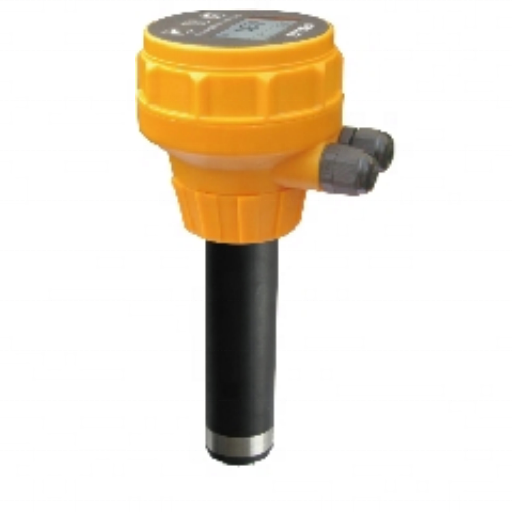
- Shanghai ChiMay’s In-line Conductivity Meter with four-electrode technology gives stable measurement in AMD conditions (pH 2–4, high ionic strength) with accuracy of ±1% of reading.
The idea of using conductivity as a surrogate for dissolved metal concentration in acid mine drainage is not new. What has changed is sensor technology and field validation by the US Geological Survey (USGS) and academic researchers, which have moved SC from an approximate screening tool to a quantitative monitoring approach with regulatory acceptance.
The Physical Basis for the Conductivity-Metal Relationship
Acid mine drainage forms when sulfide minerals—primarily pyrite (FeS₂)—are exposed to oxygen and water, generating sulfuric acid and dissolved iron:
2FeS₂ + 7O₂ + 2H₂O → 2Fe²⁺ + 4SO₄²⁻ + 4H⁺
The acidic solution then dissolves additional metals from surrounding rock—aluminum, manganese, zinc, copper, nickel, cadmium. Each contributes dissolved ions that raise electrical conductivity. Because metal dissolution is coupled to acid generation, and the sulfate ions dominate the ionic composition, conductivity naturally tracks total dissolved metal concentration.
The USGS and academic researchers have validated this relationship extensively in Colorado’s Arkansas River Basin and other mining regions. Findings across monitoring stations with varying mining influence:
- Specific conductance and total dissolved solids (TDS) show strong correlations at individual stations, with the relation stable over seasonal cycles—through both snowmelt high flow and winter low flow
- Continuous SC data, converted to TDS or metals with site-specific regression equations, captures daily and event-based load variations that monthly grab sampling misses entirely
Establishing Site-Specific Surrogate Equations
The conductivity-to-metal relationship is not universal. It must be calibrated for each site with concurrent measurements of both parameters. The general approach:
- Collect paired samples: over a 6–12 month period, collect discrete water samples for laboratory metal analysis at the same times that continuous SC is recorded
- Develop regression models: fit linear or power-law equations relating SC to total dissolved metals, individual metals, or TDS
- Validate with independent data: hold back 20–30% of samples for validation to avoid overfitting
- Update periodically: re-calibrate annually or whenever mining operations or water chemistry change significantly
A typical surrogate equation for an iron-dominated AMD site might look like:
[Total dissolved Fe] = 0.12 × SC^0.89 (where SC is in µS/cm and Fe is in mg/L)
with R² = 0.92 and a 95% confidence interval of ±15%. (Illustrative example, not a universal formula.)
That level of uncertainty rules out conductivity as a direct substitute for compliance sampling. It is more than adequate for:
- Trend monitoring — detecting increases or decreases in metal loading over time
- Event detection — catching episodic contamination such as first flush after storms
- Load estimation — calculating approximate daily or monthly metal loads when combined with flow data
- Process control — adjusting treatment chemical dosing in real time from influent strength
Four-Electrode Technology for AMD Environments
AMD streams are hard on conductivity sensors:
- Very high ionic strength: SC can exceed 30,000 µS/cm (30 mS/cm), far above typical environmental water
- Low pH (2–4): accelerates corrosion of electrode materials and reference junctions
- Iron precipitates: “yellow boy” (Fe(OH)₃) coats sensor surfaces and causes drift
- Temperature extremes: AMD seeps range from near-freezing to 40°C in exposed locations
Two-electrode conductivity cells—the traditional choice for environmental monitoring—struggle in AMD because polarization effects become significant at high conductivity, introducing errors that can reach 10–30%. The alternating current drives ions to accumulate at the electrode surfaces, creating a back-voltage that reduces effective current and under-reads conductivity.
Four-electrode conductivity technology solves this by using separate electrode pairs for current injection and voltage measurement. Because virtually no current flows through the voltage-sensing electrodes, polarization has negligible effect. Shanghai ChiMay’s In-line Conductivity Meter uses four-electrode technology with a cell geometry factor (K) of 0.5 cm⁻¹, optimized for the 1–100 mS/cm range typical of mining-influenced waters.
The instrument uses a titanium electrode body that resists acidic corrosion, an integrated Pt1000 RTD for temperature compensation with accuracy of ±0.3°C, and a self-cleaning flow cell design that limits iron precipitate buildup.
Integration with Regulatory Reporting Frameworks
Surrogate-based monitoring is gaining ground as a complement to compliance sampling:
- EPA has supported surrogate approaches—including continuous SC—for load estimation in mining-impaired watersheds, particularly in TMDL development
- State mining regulators in Colorado and other mining states increasingly rely on continuous SC records, paired with flow, for assessing AMD-impacted sites
- The EU Water Framework Directive treats conductivity as a supporting physico-chemical quality element (salinity) in the ecological status classification of surface waters
Continuous SC data combined with flow measurement and site-specific surrogate equations enables calculation of daily dissolved metal loads—a far more informative metric than periodic concentration readings for judging AMD treatment performance and watershed recovery.
Case Study: Continuous SC Monitoring in the Leadville Area
The USGS has worked the heavily mining-impacted watersheds around Leadville, Colorado for decades. Along Lake Fork Creek and neighboring drainages of the Arkansas River—among the most metal-loaded streams in the United States—USGS has combined continuous SC records with tracer-injection studies and site-specific regressions to track streamflow and metal loading. Recent work includes sodium chloride slug additions along Lake Fork Creek (USGS data release, September 2024) in which SC was the measurement that made streamflow estimation possible.
Field data from these programs shows what monthly grab sampling cannot: storm events produce a complex response—an initial SC spike as accumulated AMD is flushed out, then dilution from clean runoff, then secondary rises as floodwater remobilizes metal-rich sediments. That temporal behavior is exactly what treatment-system designers and maintenance schedulers need to see.
The Bottom Line
Conductivity monitoring as a surrogate for dissolved metal concentration in AMD is a practical, cost-effective complement to laboratory analysis. It does not replace compliance-grade chemical sampling, but it supplies the continuous, high-frequency data needed for trend detection, event capture, load estimation, and process control. With four-electrode technology from Shanghai ChiMay delivering stable measurement in the harshest AMD environments, the practical barriers to implementation are low.