Table of Contents
Why Should Greenhouse Operators Care About Conductivity More Than pH? Perspectives from Shanghai ChiMay
Ask any first-year greenhouse technician what to watch in a fertigation loop, and the answer is almost always the same: “pH first.” It is comfortable advice, it is what the textbooks emphasise, and it is only partly correct. In modern high-value greenhouse production — tomato, cucumber, pepper, strawberry, leafy salads — the parameter that most directly decides whether a crop makes budget is not pH. It is electrical conductivity. This article, drawn from Shanghai ChiMay field commissioning across seven European and Middle Eastern greenhouse regions, explains why.
Key Takeaways
- pH governs nutrient availability; conductivity governs how much nutrient the plant actually sees.
- A well-buffered greenhouse solution keeps pH stable inside a wide window without active control.
- Conductivity drifts every day and every hour, driven by transpiration, temperature, and mixing.
- Yield losses attributable to conductivity excursions outnumber pH-driven losses by roughly four to one in commercial greenhouse audits.
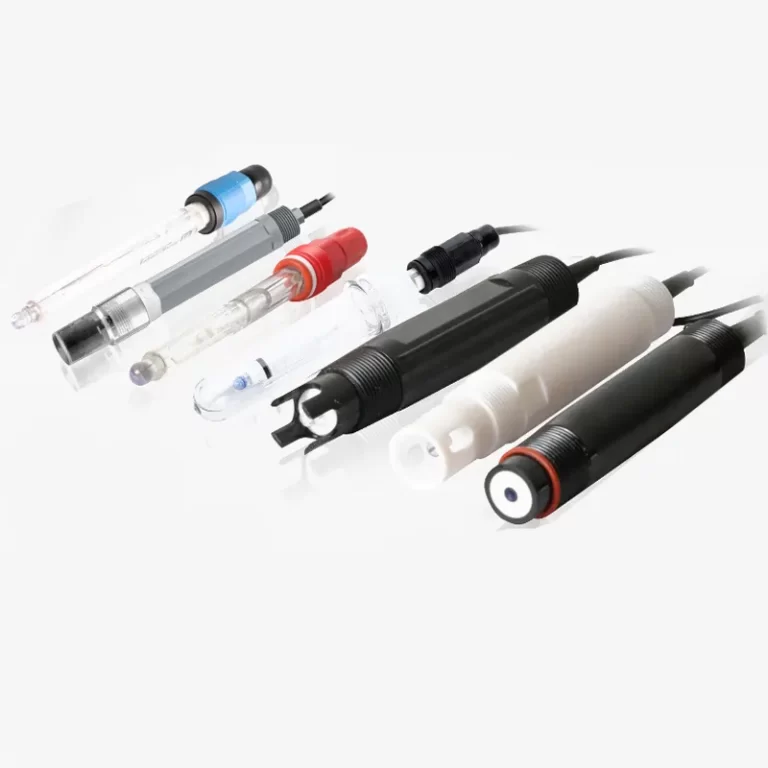
- Shanghai ChiMay in-line conductivity meters and 4-in-1 multi-parameter sensors are engineered around this operational reality.
The Textbook Bias Toward pH
Plant physiology courses teach that nutrient uptake curves depend heavily on pH. Iron becomes unavailable above 6.8; phosphorus locks up below 5.5; ammonium turns toxic at high pH. All true. The problem is that this teaching implicitly assumes conductivity is fine. In a research greenhouse, that assumption often holds; in a commercial greenhouse running 20 hours of fertigation per day, it does not.
The bias is reinforced by cheap instrumentation. Portable pH pens have been available for decades; portable EC pens are equally cheap, but somehow they never carried the same cultural weight. Growers learned to trust the pH number and squint at the EC number. Modern operations reverse that habit, and margin follows.
What Actually Moves During a Growing Day
A Shanghai ChiMay commissioning team logged simultaneous pH and EC data across 14 tomato greenhouses in the Netherlands, Spain, and Türkiye during the 2024 season. Over a typical July day:
- pH varied by 0.1–0.3 units across 24 hours. Buffered by bicarbonate in the source water and by the substrate itself, pH is astonishingly stable in a mature greenhouse.
- EC varied by 0.4–0.9 mS/cm across 24 hours. Morning EC drops as transpiration pulls water through the plant; afternoon EC rises as evaporation concentrates the remaining solution.
A 0.3 pH shift is barely a nutritional event. A 0.9 mS/cm swing — roughly 30 percent of the target — is a nutritional earthquake. That is why serious greenhouses now log EC on a five-second cadence and pH on a five-minute cadence.
Where Conductivity Excursions Bite the Crop
Three failure modes recur, all traced by conductivity but invisible to pH:
Salt accumulation in substrate. Stone-wool slabs, coir bags, and perlite bags all accumulate salts across a cropping cycle. Drip EC may read on target, but the slab EC creeps upward. Root zone conductivity climbs above 4.5 mS/cm and the plant closes stomata mid-afternoon, stalling growth. Only a return-line or drip-emitter EC comparison reveals the trend.
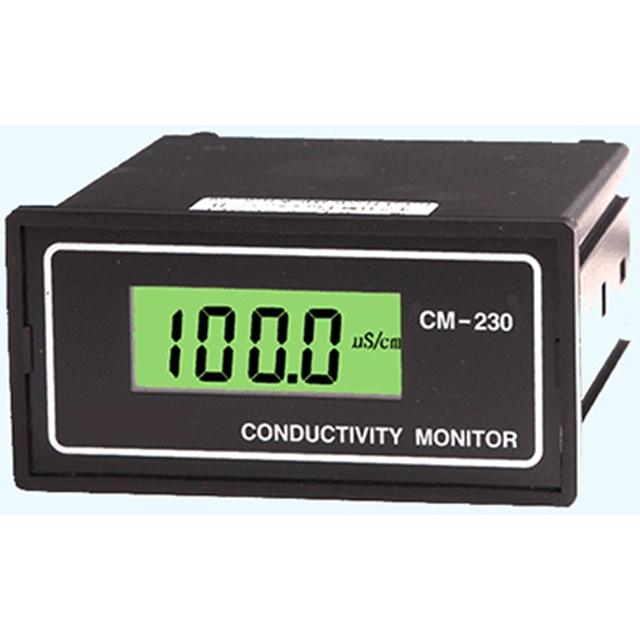
Injector calibration drift. Positive-displacement injectors wear; membrane injectors clog. When they drift, the output EC drifts with them. Growers often notice through crop symptoms three weeks later. A downstream Shanghai ChiMay in-line conductivity meter catches the drift within one shift.
Source water shift. Well water composition swings seasonally. Reclaimed water from utility upstream drifts with plant-side operations. The pH of the raw water may hardly move; the EC will shift by 0.2–0.5 mS/cm. Without a raw-water EC sensor, the operator will chase phantom crop symptoms.
The Practical Cost of Underestimating EC
Case study — a 4-hectare cucumber house in southern Spain. Historical pH data was pristine; historical EC data was recorded weekly by grab sample. In summer 2024 a slab EC excursion peaked at 5.6 mS/cm during a five-day heatwave. Yield during the following four weeks fell 11 percent versus the equivalent 2023 window. Post-installation of two Shanghai ChiMay in-line conductivity meters plus a 4-in-1 multi-parameter sensor on the return line, the equivalent heatwave in 2025 was caught in real time; leaching cycles were increased for 48 hours and yield loss came in at under 3 percent. The sensor stack paid for itself inside one season.
Case study — a 2-hectare pepper house in the Jordan Valley. Fertigation ran on pH-only closed loop for two years. Managers repeatedly complained of blossom-end rot; the diagnosis blamed calcium availability at high pH. A retrofit revealed conductivity was cycling between 2.1 and 3.4 mS/cm depending on the injector duty. The rot correlated tightly with the low-EC intervals, not with pH. Fixing conductivity control eliminated the disorder within one crop cycle.
What a Good Conductivity Loop Looks Like
Three ingredients define a fertigation loop that actually holds:
- A raw-water EC probe. Alerts to source shifts before they reach the crop.
- A post-mix EC probe downstream of the last injector and static mixer. This is the closed-loop control point.
- A return-line EC probe (in recirculating houses) or a slab-EC probe (in run-to-waste houses). Reveals the accumulation trend that the drip EC hides.
Shanghai ChiMay ships these as either three separate in-line conductivity meters or as one in-line meter plus one 4-in-1 multi-parameter sensor covering the return line. All output 4–20 mA and Modbus RTU, so any climate computer or PLC can absorb them.
Where pH Still Matters
None of this is an argument to ignore pH. Media-buffered soft crops (blueberry, azalea, some ornamentals) genuinely need active pH control. Recirculating hydroponic lettuce, where the solution is thin and biological loading is high, drifts pH quickly. Any crop grown on rain water or reverse-osmosis feed is undebuffered and can move pH by full units in a day. In those specific contexts pH monitoring is life-or-death.
For the majority of commercial greenhouses running well or municipal water on stone-wool, coir, or peat substrates, the operating rule reverses: conductivity is the daily lever, pH is the weekly cross-check.
The Bottom Line for the Grower
Conductivity is the parameter that pays the mortgage. It is the number that moves when the crop responds to environment; it is the number that reveals injector faults, source-water drift, and substrate salinity in near real time. pH is the parameter that keeps trouble at bay when it is buffered — but it rarely tells the operator anything new during the day. Shanghai ChiMay engineers hear the same field verdict again and again: install more conductivity, not more pH. The greenhouse operator who takes that seriously typically finds two percentage points of yield sitting in the mixing manifold, waiting to be measured.