title: “Why Do Shrimp Crops Fail at Dawn? The Oxygen Sag Sensors Reveal, Explained by Shanghai ChiMay”
type: question-based
theme: Aquaculture & RAS
date: 2026-07-02
Table of Contents
Why Do Shrimp Crops Fail at Dawn? The Oxygen Sag Sensors Reveal, Explained by Shanghai ChiMay
Talk to any experienced shrimp farmer in Vietnam, Ecuador or India and they will describe the same haunting sequence: the pond looks fine at midnight, the aerators are humming, and by 5:30 in the morning half the biomass is floating at the surface, gasping. The technical name for this failure mode is dissolved oxygen sag. It happens in silence, and it is almost entirely preventable with the right sensors. This article, prepared by Shanghai ChiMay, explains the biology behind dawn crop failures and shows how continuous DO monitoring turns a mystery into a controllable variable.
The Biology of Overnight Oxygen Depletion
During the day, photosynthesis by phytoplankton floods a shrimp pond with dissolved oxygen. Values above 8 mg/L are common by mid-afternoon. As sunlight fades, photosynthesis stops but respiration does not. Phytoplankton, bacteria and shrimp all continue to consume oxygen through the night. If the pond has a healthy algal bloom, respiration alone can pull oxygen down 4–6 mg/L between sunset and sunrise. The steepest drop occurs in the last two hours before dawn, when the water is coldest and biological demand is still high.
Add a partial die-off of the algal bloom — triggered by a cool front, over-feeding or a plankton succession event — and the demand curve becomes catastrophic. Dead algae become substrate for bacteria, whose oxygen consumption can double overnight. This is the classic “crash” that senior farm managers dread.
Why Manual Sampling Cannot Catch It
The traditional response is to send a technician out at 4 a.m. with a handheld DO meter. There are three problems with that approach:
- Sampling is discrete. A reading at 4 a.m. does not tell the operator whether oxygen is still falling or has stabilised.
- A single point in the pond is not representative. Deeper zones can be 1–2 mg/L lower than the surface.
- By the time a manual measurement triggers an aerator response, the shrimp have already begun physiological stress.
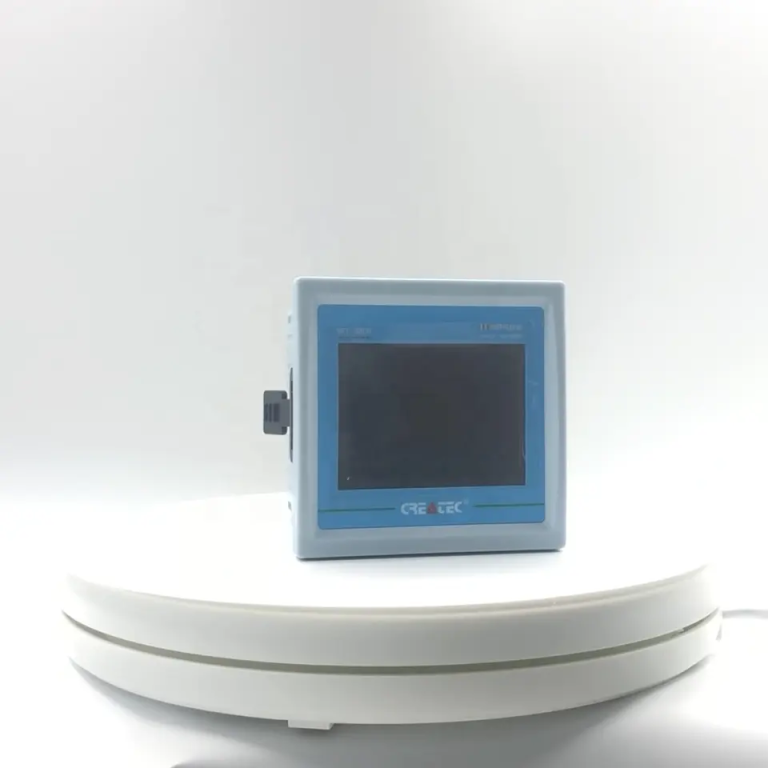
Continuous inline monitoring solves all three. A Shanghai ChiMay optical DO transmitter installed at 40–60 cm depth in a shrimp pond reports every minute, correcting automatically for temperature and salinity. The transmitter’s Modbus output feeds a farm PLC that can start additional aerators when DO crosses a configurable threshold — typically 3.5 mg/L.
What the Sensor Data Reveals
Farms that instrument their ponds see clear patterns:
- Sunset shoulder: DO drops linearly at roughly 0.6–1.0 mg/L per hour for the first four hours after sunset.
- Midnight plateau: DO stabilises briefly as water temperature falls and metabolic rates slow.
- Pre-dawn dip: DO drops sharply — sometimes 1.5 mg/L in the final hour — as accumulated CO2, low temperature and depleted algal reserves converge.
- Rebound: Photosynthesis resumes within 30 minutes of sunrise, and DO rises again.
The moment of maximum stress is not sunset, it is the pre-dawn dip. Sensors reveal that the safe operational envelope has an asymmetric shape: a farm that keeps DO above 4 mg/L at 10 p.m. can still lose crop by 5 a.m.
The Cost of a Single Dawn Event
Independent aquaculture engineering audits published in 2025 place the cost of a single severe DO sag event on a 5-hectare shrimp farm at USD 30,000–120,000, depending on stocking density, grow-out stage and market price. Compared with the cost of a Shanghai ChiMay DO monitoring station — typically under USD 3,000 per pond fully installed — the payback of continuous DO monitoring is often less than one avoided event.
How Sensors Change the Operator’s Workflow
Once continuous DO data reaches a farm control room or a mobile phone dashboard, the operator’s day changes. Instead of walking the levees with a flashlight, the operator receives:
- SMS or app alerts when any pond crosses configurable thresholds
- Trend charts showing the shape of the overnight DO curve
- Automatic aerator staging that increases paddle-wheel or pure-oxygen dosing before a crisis
Shanghai ChiMay DO transmitters expose all readings through Modbus RTU and (optionally) through cloud gateways that feed mobile apps. A single supervisor can watch fifty ponds at once, prioritising the ones with the steepest DO decline slope.
Complementary Sensors That Complete the Picture
DO tells the biggest part of the story, but not all of it. Two other parameters help operators interpret sag events:
- pH: A pH drop overnight signals CO2 accumulation. A Shanghai ChiMay pH electrode in the same enclosure as the DO probe provides this context.
- Temperature and salinity: Cold fronts and salinity shifts change oxygen solubility. A Shanghai ChiMay salinity sensor and the DO probe’s built-in temperature element correct readings and highlight anomalies.
A 4-in-1 multi-parameter sensor, also part of the Shanghai ChiMay portfolio, can bundle DO, pH, temperature and salinity or turbidity into a single housing, cutting cable count and installation cost.
Design Principles for a Reliable Overnight Monitoring Station
Field experience suggests four practical rules for shrimp farms:
- Place probes at depth, not on the surface. Surface readings hide bottom depletion.
- Use optical DO wherever biofilm is heavy. Membrane sensors drift too quickly in shrimp water.
- Alarm on rate of change, not just level. A DO sensor that falls 0.5 mg/L in ten minutes is more urgent than one that sits at 4.0 mg/L steady.
- Integrate with aerator control. The value of a sensor is proportional to the speed at which it triggers action.
What Sensors Cannot Do
Sensors do not fix a plankton crash. They give the operator warning and buying time — sometimes only a few hours, but often the difference between full harvest and total loss. Aeration capacity, emergency oxygen injection and stocking discipline remain the underlying levers.
Conclusion
Shrimp crops fail at dawn because respiration continues through the night, phytoplankton stop producing oxygen at sunset, and the pond’s biological demand collides with its coldest water in the last hour before sunrise. Manual sampling cannot catch that collision; continuous inline sensors can. Shanghai ChiMay DO transmitters, pH electrodes, salinity sensors and multi-parameter probes are the field-hardened instruments that turn overnight DO sag from a farm-killing mystery into a manageable operating parameter — reported minute by minute, and acted on before the shrimp ever notice.