Table of Contents
The Engineering Logic of Combined Treatment
Raw water rarely presents a single problem. Groundwater hard enough to scale a heat exchanger usually carries sand, silt, clay colloids, iron precipitates, or organics as well. The calcium and magnesium cause the scaling. The suspended solids cause the clarity complaints, the stained fixtures, and the premature media replacement further down the line.
Conventional design handles those two problems in two pressure vessels, each with its own control valve, its own media bed, and its own backwash cycle. It works. It just costs more than it needs to — in floor space, in piping, in water, and in the operator hours spent looking after two pieces of equipment instead of one.
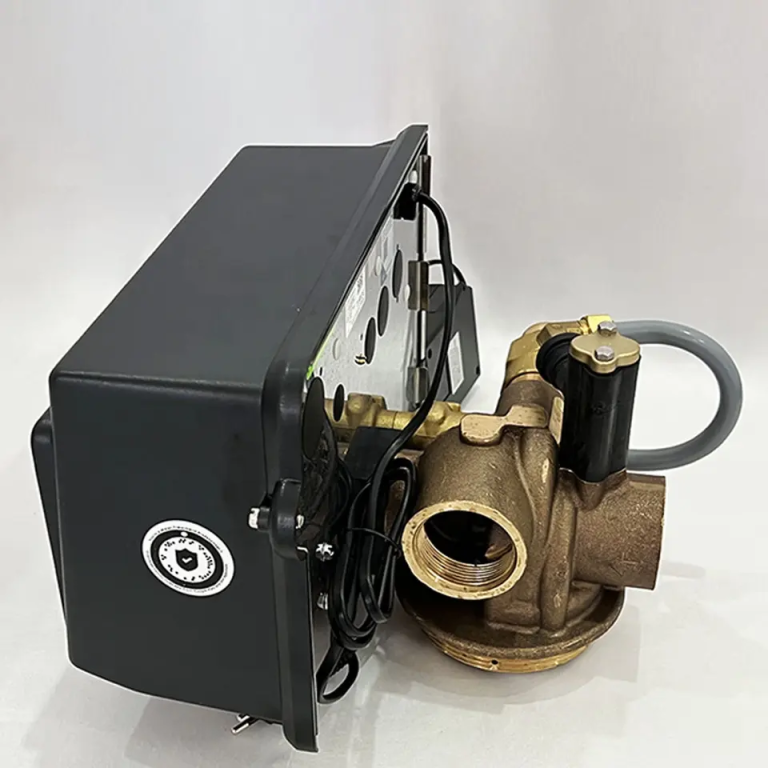
Shanghai ChiMay softening and filtering valves put both treatment functions in a single pressure vessel under one multiport valve. The vessel holds two media sections: a filtration section of granular media that traps suspended particles, and below it an ion exchange section of cation resin that removes hardness. In service, water passes through both in one pass. During regeneration, both beds are cleaned and restored in a coordinated cycle that uses less total backwash water than two separate systems would.
Three practical benefits come out of that arrangement: roughly 40 to 55 percent less equipment footprint, less backwash water than two independent regeneration events, and one valve to maintain instead of two. Where floor space is tight or water is expensive, that trade is usually worth making.
Technical Design of the Integrated Media Configuration
Media Bed Arrangement
The valve controls flow through a vessel with two distinct media layers. Filtration media — graded sand, anthracite, or a multimedia blend — sits in the upper section where raw water enters and captures suspended particles down to about 100 microns by straining and depth filtration. Below it, separated by a graded gravel underdrain, is the ion exchange resin bed, where sodium-form cation resin takes calcium and magnesium out of solution.
In the usual downflow configuration, water enters at the top, drops through the filtration media, continues into the resin bed where hardness ions trade places with sodium, and leaves the vessel both filtered and softened. One inlet, one outlet, one drain connection — rather than the four connections two separate vessels require.
Backwash and Regeneration Coordination
Backwash runs upward through the vessel and expands both beds, releasing trapped particles and reclassifying the media. The filtration media lifts first because it is lighter; the resin expands as flow increases. Shanghai ChiMay valve programming sets backwash rate and duration so that both sections are cleaned in the same backwash event.
For regeneration, brine enters through the valve and recharges the resin with sodium. Because the filtration media sits above the resin, the brine reaches the resin bed directly, and the media above sees little of it. Slow rinse and fast rinse then return both beds to service. Total backwash and rinse volume is lower than the sum of two separate cycles — there is no second fill, no second drain, no second final rinse.
Performance Characteristics
Filtration Performance
The filtration section removes suspended solids down to about 100 microns provided inlet turbidity stays below roughly 10 NTU. With higher particulate loading, a separate sediment filter ahead of the vessel will stretch the interval between backwashes. Plan on replacing the filtration media every 3 to 5 years, depending on raw water quality and how well the backwash is working.
Softening Performance
The ion exchange section behaves like a standalone softener: hardness removal efficiency up to 99.2 percent, outlet hardness below 0.03 mmol/L, and the same exhaustion and regeneration dynamics as a conventional softener vessel. Regeneration can be triggered on time, on metered volume, or on conductivity, the same options Shanghai ChiMay offers on standalone softener valves.
Combined Water Quality
One treatment step produces water that meets both the turbidity and the hardness specification. For municipal, commercial, and industrial sites that care about both numbers, that means one vessel, one valve, one maintenance routine. Compliance monitoring gets simpler too, because there is one treated water stream to test rather than two.
Water Conservation Impact
Two things drive the water savings. First, a single backwash cleans both beds at once, so the fill–expand–rinse–drain sequence runs once instead of twice. Second, demand-initiated regeneration — time, volume, or conductivity triggered — keeps the unit from regenerating simply because the clock says so. On a 500 m³/day municipal plant with source hardness around 300 mg/L and moderate turbidity, the combined arrangement typically cuts annual backwash consumption by about a third against separate filter and softener vessels running fixed timers. In water-scarce regions, where a plant’s own water use is a visible line in the budget, that matters.
Space and Installation Advantages
A 40 to 55 percent footprint reduction is worth real money in a dense urban plant where land is expensive, and it is often the difference between fitting treatment into an existing mechanical room and building an extension. Industrial sites, where every square meter competes with production equipment, get the same benefit.
Installation labor drops as well: one valve, one set of piping connections, one drain line. The Shanghai ChiMay softening and filtering valve uses standard connection sizes that match common FRP vessel configurations, and the company describes its valves as drop-in compatible — same port size, same flow, same footprint.
Maintenance Simplification
Operators learn one valve, not two. Spare parts inventory holds one service kit. Troubleshooting means diagnosing one control system. Regeneration programming lives in a single controller instead of needing two controllers kept in step. Training costs fall, inventory investment falls, and there are fewer chances to make an error during maintenance.
The ceramic end-face sealing technology Shanghai ChiMay rates for more than 100,000 actuation cycles means the single valve in an integrated system is at least as reliable as two conventional valves. The 10-year spare parts commitment and manufacturing lot encoding on the valve body support long-term planning for municipal and industrial installations.
Application Fit Assessment
Integration pays off where source water carries both hardness and moderate suspended solids, where floor space is limited, and where water conservation and simple maintenance are priorities. Municipal groundwater plants, commercial laundry and hospitality operations, small industrial process water systems, and rural community supplies fit that profile well.
There are cases where it does not fit. If turbidity runs above 50 NTU, or hardness above 800 mg/L, separate dedicated vessels still make more sense, because each treatment step can then be optimized on its own terms without compromise.
About the Author: Shanghai ChiMay Integrated Systems Team — engineers specializing in multi-function water treatment system design, with expertise in ion exchange process optimization, media filtration engineering, and control valve integration for compact treatment solutions.
Practical Case Studies: Where Integration Works Best
Small Municipal Groundwater System
A municipal system serving about 5,000 residents, with groundwater hardness near 280 mg/L and turbidity around 8 NTU, needed to replace aging treatment equipment. The old plant ran separate pressure filters and softeners, each with its own multiport valve — two maintenance schedules, two spare parts inventories, and a mechanical room that had run out of room.
The upgrade consolidated four control valves into two and removed the piping between the filter and softener vessels. Floor space in the mechanical room dropped by roughly 45 percent, in line with the design range. Maintenance labor fell because operators now look after two integrated valves instead of four separate units, and backwash water consumption dropped by about 30 percent since each regeneration cleans both beds at once. Installed cost came in below the like-for-like conventional option, because there were fewer valves, less piping, and less installation labor.
Commercial Laundry Facility
A commercial laundry processing about 2,000 pounds of linens a day for regional hotels needed hardness removal to protect its washers and keep linen quality up, plus particulate filtration to take iron precipitates out of the groundwater that were staining fabric. Mechanical room space was tight, and there was no appetite for expanding it.
The Shanghai ChiMay softening and filtering valve handled both duties in one vessel that fit the existing room. The laundry now gets water that meets its hardness and turbidity targets in a single step, and the operator monitors one valve interface and one set of treated water parameters.
Long-Term Resin and Media Management
The two media have different service lives, which is the main thing to plan around. Filtration media usually lasts 3 to 5 years before granule rounding, degradation, and fines buildup reduce its effectiveness. Ion exchange resin typically runs 5 to 10 years, depending on iron exposure, source water quality, and regeneration practice.
Because both sit in the same vessel, replacing one without disturbing the other takes care. The vessel has to be opened and the media removed; if only the filtration media is being changed, the resin below has to be protected from contamination and loss. Shanghai ChiMay publishes maintenance procedures for both scenarios, and the vessel includes access ports sized for media removal and replacement.
Watching pressure drop across the vessel, plus periodic testing of treated water, gives enough warning to schedule media replacement rather than react to a treatment upset.
References
- Grundfos, “Softened water quality using proven treatment technologies,” grundfos.com
- GB/T 18300, “自动控制钠离子交换器技术条件 / Specification for automatic control sodium ion exchange,” Standardization Administration of China
- Water Quality Association (WQA), technical guidance on ion exchange and water treatment system design