Technical Deep Dive · Engineering Perspective · Published: November 19, 2026
Table of Contents
Key Takeaways
- Pitting resistance in stainless alloys is a calculation, not a slogan: PREN = %Cr + 3.3 × %Mo + 16 × %N, which puts 316L near 26, duplex 2205 near 34 and super duplex S32750 near 42 [1].
- Industry practice treats a PREN of 40 as the threshold above which a stainless grade resists pitting and crevice attack in warm seawater. Only the super grades clear it [4].
- Chloride stress corrosion cracking separates the families sharply. 316-type alloys lose dependable margin above roughly 60 °C, while duplex 2205 stays serviceable above 100 °C [2].
- Super duplex 2507 tolerates chloride concentrations up to roughly 50,000 ppm. 316L should not be relied on beyond about 1,000 ppm once metal temperature exceeds 50–60 °C [3].
- Titanium plays a different game. A 2–10 nm self-healing TiO2 film keeps Grade 2 below 0.0005 mm/year in natural seawater at 25 °C [5]. PREN is not defined for it, because the number describes alloy chemistry and titanium’s defence is a film.
- Titanium’s price is fabrication discipline. Above roughly 500 °C it absorbs oxygen, nitrogen and hydrogen, so every weld needs full inert-gas shielding [6].
Why the Valve Body Outlives Every Other Decision
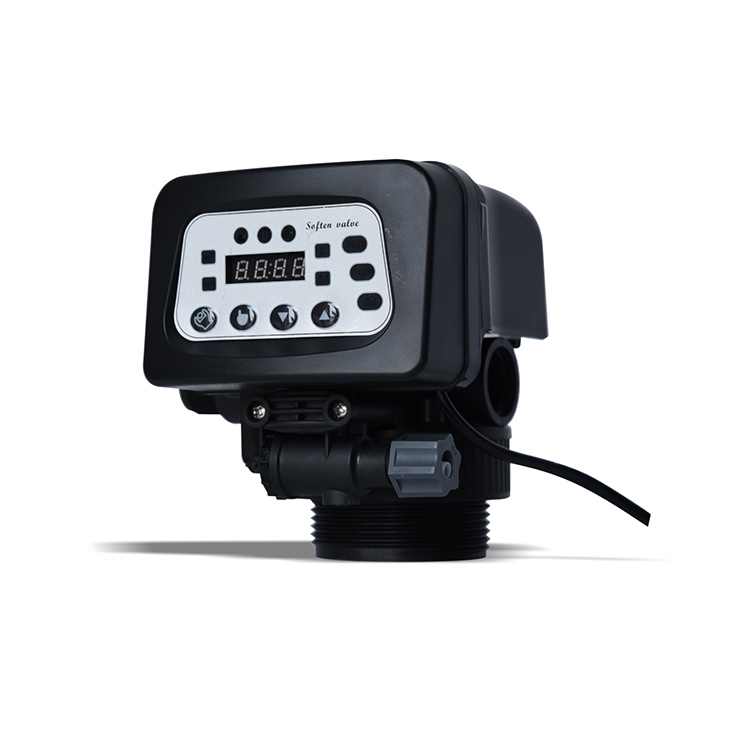
Most components on a water treatment skid can be swapped in an afternoon. Valve bodies cannot. A softener or filtration control valve is welded, flanged and piped into its manifold, buried under insulation and scheduled around production, so the wetted material chosen at design time quietly sets the maintenance budget for the next decade. In aggressive water — seawater cooling loops, brine concentrator bottoms, high-TDS regeneration effluent, coastal cooling-tower make-up — that choice decides whether the valve ages gracefully or fails by pitting, crevice attack or stress corrosion cracking.
The failure modes are localised, which is what makes them treacherous. A valve body can lose a millimetre of wall at a crevice under a gasket while the rest of the casting looks pristine. Chloride SCC needs stress, chloride and temperature to coincide, and valve internals carry residual stress from casting and machining. Material selection for aggressive water is therefore an exercise in matching a corrosion-defence strategy to the worst corner of the valve, not to the average condition of the line.
Two Defense Strategies
Titanium: the passive-film approach
Titanium does not out-alloy the chloride. It out-chemists it. On contact with air or water the metal grows a thin, strongly adherent titanium dioxide film — typically 2 to 10 nanometres — that self-heals within milliseconds when scratched [5]. While that film stays intact in an oxidising or neutral medium, the metal underneath barely corrodes: commercially pure Grade 2 titanium runs below 0.0005 mm per year in natural seawater at 25 °C [5]. The film is also immune to the chloride stress corrosion mechanism that afflicts austenitic stainless steels, which is why titanium dominates seawater-cooled heat exchangers, condensers and desalination hardware.
The strategy has boundaries. The passive film needs oxygen, so it weakens in hot, reducing or oxygen-starved pockets. Crevice corrosion of Grade 2 can begin above roughly 75 °C in hot, concentrated chloride solutions [5], fluoride-bearing streams destroy the film outright, and galvanic coupling to more active metals such as aluminium accelerates attack [5]. For valve duty those limits translate into siting rules rather than chemistry: titanium earns its premium in seawater, brine and wet-chlorine service at moderate temperature, and is wasted or at risk in hot reducing acids.
Super duplex: the alloying approach
Super duplex stainless steels defend themselves with chemistry you can compute before purchase. The pitting resistance equivalent number, PREN = %Cr + 3.3 × %Mo + 16 × %N, is the standard index for ranking chloride resistance, and it is the figure quoted on the ASTM datasheets for duplex grades [1]. Worked examples make the ladder concrete: UNS S31603 (316L) computes to a PREN of about 26, 22Cr duplex S31803/S32205 to about 34, super duplex S32750 to about 42, and hyper-duplex S32707 to about 49 [1]. Industry practice treats PREN above 40 as the threshold at which a stainless steel resists pitting and crevice attack in warm seawater [4], and S32750 in properly annealed condition typically shows a critical pitting temperature above 50 °C in ASTM G48 Method A testing [4].
The second half of the super duplex story is mechanical. The austenitic-ferritic microstructure delivers roughly double the yield strength of standard austenitic grades, which lets a designer carry the same pressure duty with thinner walls — an attractive trade when the premium alloy is billed by the kilogram. And in a duplex structure, a crack starting in one phase quickly meets the other and is blunted, which is a large part of why these grades tolerate hot-chloride service that would crack a 316 component.
The Chloride Stress Corrosion Threshold Gap
The clearest way to compare the two families is by their published threshold numbers, because stress corrosion cracking, not uniform corrosion, is what kills austenitic valves suddenly. Published comparisons put the chloride SCC threshold for 316/316L near 60 °C under full immersion, while duplex 2205 stays serviceable above 100 °C [2]. The same source lists critical pitting temperatures around 15–18 °C for 316L against 35–40 °C for 2205, and critical crevice temperatures below 0 °C for 316L against 20–25 °C for 2205 [2]. A valve body in a warm brine line sits beyond every one of those 316L numbers.
Concentration matters as much as temperature. 316L should not be relied on above roughly 1,000 ppm chloride once metal temperature passes about 50–60 °C, and field failures turn up at far lower concentrations wherever evaporation concentrates chlorides on hot surfaces [3]. Super duplex 2507, by contrast, is rated for chloride concentrations up to roughly 50,000 ppm, which covers seawater and most process brines [3]. That single comparison explains why desalination plants, offshore packages and brine-handling skids standardise on PREN ≥ 40 alloys for anything warm and wet with chloride [4].
Titanium sits outside this ranking entirely. Its defence is a film rather than alloy buffering, so PREN is not defined for it, and its chloride SCC behaviour follows film stability instead — excellent in seawater at ordinary temperatures, degrading only in the hot crevices and reducing pockets described above [5]. Reading a titanium datasheet in search of a PREN number wastes everyone’s time.
Crevice Geometry Beats Bulk Chemistry
Crevice attack deserves its own line in any specification, because the worst corrosion in a valve rarely starts on open metal. Gaskets, O-ring grooves, threaded connections, deposit build-up and scale create exactly the occluded, stagnant pockets where chlorides concentrate locally while the passive film loses its chemical support. The published numbers make the ranking blunt: in the standard crevice test 316L effectively fails below 0 °C, while duplex 2205 holds to roughly 20–25 °C [2], and super duplex gets specified for warm seawater precisely because PREN 40 or more covers crevice initiation as well as pitting [4]. A valve body concentrates all of that geometry risk. Seats, stem glands and flange faces are crevices by design, and the stagnant low-flow corners are where deposits settle. Specifying an alloy for bulk chemistry while ignoring crevice geometry is how a nominally “stainless” installation fails during its first salty shutdown, which is why serious buyers audit wetted geometry — flange type, seat design, drainability — alongside the alloy certificate.
Cost, Fabrication and Welding Discipline
Both premium materials charge for performance, and they charge in different currencies. Super duplex costs more per kilogram than 316L and standard duplex, but its strength offsets part of the premium through thinner sections, and it fabricates on equipment most pipe shops already own. The metallurgical discipline is real: weld heat input and interpass temperature must be controlled to keep the ferrite-austenite balance, and solution annealing restores properties after hot forming. A body that skips those steps can pass a pressure test and still lose its corrosion ratings.
Titanium’s fabrication cost is dominated by weld protection rather than material handling. Above roughly 500 °C titanium has a very high affinity for oxygen, nitrogen and hydrogen, so the weld pool, heat-affected zone and cooling bead all need inert-gas shielding — argon or helium — or the joint absorbs those elements and embrittles [6]. In practice that means TIG welding with a gas-lens torch, backup purging on the root side, and trailing shields that extend coverage until the metal cools. The interference colours left on the bead read as a quality report: silver or straw shades indicate adequate shielding, while blue-to-white flags contamination [6]. Fabricators without that discipline should not be quoting titanium valve work.
Material Comparison at a Glance
| Material | Typical PREN | Corrosion-defense mechanism | Relative cost | Fabrication watch-outs |
|---|---|---|---|---|
| 316L austenitic | ≈26 [1] | Chromium-oxide film; dependable only in cool, low-chloride service | Baseline | Conventional practice; SCC risk above ~60 °C in chloride [2] |
| Duplex 2205 | ≈34 [1] | Two-phase structure resists chloride SCC above 100 °C [2] | Moderate premium | Controlled heat input to keep phase balance |
| Super duplex S32750 | ≈42 [1] | Clears the PREN ≥ 40 warm-seawater benchmark [4]; tolerates ~50,000 ppm chloride [3] | Premium | Solution annealing; strict weld heat-input window |
| CP titanium Grade 2 | Not applicable [5] | Self-healing 2–10 nm TiO2 film; <0.0005 mm/y in 25 °C seawater [5] | Highest | Full inert-gas shielding; no air contact above ~500 °C [6] |
Where Each Material Wins
Seawater duties split cleanly between the two strategies. Titanium is the default for the hottest, most oxygen-starved chloride pockets: seawater heaters, evaporator internals, wet-chlorine handling, and anywhere film integrity matters more than section strength. Super duplex owns the structural chloride duties — seawater lift and injection lines, desalination high-pressure piping, brine headers, and valve bodies in RO trains, where PREN above 40 and its strength let one material carry both corrosion and pressure duty [3][4].
For the water treatment equipment builder, the decision matrix extends to milder streams too. Softener regeneration effluent, filter backwash with high salinity and cooling-tower cycles of concentration all reach chloride levels and temperatures that punish 316L internals, yet never justify a titanium budget. Super duplex — or upgraded internal trim on conventional bodies — usually lands as the rational middle. This is where a supplier’s published data earns its keep. Shanghai ChiMay publishes Cv figures, pressure-loss curves and wetted-material options openly rather than behind request-for-quote walls — we publish the numbers other suppliers make you ask for — because a material upgrade only works when the hydraulic data behind the valve is visible to the designer. The current control valve and water quality analyzer ranges are listed at https://chimaycorp.com/.
Specifying Checklist for Aggressive Water
- Compute PREN from the mill certificate, not the brochure: %Cr + 3.3 × %Mo + 16 × %N, and demand 40 or more for warm seawater service [1][4].
- Set the SCC clock by temperature. Treat 316L as a below-60 °C material in chloride service, and go duplex or super duplex beyond that [2].
- Check crevice geometry before alloy. Gasket grooves and O-ring seats are where attack starts, whatever the bulk metal [2][3].
- Audit the titanium weld procedure, not just the welder: shielding stack, purge, trailing shield and colour acceptance [6].
- Budget for annealing and testing on super duplex castings, and skip neither.
References
- XTD Special Steel — “PREN Calculation Explained: Formula, Worked Examples, and What the Number Means”: worked PREN computations for 316L, 2205 duplex, S32750 super duplex and S32707 hyper duplex, with the PREN and PREN-W formulas. https://www.xtd-ss.com/blog?p=1432
- SS Alloy Steel — “Duplex 2205 vs 316 Stainless Steel: Complete Comparison”: PREN ranges, critical pitting and crevice temperatures, and chloride SCC thresholds for 316/316L versus 2205. https://ssalloy-steel.com/blog/duplex-2205-vs-316-stainless-steel/
- Jinie Technology — “Super Duplex 2507 Chloride SCC Resistance: Threshold Limits vs 316L and 904L”: chloride concentration limits for 316L (about 1,000 ppm above 50–60 °C) and super duplex 2507 (about 50,000 ppm). https://www.jnalloys.com/info/super-duplex-2507-chloride-scc-resistance-thr-103636331.html
- Jinie Technology — “Super Duplex S32750 in Oil and Gas: Sour Service Limits per NACE MR0175/ISO 15156”: PREN above 40 as the warm-seawater pitting threshold and S32750 CPT exceeding 50 °C in ASTM G48 testing. https://www.jnalloys.com/info/super-duplex-s32750-in-oil-and-gas-sour-servi-103632681.html
- HonTitan — “Why Titanium Resists Corrosion: The Mechanism, Seawater Data, and When It Actually Fails”: TiO2 film thickness of 2–10 nm, Grade 2 seawater corrosion rate below 0.0005 mm/year at 25 °C, and crevice-corrosion onset near 75 °C. https://hontitan.com/?p=4322/
- TWI — “Weldability of materials — titanium and titanium alloys”: inert-gas shielding requirements, gas absorption above 500 °C, and interference-color assessment of titanium welds. https://www.twi-global.com/technical-knowledge/job-knowledge/weldability-of-materials-titanium-and-titanium-alloys-024?vAction=swpTextOnly
About the author: Written by the Shanghai ChiMay Technical Editorial Team — the editorial group behind Shanghai ChiMay’s softener and filtration control valve line, covering wetted-material selection, published Cv and pressure-loss data, and compatibility replacement platforms for water treatment systems.