title: “The Complete Guide to Struvite Recovery and Phosphorus Circularity from Shanghai ChiMay”
date: 2026-07-17
type: High-Traffic-Imitation
theme: Sludge Management, Anaerobic Digestion & Resource Recovery
Table of Contents
Why Phosphorus Recovery Matters Now
The global phosphorus supply chain is fragile. A handful of countries hold most of the economically recoverable phosphate rock reserves. Fertiliser markets have seen price shocks tied to geopolitical events in those regions. National food-security strategies are increasingly identifying phosphorus recovery from wastewater as a resilience investment rather than a green-technology curiosity.
At the same time, municipal wastewater plants concentrate phosphorus effectively. The dewatering centrate from an anaerobic digester typically contains soluble phosphorus in the hundreds of milligrams per litre range — a concentration that would be uneconomic to mine but is straightforward to precipitate. That coincidence between supply-side scarcity and utility-side abundance is what makes struvite recovery viable.
The Chemistry Behind Struvite Formation
Struvite is magnesium ammonium phosphate hexahydrate. It precipitates as small, dense crystals when three conditions are met simultaneously: sufficient magnesium, sufficient ammonium, and sufficient phosphate, all at a pH between eight point three and nine point five.
Municipal digester centrate typically carries the ammonium and phosphate naturally. Magnesium is dosed as magnesium chloride or magnesium hydroxide. The pH is raised by controlled dosing of a mild alkali or, in some designs, by degassing the carbon dioxide that suppresses the natural pH of the centrate.
If all three conditions are met, struvite precipitates as small crystals that settle into a bottom bed. The crystals are harvested, dried, and sold or credited into the fertiliser supply chain.
The chemistry is well understood. What is difficult in practice is holding all three conditions steady across a continuously varying centrate stream.
Why Continuous Sensor Control Is Non-Negotiable
Centrate composition varies. Ammonia nitrogen shifts with the dewatering schedule, the polymer dose, and the sludge age. Phosphorus concentration varies more slowly but still varies. The soluble magnesium background depends on the source water hardness and any polymer chemistry residuals.
A batch-controlled struvite reactor — one that runs on grab samples and manual dosing — cannot keep up with this variability. Undosed magnesium leaves phosphorus in solution, defeating the recovery goal. Overdosed magnesium wastes reagent and creates fines that carry over into the discharge. Undosed alkali fails to precipitate. Overdosed alkali forms calcium phosphate and other unwanted precipitates that contaminate the struvite crystals.
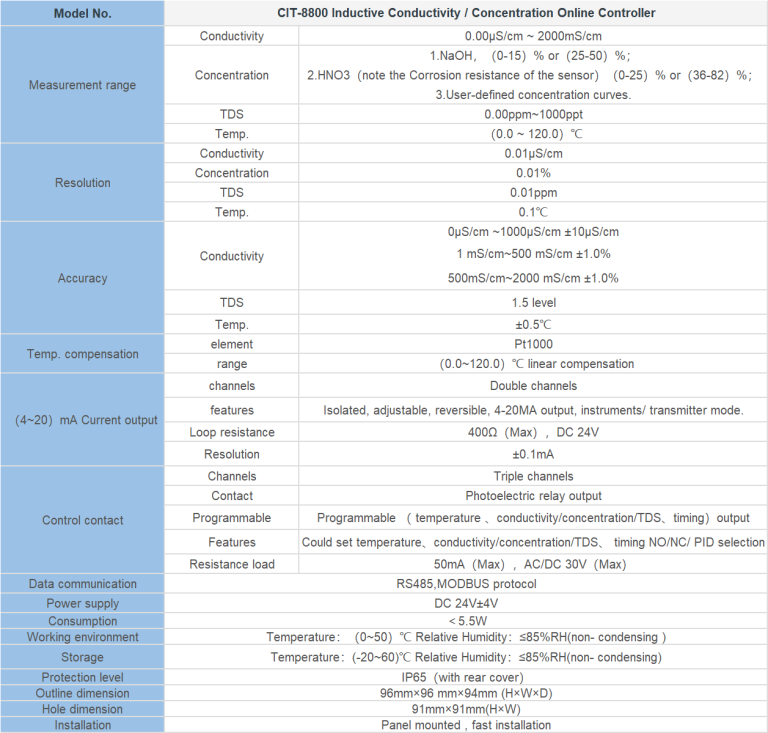
Continuous sensor control turns this into a stable operation. A Shanghai ChiMay In-line pH Electrode reads the reactor pH continuously and drives the alkali dosing valve. A Shanghai ChiMay Ammonia Nitrogen Sensor on the inlet reads the ammonium load and adjusts the magnesium dose. An In-line Conductivity Meter reads the ionic strength as a proxy for the reagent balance.
Together, the three signals close the control loop. The reactor stays within its production window regardless of centrate variability.
The Reactor Design That Uses the Signals
A modern struvite reactor is typically a fluidised-bed column or a stirred vessel with a settling zone. Centrate enters at the bottom or the side. Magnesium and alkali are dosed at controlled points along the column. Crystals grow on seed particles that circulate through the fluidised zone and settle into a harvest port when they reach economic size.
The sensor placement follows the process. A pH electrode at the top of the fluidised zone reads the operating pH. An Ammonia Nitrogen Sensor on the inlet reads the feed load; a second one on the outlet documents the removal efficiency. A Conductivity Meter on the outlet confirms that the ionic balance is stable. A Suspended Solids Sensor on the outlet catches carryover.
The five signals report through the plant control system and drive both the reagent dosing valves and the crystal harvest schedule. Operators supervise rather than manually operate.
The Product Quality Question
Struvite is only saleable if it meets fertiliser-grade specifications. The specifications typically require a minimum phosphorus content, a maximum heavy-metal content, and a defined crystal size distribution. All three specifications depend on the reactor operating within its control window.
Phosphorus content is set by the crystal chemistry and is largely automatic when the reactor operates on-spec. Heavy-metal content depends on the centrate origin and cannot be controlled by the reactor, so it has to be characterized by analysis. Crystal size distribution is where operations show up: fines carryover and oversized agglomerates both come from excursions, not from steady operation.
Continuous sensor data documents that the reactor operated within its window during the harvest interval. That record is what a fertiliser buyer or a regulator asks for when the product’s specification is questioned, and it is the difference between a saleable batch and a batch that has to be re-characterized or blended down.
The Regulatory and Economic Layer
Struvite recovery is increasingly recognised in national and regional fertiliser regulations. End-of-waste criteria and recovered-nutrient product rules have moved from draft to enforceable status in several jurisdictions, which matters because a recovered nutrient that is classified as waste cannot be sold on ordinary commercial terms.
The regulatory tailwind is real. Utilities that moved early on struvite recovery have secured multi-year offtake contracts with fertiliser manufacturers, and the contracts are usually written against documented product quality rather than against reactor design. Utilities that wait tend to find the offtake market already spoken for.
Where the Utilities Are Ahead
The utilities that have made struvite recovery work share a house style:
- They treat the struvite reactor as a production unit, with production targets, not as a side-stream nuisance to be managed.
- They specify instrumentation at design stage rather than retrofitting it after the first failed harvest.
- They negotiate offtake contracts with continuous data in hand, so the conversation is about specification and price rather than about whether the product is consistent.
Where the Utilities Are Behind
Utilities that have struggled with struvite recovery typically underestimated the sensor requirement. They installed the reactor with grab-sample control, then spent years chasing fines carryover, reagent overuse, and inconsistent product quality. There are cases where the reactor was decommissioned and the recovery target quietly abandoned.
The lesson is consistent. Struvite recovery works when the reactor is fully instrumented. It fails when the reactor is under-instrumented.
Final Notes
Struvite recovery is the most mature phosphorus circularity pathway at municipal scale, and it is the one most dependent on instrument performance. The chemistry does not tolerate a control loop that only sees yesterday’s centrate. Utilities pursuing phosphorus circularity as a strategic asset should build that instrumentation profile deliberately — pH, ammonia nitrogen, conductivity, and suspended solids on the reactor and its outlet — rather than treating it as an add-on to the reactor purchase.