Table of Contents
The 8 Water Quality Parameters Every Commercial Aquaculture Operation Should Monitor: Shanghai ChiMay Guide
The short version
- Commercial aquaculture operations monitor a minimum of 8 critical water quality parameters to keep stock healthy, feed efficiency high, and regulators satisfied.
- Water quality sensors represent 38% of the aquaculture monitoring market (valued at USD 262 million in 2026), growing at 8.2% CAGR through 2036.
- Roughly 72% of large aquaculture operations now run cloud-connected monitoring platforms that track all eight parameters simultaneously and issue automated alerts.
- Shanghai ChiMay’s portfolio covers all eight — dissolved oxygen, pH, temperature, ammonia nitrogen, conductivity/salinity, turbidity, suspended solids, and ORP — with Modbus RTU/TCP integration for farm management systems.
Water quality management is the core discipline of commercial aquaculture. Fish, shrimp, and mollusks live in their medium 24 hours a day; every aspect of their health, growth, and feed efficiency depends on the chemical and physical properties of the water around them.
The industry has converged on eight core parameters that together paint the full picture. Here’s what each one measures, why it matters, and what the safe ranges look like.
1. Dissolved Oxygen (DO)
Safe range: 5–8 mg/L for most warm-water species; 7–10 mg/L for cold-water species.
DO directly controls respiration, feeding behavior, immune function, and survival. Below 3 mg/L, most species hit acute stress; below 2 mg/L, mortality begins. The pre-dawn minimum — after a full night without photosynthesis — is the highest-risk period of the day.
Optical (fluorescence-quenching) DO sensors have become the industry standard for continuous monitoring. They consume zero oxygen at the measurement surface, require no membrane replacement, and respond in under 30 seconds. Shanghai ChiMay’s DO transmitters hold ±0.1 mg/L accuracy across the full aquaculture range.
2. pH
Safe range: 7.0–8.5 for freshwater; 7.8–8.5 for marine systems.
pH influences ammonia toxicity, enzyme function, gill physiology, and biofilter performance. Some daily swing from photosynthesis and respiration is normal; swings exceeding 1.0 unit within 24 hours cause stress and immune suppression.
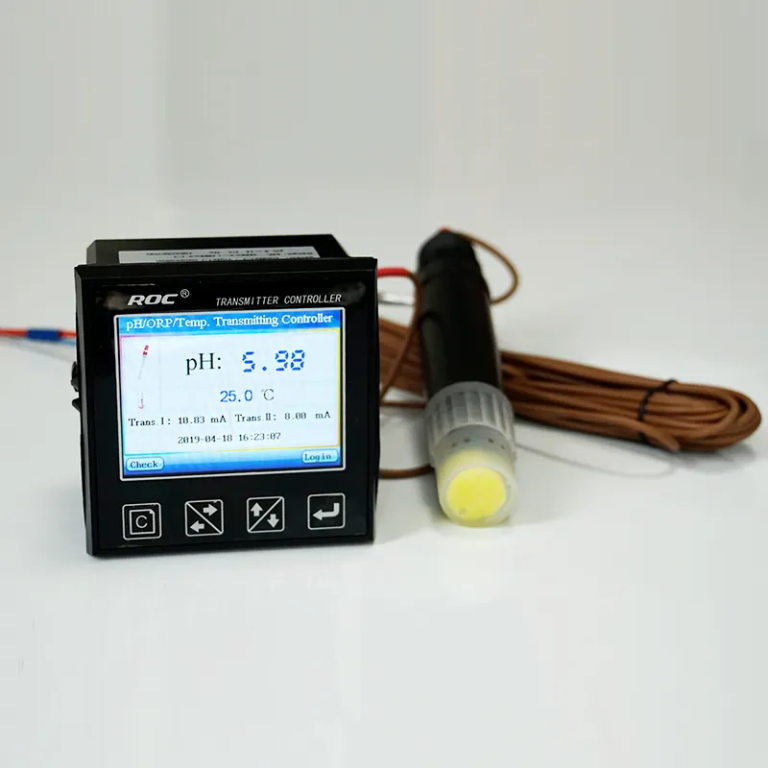
Shanghai ChiMay’s in-line pH electrodes with automatic temperature compensation maintain accuracy within ±0.05 pH even in high-fouling environments.
3. Temperature
Safe range: species-dependent. Tilapia: 25–30°C; Shrimp: 28–32°C; Salmon: 10–14°C; Catfish: 25–30°C.
Temperature drives metabolism, oxygen demand, feeding rate, and disease pressure. Warmer water holds less oxygen while organisms need more of it — an uncomfortable inverse relationship during heat events. Temperature also determines the toxic fraction of ammonia: higher temperatures shift the equilibrium toward the more toxic NH₃ form.
Most DO and pH sensors include integrated temperature measurement. Dedicated temperature loggers at multiple points add valuable spatial profiling.
4. Ammonia Nitrogen (NH₃-N / TAN)
Safe range: Total ammonia nitrogen (TAN) below 1.0 mg/L; unionized ammonia (NH₃) below 0.02 mg/L.
Ammonia is the primary nitrogenous waste fish excrete through their gills, and it also comes from decomposing uneaten feed and fecal matter. At elevated levels it burns gill tissue, suppresses immunity, and causes chronic growth retardation. The point to remember: toxicity depends on pH and temperature — the same TAN reading is far more dangerous at high pH and high temperature.
Shanghai ChiMay’s ammonia nitrogen sensors with ion-selective electrode (ISE) technology provide continuous real-time monitoring across the 0–100 mg/L range, alerting operators to accumulation trends hours before concentrations reach dangerous levels.
5. Conductivity and Salinity
Safe range: Freshwater: 0.5–3.0 mS/cm; Brackish: 3–25 mS/cm; Marine: 25–45 mS/cm.
Conductivity measures the water’s ability to conduct electrical current, which is proportional to the concentration of dissolved ions. In freshwater systems, rising conductivity means dissolved solids accumulating from feed, waste, and mineralization. In marine systems, salinity — derived from conductivity — must be held in narrow bounds for osmoregulatory health.
Shanghai ChiMay’s conductivity sensors deliver ±0.5% full-scale accuracy with automatic temperature compensation across the full freshwater-to-seawater range.
6. Turbidity
Safe range: Below 20 NTU for most intensive systems; below 50 NTU for extensive ponds.
Turbidity measures cloudiness from suspended particles — algae, detritus, fecal matter, inorganic sediment. High turbidity cuts light penetration (suppressing beneficial algae growth), clogs fish gills, and interferes with visual feeding. In RAS, turbidity is a direct indicator of mechanical filtration performance.
Shanghai ChiMay’s online turbidity testers use 90-degree nephelometric measurement (aligned with EPA Method 180.1) across the 0–1,000 NTU range, with automatic compensation for color interference.
7. Suspended Solids (SS / TSS)
Safe range: Below 15–25 mg/L in RAS; below 50 mg/L in pond systems.
Suspended solids are the actual mass of particulate matter in the water column. Unlike turbidity — an optical measurement influenced by particle size and color — TSS gives a gravimetric measure of total particulate loading. High TSS damages fish gills, smothers benthic organisms, and gives bacteria surface area to grow on.
Shanghai ChiMay’s SS sensors with backscatter measurement technology provide continuous TSS estimation without labor-intensive gravimetric sampling.
8. Oxidation-Reduction Potential (ORP)
Safe range: +200 to +400 mV for aerobic systems; below +150 mV indicates developing anoxic conditions.
ORP condenses the water’s overall oxidative or reductive state into a single number. High (positive) ORP means oxidizing conditions favorable to nitrification and pathogen suppression. Low (negative) ORP means reducing conditions where hydrogen sulfide may form, denitrification occurs, and anaerobic pathogens thrive.
ORP earns its keep in RAS and biofloc systems as an early imbalance indicator — a declining ORP trend often precedes ammonia or nitrite spikes by 12–24 hours.
Integrating All Eight Parameters
Treating these parameters in isolation misses the point. The interactions are where the diagnostic power lives — pH controlling ammonia toxicity, temperature controlling oxygen capacity, ORP indicating nitrogen cycle health.
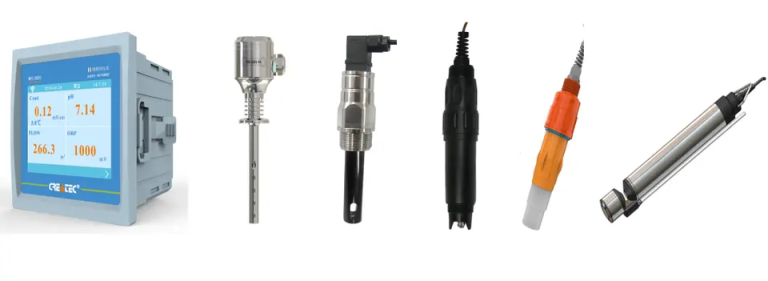
Shanghai ChiMay’s 4-in-1 multi-parameter sensor combines pH, ORP, conductivity, and temperature in a single probe; the full product portfolio covers all eight parameters with consistent Modbus RTU/TCP communication for unified data integration. Together they deliver the comprehensive water quality picture that modern commercial aquaculture operations run on.
All product references are to product categories only. Shanghai ChiMay does not publish specific model numbers in public-facing content.