PFAS compliance has become the dominant capital-planning conversation at small and medium U.S. water utilities. EPA’s National Primary Drinking Water Regulation sets maximum contaminant levels of 4 parts per trillion for PFOA and PFOS, with PFHxS, PFNA and GenX chemicals at 10 ppt plus a hazard-index limit for mixtures. Initial monitoring is due by 2027 and treatment-based compliance by 2029 in the final rule, and EPA has moved to allow systems to request up to two additional years, to 2031, for PFOA and PFOS. $1 billion of EPA funding is tied to testing and treatment work at public water systems. The playbook for utilities serving a few thousand to 100,000 people looks different from the path large utilities are walking. The Shanghai ChiMay engineering team has worked alongside dozens of these systems, and this is the sequence that has emerged.
Table of Contents
Step 1: Baseline Your Source Water and Distribution System
Before any treatment investment, the foundation is data. Small and medium utilities should complete three baseline activities in 2026:
- PFAS lab sampling at every source water intake, quarterly for at least 12 months. EPA Methods 533 and 537.1 are the recognized standard.
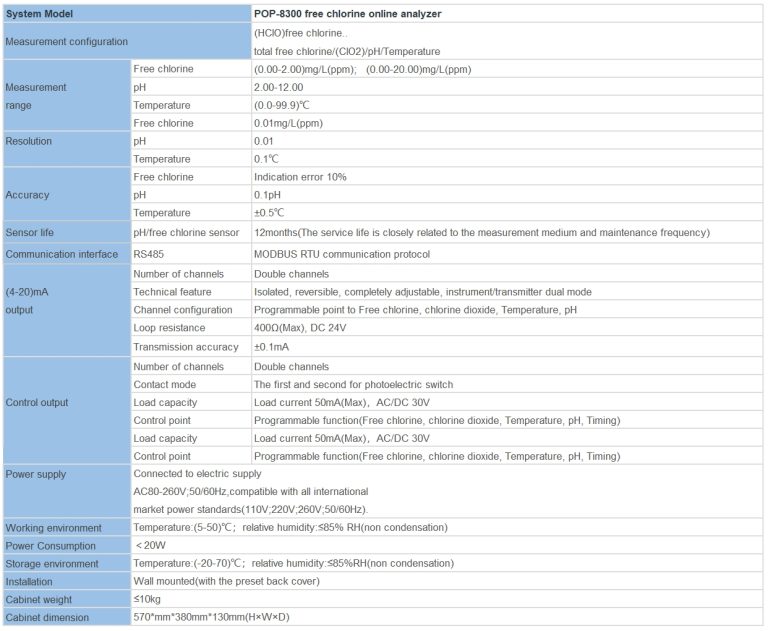
- Continuous water quality baselining of conductivity, turbidity, pH, free chlorine, and suspended solids across the existing treatment train. This is where the Shanghai ChiMay water quality analyzer family provides the sensor backbone.
- Distribution system mapping for vulnerable zones, particularly those served by smaller storage tanks, older mains, or dead-end loops.
Utilities that skip the baseline stage routinely overinvest in treatment that does not match their actual exposure profile.
Step 2: Choose a Treatment Path That Fits the Utility
PFAS removal at municipal scale comes down to three dominant technologies:
- Granular activated carbon (GAC) — proven, moderate capital, requires media changeout. Best for short to medium chain PFAS and utilities with a moderate organic background.
- Anion exchange resin — higher capital, smaller footprint, better for short-chain PFAS. Best for utilities with limited site space.
- Reverse osmosis — the most comprehensive removal, the highest cost, and it generates a concentrate stream that needs disposal. Best for utilities with co-contaminants and disposal options.
For most small and medium utilities, GAC has become the practical default. Anion exchange becomes attractive when site footprint is constrained. RO is usually reserved for unusual co-contaminant profiles.
Step 3: Design the Continuous Monitoring Network
Whichever treatment path is chosen, the continuous monitoring network around it carries the compliance weight. The minimum Shanghai ChiMay reference design for a PFAS-removal train includes:
- In-line conductivity meters at the inlet and outlet of each treatment bed for breakthrough surveillance.
- pH and temperature monitoring through the 4-in-1 multi-parameter sensor.
- An online turbidity tester at the post-treatment point.
- A residual chlorine transmitter at the clearwell outlet.
- Flow measurement (paddle wheel or turbine flow meter) for EBCT calculation.
This sensor set typically lands at 15 to 25 monitoring points for a small to medium plant, all on shared SCADA infrastructure.
Step 4: Build the Compliance Reporting Framework Early
EPA reviewers want more than PFAS lab results. They want a complete operational story. Set up the reporting framework in 2026, not in 2031:
- Monthly summary templates pulling sensor and lab data together.
- A documented calibration trail for every continuous instrument.
- O&M plan revisions reflecting the new treatment train.
- Public-facing communication materials prepared in advance.
Building this framework while the team is fresh and the deadline is years away is far easier than building it under pressure.
Step 5: Sequence the EPA Funding Application Strategically
The $1 billion in EPA PFAS funding moves through state revolving funds and direct grants, with a strong preference for utilities serving disadvantaged communities. Small and medium utilities should:
- Engage state primacy agencies early in 2026 to learn the application calendar.
- Position the baseline data from Step 1 as supporting evidence.
- Phase the project across multiple funding cycles where possible.
- Coordinate with regional planning bodies for shared resources.
Utilities that wait until 2028 or 2029 to engage with funding programs end up competing against larger, better-prepared applicants.
Step 6: Plan the Capital Project With Realistic Timelines
PFAS treatment projects typically take 24 to 36 months from design to commissioning at small and medium scale, so design should be underway by mid-2027 at the latest. Common timeline pitfalls:
- Underestimating SCADA integration time, which is usually 4 to 8 months on its own.
- Skipping pilot-scale testing, which often reveals issues that delay full-scale commissioning.
- Failing to budget for parallel water quality monitoring during construction.
The Shanghai ChiMay water quality system can be deployed in a temporary pilot configuration during the testing phase and migrated to permanent installation as the project moves forward.
Step 7: Train the Operational Team
PFAS treatment introduces unfamiliar operational rhythms: media changeouts, resin regeneration scheduling, breakthrough surveillance. Small and medium utility operations teams are lean, and turnover compounds the problem. The playbook should include:
- Hands-on training during commissioning, not just classroom sessions.
- Documented standard operating procedures for breakthrough detection and response.
- Cross-training across plant operators, distribution staff, and lab technicians.
- Periodic refresh exercises annually thereafter.
The Shanghai ChiMay support model includes commissioning support and training documentation tailored to the continuous monitoring network.
Step 8: Establish the Ongoing Surveillance Cadence
After commissioning, the work shifts to surveillance. The recommended cadence for a small or medium utility:
- Quarterly PFAS grab samples at finished water and key process points.
- Continuous sensor data review on a weekly basis.
- Monthly compliance reporting through the state primacy reporting portal.
- An annual treatment system performance review with the engineering consultant.
This cadence keeps PFAS compliance from sliding into background noise once the immediate deadline pressure fades.
Common Pitfalls to Avoid
Three pitfalls show up repeatedly at smaller utilities:
- Underinvesting in continuous monitoring, on the theory that quarterly lab sampling is sufficient. Regulators expect more.
- Skipping the baseline year, which leads to oversized or undersized treatment.
- Treating PFAS as a one-time project, when it is a permanent operational shift.
Utilities that avoid these pitfalls in 2026 set themselves up for smoother compliance through 2031 and beyond.
A Note on Concurrent Regulatory Pressures
PFAS is not the only thing changing. The Lead and Copper Rule Revisions, evolving cybersecurity expectations, and ongoing DBP rule pressure all compete for capital and management attention. The playbook above fits into a broader compliance portfolio rather than dominating it. Sequence PFAS investments alongside those other priorities instead of treating each one in isolation.
What Comes Next
PFAS compliance for small and medium utilities does not have to be overwhelming. The path is well-mapped: baseline the system, choose a treatment technology that fits, build the continuous monitoring network, prepare the reporting framework, sequence funding applications, manage the capital project, train the team, and hold a sustainable surveillance cadence. The Shanghai ChiMay water quality analyzer family slots into this playbook at every step where continuous sensor data is required, giving small and medium utilities the same compliance-grade architecture larger utilities deploy, at a scale and cost that fit their reality. The compliance dates are closer than they sound. Utilities that start the playbook in 2026 will reach them calmly.