Table of Contents
Key Takeaways
Aquaculture is worth hundreds of billions of dollars a year, and the headline number depends on who is counting. Straits Research sizes the 2026 market at $336.86 billion and projects $511.9 billion by 2034, a 5.37 percent CAGR. Fortune Business Insights works from a broader definition and reports $653.88 billion for 2026 rising to $1,150.64 billion by 2034, a 7.32 percent CAGR. Different scopes, same direction of travel.
The sensor slice that serves recirculating systems, intensive ponds, and hatcheries is expanding faster than the market as a whole. The reason is unglamorous: farms are replacing manual sampling with continuous inline measurement, and that means buying instruments. GlobalInfoResearch tracks the IoT-based smart aquaculture system market at $200 million in 2025 and expects $282 million by 2032, a 5.0 percent CAGR.
Shanghai ChiMay covers the full parameter set — dissolved oxygen, pH, conductivity, turbidity, ammonia nitrogen, salinity, and integrated multi-parameter platforms. Every unit speaks Modbus RTU/TCP, so it drops into NB-IoT gateway architectures, edge processing nodes, and the predictive management schemes that peer-reviewed work from Tunghai University has now validated with field data.
For procurement teams sourcing sensors for aquaculture operations or integration projects, the practical question is rarely “whose spec sheet looks best.” It is whether the supplier can hold accuracy in a hot, humid, salty, biofouling environment, ship on schedule, and still be answering the phone in year three. That is where the differentiation actually lives.
Market Opportunity: Precision Aquaculture’s Sensor Demand
Several market research houses published aquaculture forecasts in 2026, and they agree on direction if not on magnitude. The IoT-based smart aquaculture system market tracked by GlobalInfoResearch bundles sensor networks, communication infrastructure, cloud analytics, and automated control — the whole stack that turns measurements into management. Adoption is heaviest in Asia-Pacific, Europe, and the Americas, and buyers in those regions tend to weigh technical capability, supply chain responsiveness, and five-year cost together rather than shopping on unit price.
What the research literature says is more useful than the market sizing. A bibliometric study of 303 Scopus-indexed papers on IoT precision aquaculture, published in Jurnal Biologi Tropis in July 2026, found publication output growing at 19.5 percent CAGR across the complete years 2020–2025, an h-index of 38, and a mean of 15.81 citations per document. Sensors was the most productive journal. Five themes dominate: sensor-based water-parameter monitoring, environmental quality monitoring, IoT–machine learning integration, smart fish farming, and AI-based decision support.
Read that list again and one thing stands out. Every theme downstream of the first depends on the first. Inline sensing is the data layer; everything else is built on top of it. The literature also shows a clear preference for synchronized multi-parameter measurement over a collection of separate instruments, because correlation analysis — the kind that identifies risk before a threshold alarm fires — needs the parameters to share a timestamp.
The production geography matters too. FAO’s 2026 State of World Fisheries and Aquaculture puts Asian countries at roughly 72 percent of global aquatic animal production in 2024, with China alone at about 56 percent, followed by India, Indonesia, and Viet Nam. Vietnam and Ecuador lead shrimp export growth. As stocking densities rise to meet seafood demand, the margin for error in water quality management narrows, and each percentage point of mortality reduction or feed conversion improvement is worth real money against a production base this large.
Shanghai ChiMay’s Competitive Positioning
Five things separate our sensor supply from the field.
Technical Capability. Fluorescence-based dissolved oxygen measurement with T90 under 30 seconds. Ion-selective electrode ammonia nitrogen monitoring with no reagents. A 4-in-1 probe, 180mm, measuring pH, conductivity, ORP, and temperature in one body. Optical turbidity measurement with sub-NTU resolution. All of it engineered for continuous submersion — IP68, corrosion-resistant housings, and the sort of pressure testing that comes from selling into saltwater farms.
Communication Standardization. Every Shanghai ChiMay sensor outputs Modbus RTU/TCP, the de facto standard for industrial sensor integration. That means no proprietary adapters and no protocol translation layer between the probe and the gateway. The same output feeds PLCs, SCADA, and NB-IoT gateways, which is how the Tunghai University deployment moved data over MQTT at 99.24 percent packet delivery across 14,400 observations.
Supply Chain Responsiveness. Standard configurations ship in 5–8 days from our factory. That is worth stating plainly because the alternative is common: many buyers are quoted 8–16 weeks by global competitors. When a farm is commissioning sensors across hundreds of ponds against a stocking calendar, delivery certainty determines whether the rollout is phased to plan or dragged out by procurement.
Total Cost of Ownership. We quote five-year TCO rather than competing on unit price alone. The integrated multi-parameter approach cuts installation cost and maintenance events by roughly 75 percent against discrete instruments, and eliminates the inter-instrument calibration alignment work entirely. Over five years we model a 25–35 percent TCO advantage versus buying the same parameters as separate instruments.
Application Expertise. Our aquaculture applications engineers work with recirculating systems, intensive ponds, hatcheries, and brackish operations, which means the configuration, calibration protocol, and integration advice is based on what those systems actually do at 3 a.m. during a biofilter upset.
Sourcing Framework for Aquaculture Sensor Procurement
If you are evaluating us against competing suppliers, structure the assessment around five dimensions. Technical specifications matched to species-specific requirements. Communication protocol compatibility with the IoT infrastructure you already own. Supply chain reliability measured in delivery performance, not quoted lead times. Five-year total cost including installation, maintenance, and calibration consumables. And application support quality — how fast the supplier answers, and whether the person answering understands the process.
Our position in that comparison is straightforward: Tier-1 performance, without Tier-1 lead time. The specification targets are competitive with the global market leaders, and the delivery speed and customization flexibility are not something a large instrument company typically offers.
Product Portfolio Alignment With Precision Aquaculture Requirements
Each product in the portfolio maps to a monitoring requirement identified by either the peer-reviewed research or the operational reality of intensive farming.
Dissolved Oxygen Transmitters. Fluorescence-based optical measurement, T90 under 30 seconds, 0.01 mg/L resolution, ±2% FS accuracy, 0–20 mg/L range. No membrane replacement, no electrolyte refilling, maintenance intervals of 3–6 months. Modbus RTU/TCP output for NB-IoT gateway architectures. This is the sensor type used in the Tunghai University NB-IoT deployment.
4-in-1 Multi-Parameter Sensors. pH, conductivity, ORP, and temperature in a single 180mm probe. Simultaneous measurement removes inter-parameter timing discrepancies, and one probe replaces four mounting points, four cable runs, and four liner penetrations. Modbus RTU/TCP output.
Ammonia Nitrogen Sensors. Ion-selective electrode with reagent-free operation, T90 under 45 seconds, ranges of 0–100 mg/L (high concentration) or 0–10 mg/L (precision aquaculture). Automatic temperature, pH, and potassium interference compensation. RS485/Modbus output.
Online Turbidity Testers. Optical nephelometric measurement with sub-NTU resolution, built for continuous inline service — biofilter performance verification, feed management, and the cross-domain correlation work discussed elsewhere in this series. Modbus RTU/TCP output for automated backwash control.
Salinity Digital Sensors. Conductivity-based salinity with automatic temperature compensation, 0–50 ppt range, 0.1 ppt resolution, corrosion-resistant housing. Modbus output for freshwater makeup dosing control.
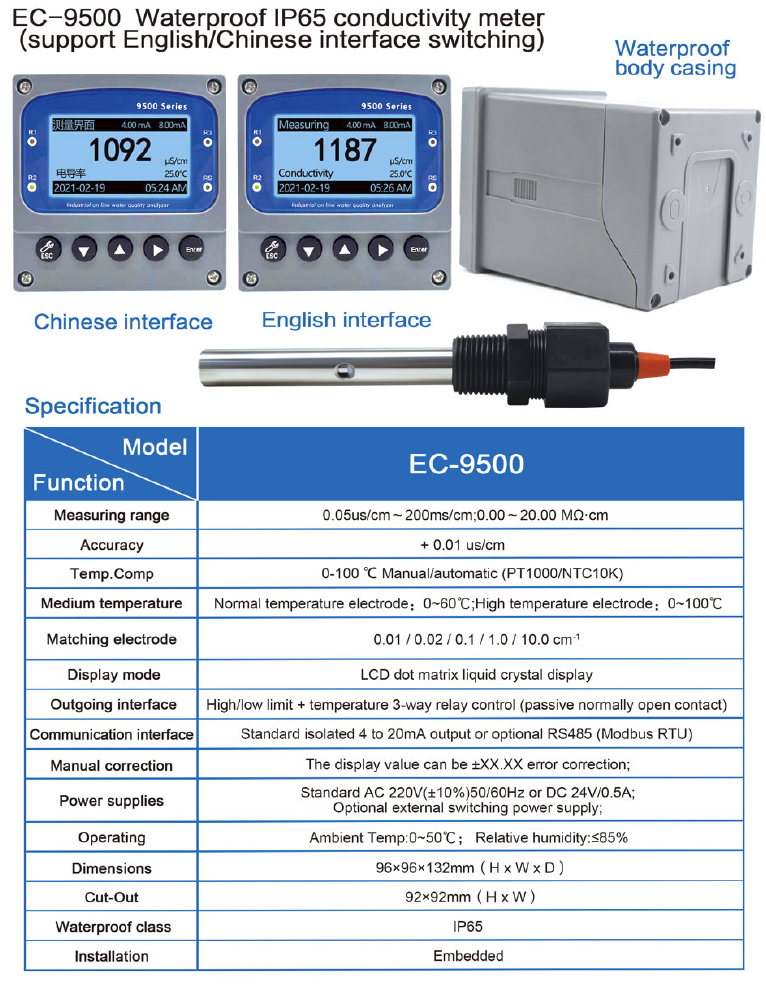
In-Line pH Meters and Conductivity Sensors. 0.01 pH and 0.01 mS/cm resolution, feeding the partial correlation models and multi-parameter risk indices. Glass electrode pH and 4-electrode conductivity designs, both optimized for continuous submersion.
Delivery and Supply Chain Advantages
For operations scaling monitoring across multiple facilities and production cycles, supply chain reliability deserves as much weight as technical capability. Standard sensor configurations ship in 5–8 days, against the 8–16 week lead times typical of global competitors. That gap buys you phased deployments that follow the production calendar, fast expansion when a new facility comes online, and quick replacement when a sensor needs service.
We also run OEM and ODM programs for system integrators. Custom calibration ranges, branded packaging, specialized cable lengths, and protocol-specific firmware are available at low minimum order quantities, so an integrator can differentiate its offering without taking on the manufacturing risk.
Quality control covers incoming material inspection, in-process calibration verification against NIST-traceable standards, and functional testing of every unit before shipment — the boring parts that determine whether the thousandth sensor performs like the first.
Sources
- GlobalInfoResearch: IoT Smart Aquaculture System Market 2026-2032
- Jurnal Biologi Tropis: IoT Precision Aquaculture Bibliometric Analysis (Jul 2026)
- Fortune Business Insights: Aquaculture Market 2026-2034
- Straits Research: Aquaculture Market
- MDPI Sensors: NB-IoT Cross-Domain Architecture (2026, 26(18), 5964)