Produced water is the oil and gas industry’s largest waste stream by volume. Commonly cited industry estimates put US production at around 20 billion barrels a year — several times the volume of oil produced — and global volumes are larger still. Almost all of it is reinjected or treated, a fraction is discharged, and the treatment performance in between is what determines whether the operation is compliant, economic and defensible.
Monitoring is what makes that performance visible. The question is no longer whether a permit requires it, but how much of it an operator needs to run the treatment plant properly and to prove what happened when someone asks.
Table of Contents
The Complexity of Produced Water Composition
Chemical Characteristics
Produced water chemistry varies enormously with the formation, the production method and the age of the field:
- Salinity: Permian Basin produced water commonly runs 100,000–300,000 mg/L total dissolved solids, several times the roughly 35,000 mg/L of seawater. Gulf of Mexico and North Sea produced water tends to be less saline, but still far above anything a conventional treatment plant handles
- Dissolved hydrocarbons: BTEX compounds and other dissolved organics, relevant both for discharge limits and for groundwater protection
- Heavy metals: arsenic, lead, barium and strontium, with barium and strontium driving scale formation as well as toxicity concerns
- Naturally occurring radioactive material (NORM): radium isotopes, which need handling and disposal provisions
- Production chemicals: corrosion and scale inhibitors, biocides and friction reducers, all present at low but non-zero concentrations
No single treatment technology handles this range of composition, which is the fundamental argument for staged treatment with monitoring between the stages. What changes week to week at a given facility is often more significant than the average composition.
Physical Properties
Oil-in-water concentration is the parameter with the widest operational spread: below 50 mg/L in mature waterflooded fields, and above 10,000 mg/L in primary production from some formations. Temperature and viscosity affect separation efficiency, and both change over field life.
ChiMay inline sensors are specified to cover this range with automatic range adjustment, which matters because a treatment plant sized for the mature-field condition has to survive the occasional upset.
Regulatory Landscape and Compliance Imperatives
Discharge Limits
The limits that apply to produced water discharge are specific, and they are frequently misquoted in secondary sources:
| Framework | Limit | Applies to |
|---|---|---|
| OSPAR Recommendation 2001/1 | 30 mg/L dispersed oil performance standard, with the objective of reducing to 15 mg/L | North Sea offshore installations |
| US offshore, 40 CFR 435 Subpart A | 42 mg/L maximum for any one day; 29 mg/L 30-day average (oil and grease) | Gulf of Mexico and other US offshore discharges |
| MARPOL Annex I | 15 ppm | Machinery space oily water discharges from ships; platforms fall under Annex I Reg 39, which defers to coastal state requirements |
Two things follow from this table. First, the OSPAR limit is an average-based performance standard, which means a single high reading does not necessarily breach it — but the operator has to be able to demonstrate the average, which requires continuous data rather than grab samples. Second, the US limit includes a daily maximum, so a short excursion can breach it even when the 30-day average is comfortable. Different rules, different monitoring implications.
ISO 9377-2 (hydrocarbon oil index by GC-FID) and ASTM D7066 (infrared) are the laboratory reference methods that permit compliance is assessed against; EPA Method 1664 covers oil and grease by hexane extraction for US permits.
Consequences of Non-Compliance
The direct penalty is the smaller part of the exposure. A discharge exceedance triggers investigation and reporting obligations, may require remediation, and in the offshore sector can affect the operator’s licence to discharge at all. Environmental incidents also carry reputational and financing consequences that exceed the fine by a wide margin. The practical argument for continuous monitoring is that it converts a compliance failure discovered by a regulator into an operational problem detected and corrected by the operator.
On the groundwater side, leakage pathways — casing failures, surface releases and abandoned wells — are a documented problem, and state regulators including the Texas Railroad Commission run well plugging programmes specifically because abandoned wells are a recognised conduit. Monitoring wells around production facilities are the standard defence.
Economic Drivers for Comprehensive Monitoring
Treatment Optimisation
Disposal by deep well injection is the dominant onshore route in the United States, and it is not free: costs are typically quoted in the low single digits of dollars per barrel, varying with depth, injection pressure and regional capacity. Every barrel that can be treated to a lower specification and reused, or diverted from injection, is money saved.
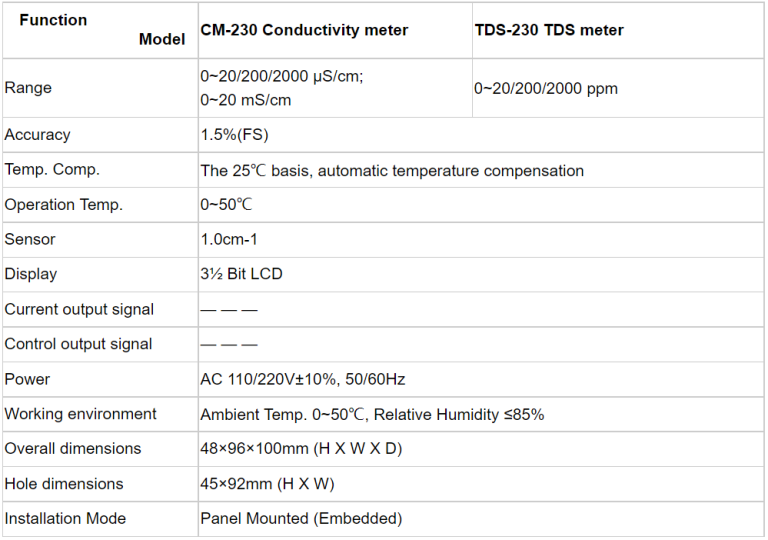
Continuous oil-in-water data lets an operator route water to the treatment pathway its actual quality requires instead of treating everything to the highest specification, and it catches separator upsets early enough to correct them before they affect a whole day’s volume. ChiMay conductivity and oil-in-water monitors provide the measurement.
Beneficial Reuse
Reuse is now a real pathway in the Permian and other shale plays, most commonly for industrial purposes and, increasingly, in discussions with data centre operators looking for cooling water supply in Texas. Reuse applications require water quality verification — salinity, oil content, solids, and in some cases specific ion limits — at a frequency that manual sampling cannot economically provide. That requirement makes continuous instrumentation part of the enabling infrastructure for reuse, not an add-on to it.
ChiMay multi-parameter sensors verify oil content, conductivity, turbidity and heavy metal parameters across the reuse-relevant range.
Environmental Stewardship and Social License
Groundwater contamination by produced water is effectively irreversible in terms of salinity: an aquifer that receives high-TDS water does not recover through natural flushing on any human timescale. That makes detection, rather than remediation, the operative control — monitoring wells around facilities, continuous measurement in the wells, and a documented response plan.
Offshore, dissolved aromatic hydrocarbons from produced water discharge are bioavailable and accumulate in marine organisms, which is the basis for the discharge limits described above. Compliance monitoring against those limits is the direct mitigation.
The Path Forward: Integrated Monitoring
The shift from periodic sampling to continuous measurement is what changes produced water management from a reporting exercise into process control. Real-time data supports dynamic adjustment of treatment, predictive maintenance on separators and filters, and a compliance record that is generated as a by-product of operating rather than assembled retrospectively.
ChiMay online analysers cover the relevant parameters — oil content, conductivity, pH, turbidity, dissolved oxygen — integrated through SCADA and IIoT platforms for operational use.
Conclusion
Produced water monitoring is essential because the regulatory limits are average-based and daily-maximum-based at the same time, because the volumes are too large to treat speculatively, and because reuse only works when water quality can be verified continuously. Operators who instrument the treatment train get compliance as an output of good operation; operators who sample it get compliance as a periodic guess. ChiMay’s multi-parameter monitors and oil-in-water analysers provide the measurement layer for the first approach.