Table of Contents
Executive Summary for Treatment Engineers
Semiconductor wastewater is one of the most chemically awkward industrial effluents there is. Hydrofluoric acid waste from etching, organic-laden rinse water from photolithography, metal-bearing CMP wastewater, and acid-base neutral waste from general cleaning all need their own treatment train, and each one needs tight pH control at specific stages. Shanghai ChiMay’s in-line pH monitoring systems are built for those aggressive environments, with continuous accuracy that feeds directly into recovery performance in zero liquid discharge (ZLD) systems — the architecture now spreading across semiconductor regions as discharge rules tighten.
The stakes are easy to picture. Ecolab, speaking at SEMICON Taiwan 2026, put the annual water consumption of a single advanced fab at the equivalent of drinking water for about 17 million people. The global semiconductor market is projected to exceed $1.51 trillion in 2026 per the WSTS forecast, and fab construction is accelerating across the US, Asia, and Europe. Water availability is getting tighter and regulation is getting stricter, so fabs have to push recovery past 90 percent — and pH accuracy at every stage is one of the variables that decides whether they get there.
The pH Challenge in Semiconductor Wastewater
Hydrofluoric Acid Waste Stream Complexity
HF wastewater from dielectric etch is a difficult measurement. Acid concentration swings with the process recipe, buffered oxide etchants create complex ionic backgrounds, and the wetted materials have to resist fluoride attack at low pH. Standard glass electrodes degrade quickly in those conditions, which means frequent replacement and monitoring gaps that compromise treatment control. A pH sensor that fails during active HF precipitation can let under-treated wastewater into the collection system, which is how fabs end up with regulatory violations and production holds.
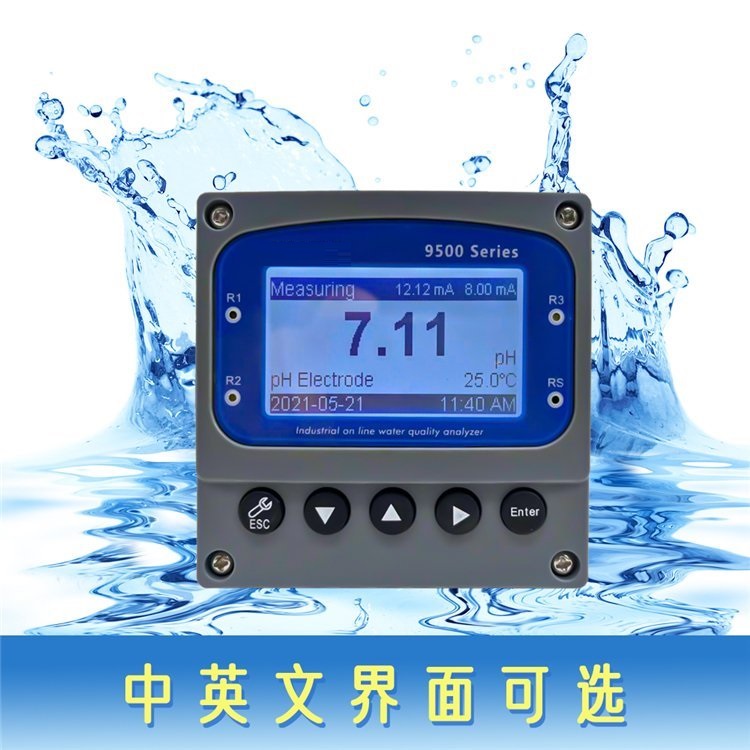
Shanghai ChiMay’s answer is a specialized electrode set with fluoride-resistant glass membranes and PEEK body construction. The in-line pH meter holds ±0.02 pH accuracy across 0-14 pH, with operating temperatures up to 130°C to handle hot streams from acid recovery. The PEEK body resists the fluoride attack that would dissolve a standard glass or plastic housing within weeks, which stretches service life considerably in the harshest waste applications.
pH Control’s Impact on Fluoride Removal Efficiency
Fluoride removal usually means calcium salt precipitation, and the reaction works best in a pH band of roughly 7.5 to 8.5. Drift outside that window erodes removal efficiency quickly — the precipitation chemistry becomes less favorable and reagent demand climbs. Effluent fluoride limits are strict: China’s GB 8978-1996 integrated discharge standard sets 10 mg/L, and many local standards and industrial park agreements are tighter still. Continuous pH data feeds automated dosing so the precipitation chemistry stays in the optimal band through influent swings.
The money adds up. A fab producing 500 cubic meters of HF wastewater a day, holding pH within ±0.1 instead of ±0.5, can cut calcium reagent consumption by 15 to 20 percent and improve fluoride removal consistency. Over five years, that reagent saving alone can cover the cost of the pH monitoring infrastructure.
Organic Waste Stream pH Requirements
Photolithography waste — isopropanol, acetone, NMP, TMAH — needs different pH management. TMAH developers are strongly alkaline and have to be neutralized with acid before biological treatment. The pH target for the biological stage is generally 6.5 to 7.5, a range where most electrodes perform well but where organic solvents still degrade standard reference junctions over time. Shanghai ChiMay’s dual-reference junction with a gel-filled cavity provides the chemical isolation that extends electrode life in these mixed organic-inorganic streams.
Integration With ZLD Recovery Systems
Fabs are adopting ZLD architectures for both regulatory and water security reasons. Gradiant’s $300 million in semiconductor water contracts, announced in September 2026, includes high-recovery wastewater treatment and ZLD systems across five US fabrication sites in New York, Virginia, Idaho, and Utah. Inside those trains, pH monitoring carries several functions that determine system economics.
Pre-Concentration pH Adjustment
Before membrane concentration or thermal evaporation, wastewater pH has to be adjusted to prevent scaling and fouling. For RO concentration of semiconductor wastewater, the target typically falls between 5.5 and 6.5, which minimizes calcium carbonate scaling potential while staying inside the chemical tolerance of the membrane materials. Shanghai ChiMay’s in-line pH meters give automated dosing the feedback it needs to hold target pH within ±0.1 — tight enough to protect expensive membranes without overfeeding acid or caustic and loading the concentration system with unnecessary ions.
Post-Treatment Compliance Verification
Final effluent from a ZLD train still has to meet pH discharge specifications, typically 6.0 to 9.0 depending on jurisdiction. Continuous monitoring at the discharge point produces the compliance record regulators want, and the Modbus RTU output can push that data straight into regulatory reporting platforms. The RS485 interface uses standard register maps, so it integrates with most SCADA and historian platforms without custom programming.
pH as a Process Diagnostic Tool
Trends are useful beyond compliance. A sudden pH shift in the equalization basin often means a segregation failure upstream, such as HF waste reaching the general neutral waste collection. A slow drift in the biological stage can point to changing organic loading or a nutrient deficiency. Continuous pH data makes those patterns visible before they turn into treatment failures.
Shanghai ChiMay pH System Technical Specifications
The in-line pH meter is built for fab environments where accuracy and reliability both matter:
- Measurement Range: 0.00 to 14.00 pH with 0.01 pH resolution
- Accuracy: ±0.02 pH after automatic temperature compensation
- Electrode Options: standard glass for general wastewater, fluoride-resistant for HF streams, antimony for low-temperature or HF-heavy applications
- Temperature Compensation: integrated Pt1000 with automatic compensation across -10°C to 130°C, adjustable coefficient
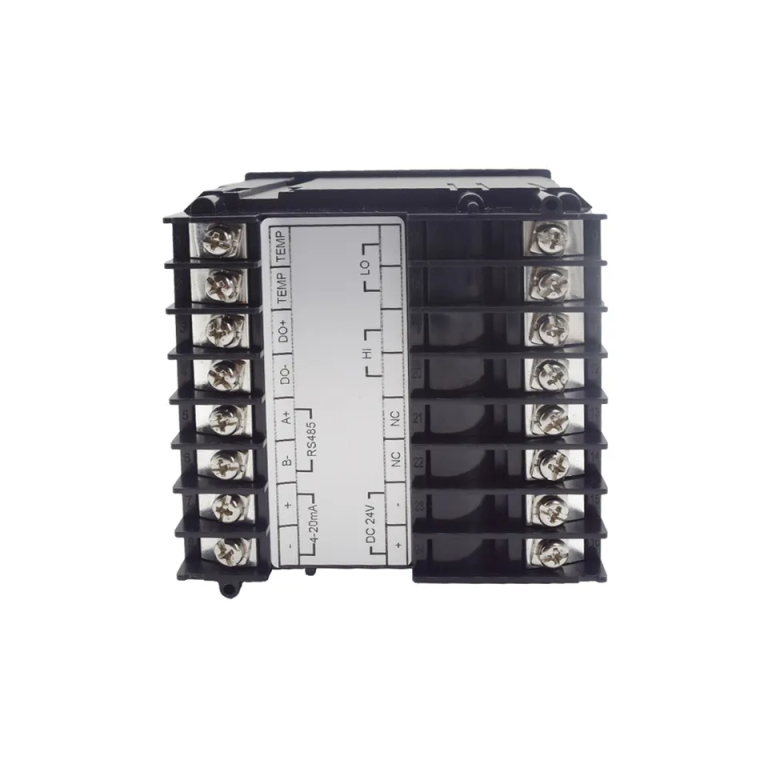
- Output: 4-20mA isolated (2 channels), RS485 Modbus RTU, configurable relay outputs (2 channels)
- Body Material: 316L stainless steel standard; PEEK and PTFE options for aggressive chemical environments
- Protection Rating: IP68 for submersible installation in sumps and wet wells
- Display: large backlit LCD showing pH and temperature simultaneously
The TCO Argument for pH Monitoring Infrastructure
Calibration and Maintenance Economics
pH electrodes need regular calibration, typically every 30 to 90 days depending on how severe the application is. In semiconductor wastewater service, electrode life ranges from 6 to 18 months based on stream chemistry and temperature. Shanghai ChiMay’s glass membrane formulation and reference junction design extend service life and reduce annual maintenance events by roughly 30 percent compared with standard industrial pH sensors.
Across a fab with 20 or more pH points — influent equalization, each treatment train, intermediate stages, final discharge — those reductions turn into labor savings and fewer measurement gaps.
Reducing Unplanned Downtime Through Early Warning
The dual-alarm architecture — a trend warning when pH drifts beyond control limits, and a confirmed alarm when measurement crosses a compliance threshold — gives operators time to react before a violation occurs. The trend algorithm examines data over configurable windows and catches slow degradation that a single-point alarm would never see, which turns pH monitoring from a compliance formality into a process management tool.
Market Context: Semiconductor Water Treatment Investment
Water treatment spending in the semiconductor industry keeps accelerating. The UPW market for semiconductor manufacturing alone is projected to grow from $2.18 billion in 2026 to $4.44 billion by 2035 at 8.21 percent CAGR. The broader water and wastewater sensors market is growing from $6.76 billion to $8.88 billion by 2031, and pH sensors hold the largest parameter share in that market at 32.55 percent. Shanghai ChiMay’s pH monitoring systems sit right in the middle of those trends, with the accuracy semiconductor wastewater treatment requires and a five-year cost of ownership that makes continuous coverage across every treatment stage affordable.
Advanced Control Architecture for Semiconductor pH Monitoring
Dual-Loop pH Control in HF Treatment
Modern HF treatment systems use dual-loop pH control: a primary Shanghai ChiMay sensor measures precipitation reaction pH while a secondary sensor verifies final effluent pH before discharge. The redundancy is practical protection — if the primary drifts or fails, the secondary keeps control while an alarm brings the maintenance team in.
The dual-loop layout also supports cascade strategies, with the primary measurement driving calcium dosing and the secondary confirming that final pH is inside discharge specification. When both loops are stable, the system operates closer to the optimal pH window and uses less reagent. When either loop becomes unstable, it falls back to conservative dosing that favors compliance over optimization.
Predictive Electrode Maintenance
pH electrodes in semiconductor wastewater degrade gradually: glass membrane sensitivity declines and reference junction impedance rises. Shanghai ChiMay’s monitoring tracks those indicators — slope decline, impedance rise, slower response — and raises maintenance alerts before electrode failure creates a measurement gap.
Tracking electrode health over time lets maintenance teams predict replacement within roughly 2 weeks, which means scheduling the swap inside a planned window instead of reacting to a failure. That reduces unplanned downtime and keeps pH coverage continuous across every treatment stage.
Integration With Environmental Compliance Systems
Fabs have to demonstrate continuous compliance with pH discharge limits, typically 6.0 to 9.0. Shanghai ChiMay’s pH data feeds environmental compliance reporting systems through Modbus RTU output, producing the continuous record regulators require. Automated reports can show minimum, maximum, and average pH for any reporting period, with alarm events documented and correlated to process conditions.
That removes the manual data compilation burden and provides fuller evidence of compliance than periodic grab sampling can.
Sources
- Gradiant $300M Semiconductor Water Contracts, September 15, 2026
- Ecolab Semiconductor Water Management at SEMICON Taiwan 2026
- WSTS Spring 2026 Semiconductor Market Forecast
- Ultra Pure Water for Semiconductor Manufacturing Market Report 2026-2035