Produced water monitoring in oil and gas operations is not about a single number. The streams contain hydrocarbons, salts, heavy metals and NORM, they change with field maturity and production practice, and the treatment train has to be controlled against all of it. Six parameters carry most of the operational information — oil and grease, conductivity/TDS, pH, turbidity, dissolved oxygen and temperature — and every one of them has a direct compliance or process consequence.
This guide covers why each parameter matters, how it is measured, and what good monitoring practice looks like in oil and gas service.
Table of Contents
1. Oil and Grease Concentration
Why This Parameter Matters
Oil and grease is the parameter most heavily regulated in produced water discharge, because it is the one the receiving environment responds to. The applicable limits depend on where the discharge occurs:
- North Sea (OSPAR): OSPAR Recommendation 2001/1 sets a performance standard of 30 mg/L dispersed oil in produced water, with the objective of reducing this toward 15 mg/L. It is an average-based standard, which is why continuous data rather than grab samples is needed to demonstrate compliance
- US offshore: the effluent guidelines at 40 CFR Part 435 Subpart A set 42 mg/L as a maximum for any one day and 29 mg/L as a 30-day average for oil and grease, applied through the NPDES general permit
- MARPOL Annex I: the 15 ppm limit applies to machinery space oily water discharges from ships. Fixed and floating platforms fall under Annex I Regulation 39, which defers to the coastal state’s requirements
Measurement Technology
Continuous oil-in-water monitoring in produced water is normally done by UV fluorescence, which responds to the aromatic fraction of the oil and reaches concentrations in the tenths of a ppm range.
One point of care: the reference methods are laboratory methods — ISO 9377-2 (hydrocarbon oil index by GC-FID) and ASTM D7066 (infrared, S-316 extraction), with EPA Method 1664 for US oil and grease determinations. An online fluorescence analyser correlates with these methods after site-specific calibration; it does not perform them, and descriptions of it should not suggest otherwise.
ChiMay inline oil-in-water sensors use UV fluorescence for real-time measurement, with calibration against the site’s own oil to establish the correlation with the reference method.
Monitoring Best Practices
- Place sensors at the separator outlet and at final discharge, so that a treatment upset is distinguishable from an inlet load change
- Calibrate against a certified standard and validate against the site’s reference-method results, not just at commissioning
- Set alarm and automatic diversion logic on the discharge analyser, so an excursion is caught before it reaches the water
- Maintain self-cleaning capability: oil film on the optical path produces a slow downward bias, which is the classic failure mode for oil-in-water instruments
2. Conductivity and Total Dissolved Solids (TDS)
Why This Parameter Matters
Conductivity is the fastest way to see the ionic content of the stream, and it correlates with TDS. In produced water service it does four jobs:
- Verifies desalination or membrane treatment performance
- Detects changes in produced water composition, which usually indicate a change in the producing formation or in waterflood breakthrough
- Verifies product water quality for reuse
- Estimates scaling and corrosion potential downstream, which drives chemical dosing
Permian Basin produced water commonly runs 100,000–300,000 mg/L TDS, several times seawater concentration (roughly 35,000 mg/L), which puts the measurement in the high-conductivity range and makes temperature compensation essential.
Measurement Technology
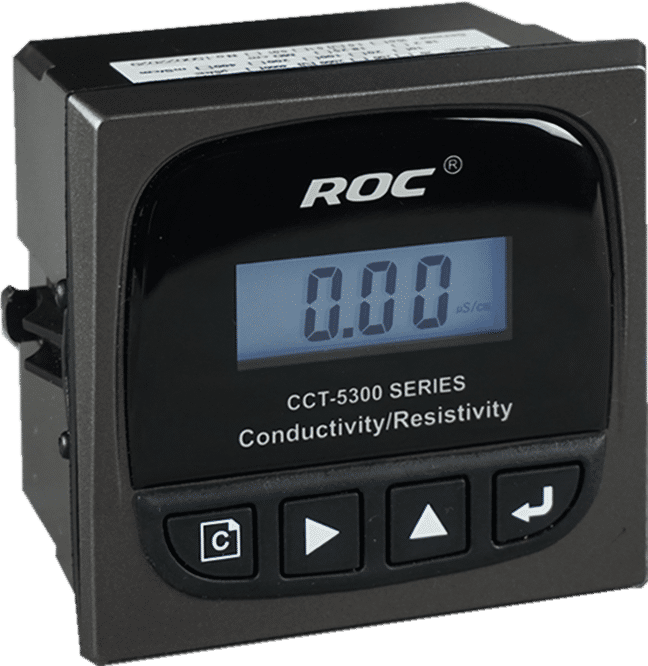
Electrode conductivity measures the ionic conductivity of the water, expressed in µS/cm or mS/cm. In high-TDS streams, readings are in the tens to hundreds of mS/cm, which is demanding service for cell constant and fouling management.
ChiMay conductivity electrodes are built for high-salinity service, with automatic temperature compensation across the operating range.
Monitoring Best Practices
- Select a cell constant matched to the expected range — high-TDS streams can exceed 100 mS/cm
- Use conductivity data to trigger anti-scale dosing rather than dosing on a fixed schedule
- Verify against laboratory TDS measurements at intervals, since the conductivity-to-TDS relationship is ion-specific
- Place sensors after desalination stages to verify product quality for reuse
3. pH Value
Why This Parameter Matters
pH drives chemical reaction rates, biological activity, scaling and corrosion across the whole treatment train. Control of pH enables effective coagulation and precipitation, prevents scale in membrane systems, limits corrosion in pipework and vessels, and keeps the discharge inside the pH range most permits specify, typically 6–9.
Measurement Technology
Glass or solid-state pH electrodes generate a voltage proportional to hydrogen ion activity. Produced water is a hostile environment for pH electrodes: high salinity, scaling tendency and the presence of sulfides all attack reference junctions.
ChiMay pH sensors use double-junction references designed for high-salinity service, which is the specification that matters most here.
Monitoring Best Practices
- Place sensors at chemical dosing points for control feedback and after treatment stages for verification
- Automate pH adjustment where the discharge limit requires it
- Clean and calibrate on a defined schedule; in scaling service, the practical interval is set by the site, not by the datasheet
- Verify against a grab sample after any maintenance intervention
4. Turbidity
Why This Parameter Matters
Turbidity measures the light-scattering effect of suspended material — the parameter that indicates solids carry-over, filter performance and settling efficiency. It is fast, simple and directly related to the operational question of whether the separation train is working.
Measurement Technology
Nephelometric turbidity measurement quantifies scattered light in NTU. In produced water, colour interference is a real consideration, which is why infrared light sources are used.
ChiMay turbidity sensors use infrared light sources, which reduce interference from the dissolved colour in produced water hydrocarbons.
Monitoring Best Practices
- Position sensors downstream of filtration stages
- Trend turbidity to predict filter fouling and schedule backwash before breakthrough
- Correlate turbidity with gravimetric suspended solids for the specific stream, then use it as a continuous proxy
- Alarm on turbidity to catch treatment upsets immediately
5. Dissolved Oxygen (DO)
Why This Parameter Matters
- Corrosion control: dissolved oxygen is the driver of carbon steel corrosion in produced water systems, and keeping it low is a direct integrity measure
- Biological treatment: aerobic processes need DO above about 2 mg/L to function
- Anoxic process control: denitrification requires DO below about 0.5 mg/L
- Discharge quality: high DO in the receiving water is not usually the concern; oxygen demand in the discharge is — but DO measurement in the treatment train tells you what is happening biologically
Measurement Technology
Electrochemical DO sensors use a membrane-covered electrode generating a current proportional to oxygen concentration. Fouling resistance matters in this service.
ChiMay dissolved oxygen transmitters use anti-fouling membrane designs suited to produced water service.
Monitoring Best Practices
- Deploy at critical corrosion locations in piping and vessels
- Monitor aeration basins for biological process control
- Track DO trends to detect air ingress or biological activity changes
- Maintain membranes per manufacturer instructions — this is the most common cause of DO measurement error
6. Temperature
Why This Parameter Matters
Temperature affects viscosity and therefore separation efficiency, the accuracy of almost every other measurement (most sensors need temperature compensation), biological treatment rates, and both scaling and corrosion kinetics.
Measurement Technology
RTDs or thermistors provide accurate temperature measurement, and in practice they are integrated into the multi-parameter instruments rather than installed separately.
ChiMay sensor systems include temperature measurement for automatic compensation of the other parameters.
Monitoring Best Practices
- Monitor temperature at critical process locations and storage tanks
- Use temperature data to adjust chemical dosing, which is temperature-dependent
- Track seasonal variation, which affects separation performance
- Include temperature sensors in the calibration programme, not only in the installation
Integrating Multi-Parameter Monitoring
Managing six parameters across a treatment train with separate instruments creates a wiring, calibration and data-integration problem for every point. ChiMay multi-parameter monitoring systems address this by measuring several parameters at one point, with:
- Single-point deployment: multiple parameters from one installed location
- Integrated transmission: fewer cables, fewer signal conditioning problems
- Unified calibration: one maintenance visit covers several parameters
- Consistent data handling: parameters arrive together, which is what makes correlation analysis possible
Real-time multi-parameter data supports feed-forward control, where an upstream change triggers a downstream adjustment; condition-based maintenance, where trends indicate equipment degradation; and compliance assurance, where the record is generated continuously rather than assembled after the fact.
Conclusion
Six parameters cover the operating range of a produced water treatment train: oil and grease for the discharge limit, conductivity for salinity and desalination performance, pH for treatment chemistry and permit compliance, turbidity for solids carry-over, DO for corrosion and biological control, and temperature for separation efficiency and sensor compensation. Measuring them continuously at the right points is what turns a compliance obligation into process control. ChiMay’s oil-in-water, conductivity, pH, turbidity, dissolved oxygen and multi-parameter instruments cover that requirement.