title: “Sensor Strategies for Electrochemical Oxidation Reactors Treating PFAS Concentrate”
date: 2026-07-08
category: PFAS Destruction
audience: Technical
tags: [electrochemical oxidation, PFAS, sensor strategy, reactor monitoring]
Electrochemical oxidation (EO) has moved from laboratory demonstration to engineered skid in the space of a few years, largely because of landfill leachate and industrial reject streams where no other destruction route is cost-effective. The reactors are electrically simple and chemically brutal: extreme anodic potentials, aggressive pH swings, foam, and a brine matrix that eats the wrong materials in weeks. Instrumentation is where most of the operational failures originate, and it is the least discussed part of the design.
Table of Contents
The Electrochemical Oxidation Landscape in 2026
The dominant design conversation now starts with concentration upstream of the reactor. Foam fractionation — commercialised under names such as surface-active foam fractionation — has become the standard front end for landfill leachate and industrial reject, because it concentrates PFAS into a small foamate volume while leaving the bulk of the water to be handled conventionally. That foamate is what enters the EO reactor, and it is a much harder measurement environment than raw leachate: higher surfactant loading, more foam, and a much higher ionic strength.
Three anode chemistries define the operating envelope:
- Boron-doped diamond (BDD). Highest oxidation potential, longest lifespan, highest capital cost. The default for difficult matrices.
- Mixed metal oxide (MMO). Lower cost, moderate lifespan, more selective oxidation chemistry. Common in polishing duty.
- Ti/PbO₂ and SnO₂. Legacy chemistries still found in older installations, with known dissolution and leaching concerns.
The anode choice changes the sensor strategy only slightly, but it changes the maintenance interval substantially.
The Six Core Parameters
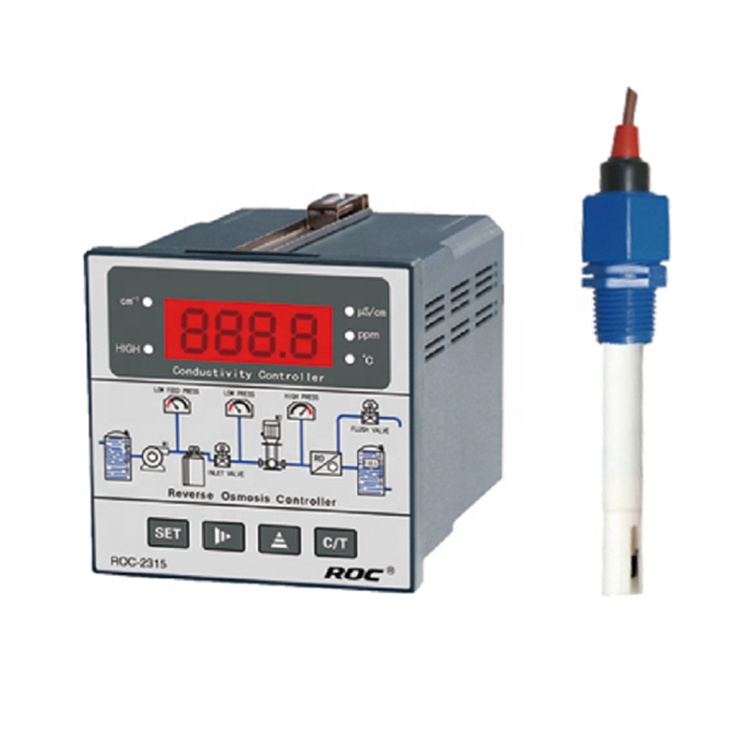
Conductivity. The single most useful parameter on an EO skid, because the electrolyte concentration sets cell voltage, current efficiency, and the whole thermal balance. Toroidal (electrodeless) measurement is the correct choice here: contact electrodes corrode in this service, and the ionic strength is often far higher than a two-electrode cell handles well.
pH. EO destroys PFAS by direct and indirect oxidation, and the byproducts acidify the bulk solution. A batch run typically starts near neutral and finishes acidic, so the pH sensor is not measuring a process setpoint — it is measuring a trajectory, and it needs to track it without frequent recalibration.
ORP. The best available proxy for whether the anode is producing hydroxyl radicals as intended. BDD anodes in PFAS service typically run in the +800 to +1,400 mV range versus Ag/AgCl; a sustained drop usually indicates passivation, a competing oxidant demand, or a change in the feed matrix.
Temperature. Cell voltage drives Joule heating directly, and elevated temperature accelerates both reaction rates and sensor aging. A PT1000 in a titanium sheath is the standard.
Dissolved oxygen. A byproduct of water oxidation at the anode, and useful as an indicator of reaction intensity and of air entrainment in the recirculation loop. Optical (luminescence) DO sensors are preferred because they do not consume oxygen and do not require membrane maintenance.
Turbidity. Foam, suspended solids, and electrode wear products all appear here. It is also the parameter that tells you when a bubble flush or foam removal cycle is needed.
A seventh, fluoride, is normally derived rather than measured — it can be inferred from conductivity and pH trends, since fluoride release accompanies PFAS destruction, and direct fluoride measurement in this matrix is expensive and fragile.
A 4-in-1 multi-parameter sensor covering pH, ORP, conductivity, and temperature packages the four measurements that share the same flow cell, which reduces both the wetted surface area and the number of fittings that can leak.
Materials Selection for the EO Environment
Materials selection matters more than measurement physics in this service, because most failures are chemical rather than electronic.
- pH and ORP. Solid-state glass or antimony electrodes with PTFE or PEEK bodies are the usual. A double-junction reference with a hydrophilic gel plug is required; a single-junction reference will be poisoned by the brine matrix within weeks.
- Conductivity. Non-contact toroidal sensors with PVDF or PEEK bodies and titanium or PFA wetted parts.
- Temperature. PT1000 in a titanium sheath.
- Dissolved oxygen. Optical/luminescence type, which avoids membrane fouling entirely.
- Turbidity. Sapphire windows with a self-cleaning wiper for the high-solids stages.
Shanghai ChiMay’s inline pH electrode with a double-junction reference and PEEK body is a common specification for this duty, as is its optical DO transmitter, which uses no membranes or consumable sensing film and therefore has no membrane replacement interval to manage.
Sensor Placement in an EO Reactor Skid
Four locations carry the useful information:
- Inlet feed line. Characterises what is entering the reactor and provides the baseline for the mass balance.
- Anode compartment recirculation line. Where the oxidation chemistry is actually happening, and where ORP and pH move fastest.
- Cathode compartment recirculation line. The reducing environment here matters for scale and for hydrogen management.
- Outlet effluent. Post-treatment verification, and the point that has to agree with the discharge limit.
That four-location architecture generates enough data for real-time control (inlet versus outlet comparison) and for post-batch mass balance analysis. Shanghai ChiMay’s transmitter platform supports multiple sensors per Modbus gateway, which keeps the panel count and the wiring run manageable on a skid.
Managing pH Drift During PFAS Destruction
Batch EO runs on concentrated foamate typically begin in the mildly acidic to neutral range and end several pH units lower, because defluorination releases acidic species and the anode produces acid as well. The trajectory matters more than any single value, and the sensor has to remain accurate across the whole span.
Two strategies are used to keep the reactor in a workable window:
- Automated caustic dosing, with the pH sensor as the control input.
- Buffered feed conditioning, which moderates the swing and reduces the caustic requirement.
Both depend on a pH sensor that survives the brine matrix. Shanghai ChiMay’s inline pH electrodes are specified for continuous operation across pH 2–12, which covers the full excursion range of a batch run with reference stability retained.
Data Rates and Digital Requirements
Sampling rate is set by how fast the fastest parameter can change. Five-second sampling is the practical minimum for the six core parameters — ORP and temperature both move on that timescale during a batch, and a slower interval aliases them. At that rate, a mid-size EO skid generates a meaningful load of raw sensor data per year, which is a storage planning question rather than a measurement one, and local time-series storage of at least 30 days should be treated as the floor.
On the protocol side:
- Modbus RTU or Modbus TCP, or HART where the plant already standardises on it.
- OPC UA for any site integrating with a plant historian or a digital twin.
- Local time-series storage of at least 30 days, so that a network outage does not create a compliance gap.
- Non-repudiation stamping for compliance evidence, which matters increasingly under the EPA’s May 2026 proposed PFAS rulemaking rather than under any final rule in force today.
Shanghai ChiMay firmware covers all four: Modbus RTU/TCP, OPC UA, local logging, and signed data records.
Calibration and Life-Cycle Management
A realistic maintenance plan for an EO skid looks like this:
| Item | Interval |
|---|---|
| pH electrode calibration | 6 to 9 months in this matrix |
| Reference junction inspection | 3 to 6 months |
| Toroidal conductivity verification | Quarterly calibration, annual inspection |
| Optical DO cap replacement | Annually, or when response time lengthens |
| Turbidity wiper check | Monthly |
| Turbidity window inspection | Quarterly |
The intervals are shorter than in municipal water service, and the reason is the matrix rather than the instrument. Shanghai ChiMay publishes a full-platform maintenance plan that maps these intervals to instrument serial numbers, which simplifies the record-keeping that a compliance programme requires.
Real-Time Control Strategies
Three control loops are worth closing on an EO skid:
- Current density modulation based on ORP. When ORP falls while current holds, the reactor is working on a harder load; when it rises, the load is easing. Modulating current density against ORP reduces both energy use and electrode wear.
- pH-based caustic dosing, as described above.
- Turbidity-driven bubble flush cycles, which clear foam and accumulated solids from the sensor and electrode surfaces before they affect the measurement.
These approaches are documented in Shanghai ChiMay’s technical brief on electrochemical oxidation instrumentation, which is available to OEMs and end users on request.
Closing Thoughts
An EO reactor is a harsh electrical environment wrapped around a chemical process that changes from hour to hour. The instrumentation that survives it is not the most precise available; it is the most chemically compatible, with measurement chosen to match the matrix rather than the catalogue. A 4-in-1 multi-parameter sensor, a dedicated inline pH electrode with a double-junction reference, toroidal conductivity, optical DO, and a self-cleaning turbidity sensor together form a defensible baseline for anyone building or operating a PFAS destruction skid in 2026.