Technical Deep Dive · Plant selection perspective · Published: November 6, 2026
Table of Contents
Key Takeaways
- The water picks the filter, not the catalogue. Suspended-solids load and how much of that load is organic sort any intake into sand media, disc or cartridge territory [1][4].
- Sand media filters are the depth-filtration workhorse for algae-laden surface water, holding 5 to 10 times the organic solids of a mesh screen of comparable grade [1].
- Disc filters cover roughly 25–400 µm (about 40–600 mesh), trap deformable organics in stacked grooved rings, and backflush quickly on less water than a media filter of the same duty [4].
- Cartridge filters give the finest guard — absolute-rated elements down to 0.2 µm at 99.9%+ retention — but they hold the least dirt and get replaced, not backwashed [5].
- Sizing rules that hold up in the field: media loading at or below about 25–28 gpm/ft², backwash at roughly 10 psi differential, reduced loading above about 100 ppm suspended solids, and a hydrocyclone ahead of the train wherever the water carries more than about 2 ppm of sand [2][6].
- The train beats any single filter: coarse intake screening → sand separator → media or disc → cartridge guard, with the final grade set by whatever sits downstream [3][5][6].
Why the Intake Decides Everything
Every asset downstream inherits the intake’s leftovers. Particles that get past the intake score pump seals and valve seats, settle out in tanks, blind the final cartridge, and eventually reach the emitter or membrane passage whose size sets the filtration requirement for the whole system [1].
Particle-size context helps when you compare technologies. Coarse sand runs 0.5–1.0 mm. Fine sand 0.10–0.25 mm. Silt 0.002–0.05 mm. Clay below 0.002 mm [2]. Three orders of magnitude — no single element spans that economically.
Which is why intake protection is a chain, and the three technologies here occupy different links of it.
Sand Media Filters: Depth Loading for Dirty Water
A media filter is a pressurised tank of graded crushed silica or granite. Water passes through the bed and solids lodge in the interstitial voids across the full bed depth, not on a single surface [1].
That depth mechanism is where the organic capacity comes from. For algae, slime and other compressible organics, a media bed holds 5 to 10 times what a mesh screen of comparable grade accepts before head loss forces a cleaning [1].
The operating numbers are well established in extension guidance. Loading should not exceed roughly 25 to 28 gpm per square foot of filter area, and sources carrying more than about 100 ppm of suspended solids should run at lower rates to keep backflush frequency sane [2]. The backwash trigger is differential pressure — typically about 10 psi across the bed, or whatever the manufacturer specifies [2].
Media grade sets the effective cut. Crushed silica with a mean effective size near 0.46 mm corresponds to a 200–230 mesh screen equivalent; coarser crushed granite runs in the 100–140 mesh band [3].
Two design details finish the picture. Automatic backflush is standard on media installations. And a screen or cartridge filter belongs downstream as a guard, because a media bed can shed a slug of its own sand into the line [3].
Cartridge Filters: Precision at a Consumable’s Price
The cartridge is the precision instrument of the train. Pleated and melt-blown elements are rated down to sub-micron grades, and absolute-rated media at 0.2 µm carries a 99.9%+ retention figure — Beta 5000 by industry convention [5].
Pleating buys surface area. A standard 10-inch-class absolute element offers up to about 7 ft² of media, and large-format high-flow elements go far beyond that, which lowers initial pressure drop and stretches the dirt-holding run [5]. The mechanical envelope is generous too: maximum differential pressure ratings in the 75 psid class at ambient temperature are typical for pleated industrial elements [5].
What a cartridge cannot do is backwash. It is a consumable. When differential pressure crosses the change-out limit the element is replaced, and on turbid intakes that can be often and expensive [5].
That is why cartridges sit at the end of the train — guarding membranes, emitters and analyzers, where an absolute rating earns its operating cost — rather than facing raw surface water on their own [5].
Disc Filters: The Modular Middle Ground
Disc filters stack grooved plastic rings into a spring-compressed cylinder. The grooves form a three-dimensional matrix that captures particles through the depth of the stack rather than on its face [1].
Their grade range is the widest of the three: roughly 40–600 mesh, about 25–400 µm, so one housing family covers everything from canal-water polishing to fine emitter protection [4]. The groove geometry is also why discs handle deformable organics well — elongated algae and biological slime seat into the grooves instead of weaving across a flat screen [4].
Operationally, discs are the modular choice. Housings multiply into banks on a common backflush controller, cleaning is quick, and backflush water use comes in below a media bed of comparable duty [4]. For the 120-mesh (about 130 µm) grade that has become the default for standard drip emitters, a disc filter is the pragmatic first pick on mixed organic-and-mineral loads [4].
Side by Side
| Dimension | Sand media filter | Cartridge filter | Disc filter | Typical fit |
|---|---|---|---|---|
| Separation mechanism | 3D crushed-silica/granite bed; solids held through bed depth [1] | Pleated or melt-blown element; absolute grades to 0.2 µm at 99.9%+ [5] | Stacked grooved rings; depth capture through the stack [1] | — |
| Effective cut-off | Media-dependent; No. 20 silica ≈ 200–230 mesh equivalent [3] | 0.2 µm to coarse grades [5] | ~25–400 µm (40–600 mesh) [4] | — |
| Solids loading | Highest for organics: 5–10× a mesh screen [1]; ≤25–28 gpm/ft² loading [2] | Lowest; element swap at ΔP limit [5] | Moderate; backflushes with less water than media [4] | Sand for algae blooms; disc for mixed loads; cartridge as final guard |
| Cleaning | Automatic backwash; ΔP trigger ~10 psi [2] | Replace element (consumable) [5] | Automatic backflush, modular banks [4] | — |
| Carryover risk | Can shed media; needs downstream guard [3] | None; element-contained [5] | Low | — |
| Best water source | Surface water, open reservoirs, heavy algae [1] | Polishing and membrane/emitter guard duty [5] | Mixed organic + mineral loads [4] | — |
Building the Train: Coarse to Fine
The intake train is sequenced by particle economics. Take out the big, cheap mass first and protect the precision element last.
Where the source carries more than about 2 ppm of sand, a hydrocyclone goes ahead of the main train to strip the heavy fraction [6]. Solids above roughly 100 ppm call for settling or reduced loading before fine filtration [2][6]. Then the media or disc stage handles the bulk of the organic and fine-mineral load, and the cartridge guard — selected against the downstream emitter or membrane passage — finishes the job [3][5]. Extension guidance for drip systems commonly sets the final grade between 140 and 200 mesh, matched to the emitter model in service [6].
Turbidity peaks are the train’s stress test. Spring runoff, algal blooms and canal maintenance multiply the load faster than any single element can absorb [1]. Architecture is the answer: the hydrocyclone keeps surging sand off the media bed, the media bed keeps the spikes off the disc stage, and the cartridge only ever sees residue [1][2]. Continuous turbidity measurement at each station, wired to the backwash controller, turns those peaks from surprises into scheduled backflushes.
Matching the Filter to the Source
Groundwater and clean-to-average surface water usually run fine on screen or disc filtration. Mixed organic and mineral loads belong to discs. Open reservoirs and algae-bearing canal water belong to media [4]. Extension guidance for drip systems generally lands the default between 150 and 200 mesh for typical emitters [4].
The cost logic follows the water. Media filters trade backwash water and civil work for organic capacity. Cartridges trade consumables for precision. Discs sit between the two with the fastest cleaning cycle [1][4][5].
Ownership cost, more than purchase price, is where the three actually separate. Media filters cost the most to install and the most in backwash water, but capacity per square foot of footprint on organic loads is unmatched — which is why they stay the default on reservoir and canal intakes despite the civil bill [1]. Discs cost more per unit than a screen of the same connection size, but modular banks scale with flow and automatic backflush keeps the labour line near zero through turbid seasons [4].
Cartridges look cheapest on the quote and are the only technology with a recurring consumable line that tracks turbidity directly. An intake whose cartridge bill climbs every month is telling you the upstream stages are undersized — not that the emitters suddenly got more demanding [5]. Reading those cost signals correctly is worth more than any single component upgrade.
The Instrumentation Angle
Filtration trains are measurement problems as much as hardware problems. Differential pressure drives the backwash decision, turbidity trends expose intake events, and flow rate validates the loading rule.
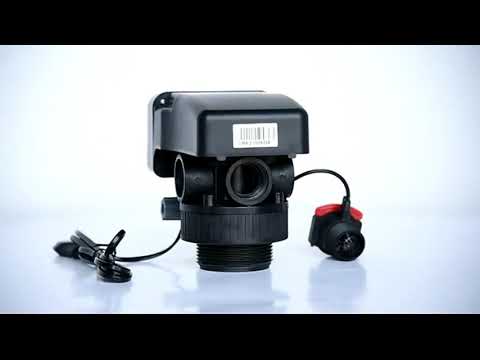
Shanghai ChiMay approaches the intake application-first — not a catalogue, an application playbook for your industry. Online turbidity and multi-parameter analyzers watch each station of the train, and downstream of filtration the softening-and-filtration control valve closes the loop between filtered water and protected plant: ion exchange and particle capture in a single body.
A train instrumented end to end tells you which stage is loading, which stage is passing material through, and which maintenance call actually protects the emitters, the membranes and the analyzers behind them.
References
- IrriNex — “Drip Irrigation Filtration: How to Choose Screen, Disc, and Media Filters” — Technology comparison of screen, disc, and sand media filters; 5–10× organic holding capacity of media beds over mesh; 3D depth-capture mechanisms. https://irrinex.com/en/blog/drip-irrigation-filtration-guide
- Kansas State University, Western Kansas Research-Extension Centers — “Filtration and Maintenance Considerations for SDI Systems” — Particle-size table (sand/silt/clay), media loading limit of ~25–28 gpm/ft², reduced loading above 100 ppm suspended solids, and ~10 psi backwash trigger. https://www.wkrec.org/programs/irrigation_engineering/subsurface_drip/reports/maintaining-the-sdi-system2.html
- Eastern States Extension (via Irrigation Toolbox) — “Filtration, Treatment, and Maintenance Considerations for Micro-Irrigation Systems” — Media-size-to-mesh equivalence table (No. 20 silica ≈ 200–230 mesh), automatic backflush practice, and the downstream guard filter against media carryover. https://irrigationtoolbox.com/ReferenceDocuments/Extension/Eastern%20States/Filtration,%20Treatment,%20and%20Maintenance%20Considerations.pdf
- AZ Growshop — “Drip Irrigation Setup and Maintenance for Small Farms” — Grade ranges by filter type (screen 60–200 mesh; disc 40–600 mesh ≈ 25–400 µm), 120 mesh ≈ 130 µm for standard drip emitters, and the 150–200 mesh extension default. https://azgrowshop.asia/pages/drip-irrigation-setup
- Graver Technologies — “QMA Series Filter Cartridges” (datasheet) — Absolute-rated pleated polypropylene: 0.2 µm rating at Beta 5000 (99.9%+), up to ~7 ft² media area per element, and maximum differential pressure of 75 psid at 70 °F. https://cdn.prod.website-files.com/605bb73f62e039589786b760/61d4886f509f62eaccd8fe7d_QMA-10.21.pdf
- Revista Cultivar — “Irrigation system increases agricultural productivity” — Hydrocyclone required ahead of the train above ~2 ppm sand; settling above ~100 ppm solids; final screen/disc grade generally 140–200 mesh per emitter model. https://revistacultivar.com/artigos/sistema-de-irrigacao-eleva-a-produtividade-agricola
About the author: Written by the Shanghai ChiMay Technical Editorial Team — the engineers behind Shanghai ChiMay’s online turbidity and multi-parameter water quality analyzers and its softening-and-filtration control valves for irrigation and industrial intakes.