Membrane procurement goes wrong in a consistent way: the specification is written around membrane type and price, and the operating conditions that determine whether the membranes last are treated as an afterthought. This guide sets out what to specify, what to test before you commit, and how to compare offers on total cost rather than capital cost.
Table of Contents
The Four Technologies, and What They Actually Do
- Microfiltration (MF) — nominal pore size roughly 0.1–10 µm. Removes suspended solids, bacteria and protozoa. Used as pretreatment and for solids separation.
- Ultrafiltration (UF) — roughly 0.01–0.1 µm. Removes viruses, colloids and high-molecular-weight organics. The usual pretreatment for RO on difficult waters.
- Nanofiltration (NF) — rejects multivalent ions and organics above roughly 200–300 daltons while passing much of the monovalent content. Used where partial softening or selective separation is wanted, including in some pharmaceutical and food streams.
- Reverse osmosis (RO) — rejects dissolved salts, and organics above roughly 200 daltons. The tightest of the four, and the one whose feed quality most needs protecting.
The boundaries overlap in practice; what matters for procurement is the separation target, not the label. A specification that says “UF, 0.03 µm” without stating what has to be removed and to what level leaves the vendor to choose the performance that suits them.
Start with the Feed, Not the Membrane
Influent characterisation is the foundation of the specification, and it is where most disputes originate. A programme that captures seasonal variation, not a single campaign, is what protects both parties.
What the characterisation should establish:
- Suspended solids concentration, particle size distribution and variability
- Turbidity range, including storm or upset conditions
- Oil and grease, if any, and how it behaves under pH change
- TOC/DOC, and the fraction likely to foul
- Scaling ions: calcium, barium, strontium, silica, phosphate, plus alkalinity and pH
- Temperature range, including CIP conditions
- COD/BOD where biological fouling is expected
- The cleaning chemicals the plant is willing to handle (this constrains membrane chemistry more often than buyers expect)
Tip: ask for the characterisation in units and detection limits that the membrane warranty refers to. A scaling calculation done with a different analytical method is not evidence in a warranty claim.
Sector-Specific Considerations
Petrochemical and refinery. Hydrocarbons, phenols and ammonia. Oil rejection and chemical resistance are the deciding properties, and the specification should state the hydrocarbons present, their concentration and how the stream is pretreated (API separator, DAF, or biological stage). pH tolerance has to cover both operation and cleaning — a membrane rated for pH 2 during operation is not necessarily rated for the pH of the CIP cycle being proposed.
Food and beverage. High organic load, temperature variation, and frequent cleaning with food-contact-approved chemicals. Ask for the regulatory status of the membrane materials under the applicable food-contact framework, and confirm the maximum continuous and CIP temperatures rather than relying on a general “high temperature” claim.
Pharmaceutical. Purified water and water for injection service is specified by conductivity and resistivity against the pharmacopoeial requirements (for example 18.2 MΩ·cm at 25 °C for purified water in continuous mode, per USP <645>), plus validation documentation, material certification and audit trails. Where the system feed water comes from a membrane train, the membrane’s extractables and cleaning residues become part of that documentation.
Municipal and general industrial reuse. The driver is usually a discharge permit plus a reuse specification. Specify the required permeate quality under worst-case feed, not average feed.
Specification Parameters Worth Naming
| Parameter | What to specify | How it is verified |
|---|---|---|
| Pore size / MWCO | Nominal and absolute, plus the test method | Bubble point or challenge test |
| Integrity | Bubble point, pressure decay or marker test method and acceptance limit | On-site integrity test |
| Burst / pressure rating | Maximum transmembrane and backwash pressure | Manufacturer test certificate |
| pH range | Separate operating and cleaning ranges | Accelerated ageing data |
| Temperature range | Continuous, peak and CIP | Manufacturer data plus pilot |
| Chemical compatibility | Compatibility with named cleaning agents | Compatibility matrix, with dilution and contact time stated |
| Materials | Membrane polymer, potting, housing, seals, and compliance documentation | Certificates |
| Warranty | Flux/retention guarantee, conditions, and what invalidates it | Contract terms |
A note on warranties: membrane performance guarantees are written against specified feed conditions. If the feed characterisation is loose, the warranty is effectively unenforceable, and the vendor is entitled to point at the feed.
Fouling: The Real Procurement Criterion
Fouling dominates operating cost in most membrane installations, and it is the reason two plants with identical membrane elements have very different operating costs. Four mechanisms to specify against:
- Particulate — solids loading and backwashable design. Define the feed turbidity or silt density index limit the system must tolerate.
- Organic — NOM, oils and greases, and the risk of adsorption. This is the mechanism most sensitive to pretreatment and cleaning strategy.
- Biofouling — biofilm formation reducing flux and increasing differential pressure. Preventive chlorination or alternative disinfection has to be compatible with the membrane chemistry, which rules out free chlorine for polyamide RO.
- Scaling — precipitation of sparingly soluble salts as concentration rises. Antiscalant selection and dosing control typically sits alongside the membrane supply, and the specification should say who owns the saturation index calculation.
What to ask vendors for on fouling:
- Documented, third-party or pilot data on fouling rates in comparable duty, not datasheet claims about surface modification
- A cleaning protocol for each expected foulant type, with the maximum cleaning frequency considered acceptable
- Hydrophilicity evidence where claimed: contact angle measurement is a reasonable way to substantiate a “low-fouling” claim, and it should come with a stated measurement method
- The concentration factor or recovery at which the guarantee applies
Total Cost of Ownership
Compare offers on lifecycle cost, with the operating assumptions stated explicitly. The structure of the comparison matters more than the numbers you put in it:
Capital: membrane modules, pressure vessels and housings, associated instrumentation and controls, installation and commissioning, and supporting systems (cleaning skid, pipework, electrical). Module price per m² varies widely with material and configuration, so normalise on installed cost for the duty, not list price.
Operating: energy consumption (highest for RO, lowest for low-pressure membrane filtration), chemical cleaning including the labour to do it, membrane replacement frequency and price, and routine maintenance. Add the cost of the downtime associated with cleaning — on many plants that is larger than the cleaning chemicals.
Replacement cycle: define what “life” means in the contract. For RO elements that is typically in the three-to-seven-year range with flux and salt passage limits; immersed and pressure-driven low-pressure membranes often run longer with individual module replacement. The replacement price agreement is frequently the most valuable clause in the contract, because nobody wants to negotiate it in year five.
Warranty terms and invalidation conditions: state them in the comparison. A cheap module with a warranty voided by the plant’s CIP regime is not cheap.
Vendor Evaluation
Technical capability: manufacturing certification (ISO 9001, ISO 14001, and food or pharmaceutical grade certification where relevant), in-house integrity and performance testing, evidence of module design work appropriate to the duty, and engineering support that includes piloting.
Application experience: reference installations in the same duty, of similar size, with contactable operators and preferably operating data they are willing to share. Ask specifically about the problems, not just the successes; a vendor who cannot describe a failure mode on a comparable site has not worked on enough of them.
Support structure: service coverage where the plant is, spare parts commitments and lead times, documentation in the language the operators use, and a route to technical escalation that does not depend on an individual salesperson.
Commercial: total cost over the warranty period, plus the replacement and service price schedule. Compare payment terms and currency exposure for long-lead items if the plant is being delivered over several years.
Instrumentation: Specify It With the Membranes
Membrane performance is only as good as the data going to its control system, and instrumentation is the item most often cut when budgets tighten. The measurements that decide whether a membrane system meets its guarantee are:
- Turbidity for particulate loading and filter breakthrough — 0–4000 NTU range covers most industrial applications, with response under about 15 seconds wanted for backwash triggering
- Conductivity for concentration factor and salt passage, up to 0–200 mS/cm for brine duties
- pH and ORP for scaling potential and dechlorination confirmation
- Residual chlorine where chlorination is used ahead of the membranes
- Dissolved oxygen where biological treatment or anoxic conditions matter
- SDI or particle counting on RO feed, as the parameter the warranty actually refers to
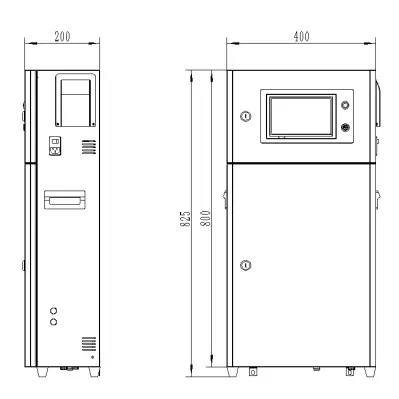
Shanghai ChiMay supplies online analysers and turbidity sensors for these duties, and the practical procurement point is to name the required measurement range, response time, cleaning regime and communication protocol in the tender — rather than accepting whatever the membrane vendor bundles in. Getting that in the specification avoids the situation where a monitoring sensor is installed at a point where it cannot see a failure developing.
Wrapping up
The procurement decision that survives a decade of operation is the one built on a proper feed characterisation, an explicit statement of the separation and fouling performance required, and a total-cost comparison that includes cleaning downtime and the replacement price schedule. Membrane technology choice matters; the specification discipline around it matters more.