Technical Deep Dive · Technical Perspective · Published: October 16, 2026
Table of Contents
Key Takeaways
- No electrochemical or optical sensor responds to exactly one species. For ion-selective electrodes (ISEs), the interfering contribution is quantified by the potentiometric selectivity coefficient in the Nikolsky-Eisenman equation [1].
- Ammonium ISEs built on the nonactin ionophore show significant interference from potassium, and selectivity coefficients are routinely evaluated by the separate solution and fixed interference methods [2].
- pH glass electrodes develop the alkaline (sodium) error above roughly pH 10, where sodium ions begin to occupy membrane sites and the reading is biased low; in 1 M NaOH a high-pH electrode may read around pH 13.7 instead of 14 [3][4].
- Colorimetric methods such as DPD chlorine testing are interfered with by sample color, turbidity and metals such as manganese, which is why sample blanking and filtration are built into the standard procedures [5].
- Optical dissolved oxygen sensors show no cross-sensitivity to H₂S, CO₂ or SO₂ on the luminescence principle, but organic solvents such as acetone, toluene and chloroform can attack the sensor cap [6].
- Cross-sensitivity is managed by three levers: sample preparation, instrument compensation, and method selection — in that order of reliability.
What Cross-Sensitivity Actually Is
A sensor’s selectivity is a ratio, not a switch. An ion-selective electrode responds primarily to its target ion, but structurally similar ions also interact with the membrane and contribute to the measured potential. The IUPAC definition is explicit: the Nikolsky-Eisenman equation extends the Nernst response with a summation term in which each interfering ion’s activity is weighted by a potentiometric selectivity coefficient, K pot [1]. The smaller that coefficient, the better the electrode discriminates. The larger the interfering activity, the more even a small coefficient matters.
Two practical consequences follow. First, interference is concentration-dependent: a “selective” electrode in a dilute sample can be badly biased in a concentrated one. Second, interference is temperature- and matrix-dependent, which is why a calibration that looks perfect in standard solutions can drift in process water. Cross-sensitivity is not a defect to be surprised by; it is a predictable, calculable property of the measurement chain.
Electrochemical Sensors: Where the Numbers Go Wrong
Ion-selective electrodes
The classical example is the ammonium electrode. The widely used nonactin ionophore is documented to interfere significantly with potassium, and manufacturers characterise the effect with selectivity coefficients measured by the separate solution method (SSM) and the fixed interference method (FIM) [2]. In practice, a sample with high and variable potassium — aeration basins, industrial effluent, some groundwaters — will read as elevated ammonium unless the interference is corrected or the method is changed.
Sodium, calcium and magnesium contribute as well, which is why standard ISE protocols use ionic strength adjustment buffers: they fix the activity coefficient so the calibration curve and the sample matrix behave the same way. Soaking and conditioning rules exist because absorbed interfering ions can persist on the glass or membrane surface and produce memory effects after a high-concentration exposure [1][2].
pH glass electrodes: sodium error and acid error
The pH glass membrane is highly selective for hydrogen ions, but not perfectly so. Above roughly pH 10 — where hydrogen activity is very low and sodium activity is high — sodium ions partially replace hydrogen in the hydrated gel layer of the glass and contribute to the boundary potential. The result is the alkaline or sodium error: the meter reads lower than the true pH [3]. A manufacturer FAQ puts concrete numbers on the effect: at very high pH the electrode responds slightly to Na⁺, and a high-pH electrode will read 1 M NaOH (pH 14) as roughly pH 13.7, because sodium is about ten orders of magnitude more concentrated than hydrogen in that solution [4].
Temperature aggravates it. Sodium error grows as the process warms, and no glass formulation has zero sodium error [3][4]. The mirror-image problem occurs at the acid end, where the response curve bends and the reading trends high. Neither error is removed by calibration alone; they are managed by glass selection, by limiting the measurement range, and by documenting the expected bias.
Dissolved oxygen: electrochemical versus optical
Membrane electrochemical (Clark-type) oxygen sensors are famously vulnerable to sulfide: hydrogen sulfide can poison the cathode and attack the membrane, producing drift and eventual loss of response in sulfide-rich waters. Luminescent optical sensors measure oxygen by the quenching of a fluorescent dye and consume no oxygen at the sensing surface. A published sensor datasheet states the practical result directly: no cross-sensitivity to pH 1-14, CO₂, H₂S or SO₂, and no flow requirement [6]. The same datasheet lists the optical technology’s real vulnerability — organic solvents such as acetone, toluene and chloroform can swell or damage the sensor cap, so the cap is a consumable in solvent-bearing streams [6].
Optical and Colorimetric Methods: Light Has Enemies Too
Colorimetric determinations convert chemistry into absorbance, which means anything that scatters or absorbs light at the measuring wavelength competes with the signal. Regulatory test guidance for drinking water states the problem plainly: highly colored or turbid samples can mask a color change at the endpoint, and chlorine itself can interfere with some indicators [5]. For residual chlorine by DPD, the standard remedy is a sample blank — zeroing the photometer on the sample before reagent addition — plus filtration where particulate matter is heavy.
The failure mode is worth naming because it is systematic, not random. Turbidity and sample color bias a colorimetric reading in one direction (upward absorbance) and can be corrected with a blank. Chemical interferents such as manganese or high oxidant levels bias the reaction itself and cannot. When an operator reports “implausible” colorimetric numbers, the first questions are about sample handling and blanking, not about the instrument.
| Sensor / principle | Typical interferent | What it looks like | Standard countermeasure |
|---|---|---|---|
| Ammonium ISE (nonactin membrane) | Potassium, then Na⁺/Ca²⁺/Mg²⁺ | Positive bias, worse as K⁺ rises [2] | Ionic strength adjustment, interference correction, method change |
| pH glass electrode | Na⁺ at high pH | Reading biased low above ~pH 10 [3][4] | Low-sodium-error glass, range limits, documented bias |
| pH glass electrode | Strong acid media | Reading biased high at the acid end [3] | Acid-range glass, shortened response time |
| Colorimetric (DPD) | Turbidity, sample color, manganese | Endpoint masking, elevated absorbance [5] | Sample blank, filtration, alternate method |
| Optical (luminescent) DO | Organic solvents | Cap swelling, signal loss [6] | Cap replacement schedule, isolation from solvent carryover |
| Optical (luminescent) DO | H₂S, CO₂, SO₂ | No cross-sensitivity on the luminescence principle [6] | None required |
| Membrane electrochemical DO | H₂S | Cathode poisoning, drift, loss of response | Frequent maintenance, or change to optical principle |
Three Levers: Preparation, Compensation, Method Choice
1. Sample preparation first. Filtration removes particulates that scatter light; dilution brings interferents below their effect threshold; conditioning and ionic strength buffers equalise calibration and sample matrices. A measurement problem fixed at the sampling point costs a filter. The same problem fixed in software costs an argument about data quality.
2. Compensation second. Manufacturers publish selectivity coefficients so that interference terms can be computed from the Nikolsky-Eisenman relationship [1], and modern transmitters apply sodium, temperature and blank corrections automatically. Compensation is legitimate engineering — but it extrapolates from characterised behaviour, so it should be validated against a grab sample when the matrix changes.
3. Method choice last. If potassium runs high, an ammonia ion-selective method may need to give way to a distillation or gas-sensing approach. If the stream is heavily colored, colorimetry gives way to an electrode or an ion-chromatographic method. If sulfide is present continuously, an optical dissolved oxygen principle removes a maintenance class entirely [6]. Choosing the method for the matrix is cheaper than fighting the matrix with the wrong method.
What This Means for Multi-Parameter Installations
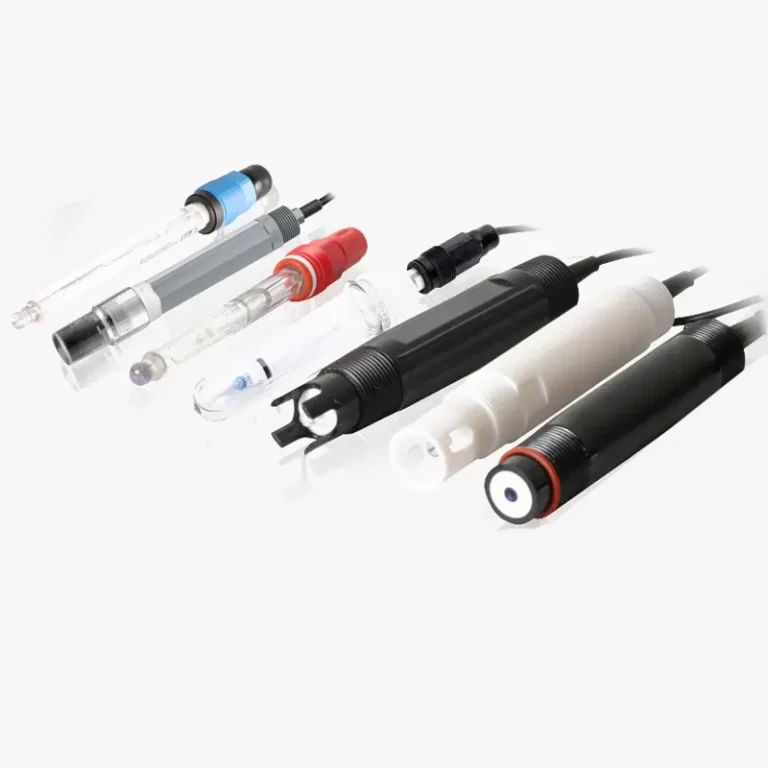
Most plants do not fight these battles one sensor at a time. They deploy combined measurement — pH, conductivity, ORP and temperature in one probe body — and manage the whole chain as a single instrumented point. The design benefit is not only mechanical: when four parameters are sampled at one location with one calibration event, the cross-checks between them become free. A sodium error shows up as a pH deviation that conductivity and temperature context can confirm; a colorimetric interference event shows up as an outlier against the electrode trend.
This is the philosophy behind the Shanghai ChiMay multi-parameter water quality sensing line: synchronized multi-parameter data streams, digital Modbus output, and calibration documentation packaged for audit. Four parameters. One probe. Zero alignment error. And because the data stream is digitised at the probe, the same readings that drive the operator’s dashboard can feed an analytics platform directly — sensors that feed your AI water model, not just your dashboard.
Practical Checklist for Specifying Around Interference
- List the credible interferents in the sample matrix before listing the parameters to measure.
- Check the manufacturer’s selectivity coefficients and cross-sensitivity tables against those interferents [1][2][6].
- Define sample conditioning (filtration, blanking, buffering) in the installation scope, not as an afterthought [5].
- Set the expected bias and its direction in the calibration records — a documented systematic error is manageable; an undocumented one is not [3][4].
- Specify the fallback method for the worst-case matrix, and the trigger point for switching to it.
References
- IUPAC Gold Book — “Nikolsky-Eisenman equation”: definition of the potentiometric selectivity coefficient and interfering-ion terms. https://goldbook.iupac.org/terms/view/09120
- MDPI Chemosensors (2021) — “Fabrication of an All-Solid-State Ammonium Paper Electrode Using a Graphite-Polyvinyl Butyral Transducer Layer”: nonactin ammonium ionophore, potassium interference, SSM/FIM evaluation of selectivity coefficients. https://www.mdpi.com/2227-9040/9/12/333
- pH Measurement Guide (instrument maker technical guide): alkaline/sodium error mechanism above pH 10 and the role of lithium glass formulations. https://www.chayon.co.kr/wp-content/uploads/2022/11/pH-Measurement-Guide
- MANTECH FAQ — pH electrode behavior at high pH: 1 M NaOH reading approximately pH 13.7 on a high-pH electrode. https://mantech-inc.com/resources/faq/
- Alaska DEC — “Testing Your Drinking Water, Chapter 10”: color and turbidity interference in colorimetric endpoints and DPD free-chlorine procedure. https://dec.alaska.gov/media/11467/chapter-10-testing-your-drinking-water.pdf
- TriOS — dissolved oxygen sensor datasheet: cross-sensitivity statement for H₂S, CO₂, SO₂ and organic solvents on the luminescence principle. https://webdev.trios.de/en/do.html
Brand and organization names appearing in the references identify the sources of technical data only. Shanghai ChiMay is not affiliated with, endorsed by, or sponsored by any of the referenced organizations.
About the author: Written by the Shanghai ChiMay Technical Editorial Team — the group documenting Shanghai ChiMay’s water quality analyzer line, covering electrode interference management, calibration practice and multi-parameter monitoring design.