Comparison analysis · Procurement perspective · Published: November 6, 2026
Table of Contents
Key Takeaways
- Both are granular-media filters. The difference is the driver: gravity filters are open basins working at atmospheric pressure, pressure filters are closed steel vessels pushed by pump pressure [1][2].
- Filtration rate is the headline number. Rapid gravity filters typically run 5–7.5 m/h with conventional sand and 7.5–12.5 m/h with uniform sand [3]; pressure filters can be operated at 15–30 m/h [2].
- Performance targets are shared: filtrate turbidity of 1 NTU or less, runs normally not less than 24 hours, terminal head loss not exceeding 2 m, wash water not exceeding 2% of the volume filtered [4].
- Backwash is where the two diverge most. Expect 36–48 m³/m²/hr for 5–10 minutes to fluidise the bed, with head loss running from roughly 0.3 m clean to about 2.5 m at the end of a run [5].
- Gravity wins on visibility, inspection and large municipal flow. Pressure wins on footprint, single-stage pumping, and remote or automated sites [1][2].
- We publish the numbers other suppliers make you ask for. Whatever housing you select, demand filtration-rate, backwash and monitoring data before you compare prices.
The Same Media, Two Different Drivers
Start with the definition, because most confusion in filtration procurement comes from mixing up the media with the vessel.
Sand is the most used filtration medium, with an effective grain size commonly in the 0.4–1.2 mm range depending on duty. Flow can be directed downward or upward, and the water can be driven by pumping or by gravity [2].
Gravity (open) filters are open tanks, usually concrete, where water passes down through the media at atmospheric pressure. The driving force is the water column above the media plus the depth of the filter box. Downflow gravity filters are everywhere because they are easy to inspect and maintain — the operator can see the bed, the supernatant and the wash sequence with the naked eye [2].
Pressure filters are closed vessels, usually steel shells, holding beds of sand or another granular material through which water is forced under pressure [1]. Because the vessel is full and pressurised, the filter can sit anywhere in the hydraulic gradient — after a pump, before a tank — and the effluent often continues to the point of use without a second pumping stage. Industry guidance notes that pressure filters suit a high degree of automation, remotely situated plants with only occasional attendance, and systems where a single pumping stage between inlet and distribution is desirable [1].
That last sentence is the procurement thesis of this whole comparison. The choice is rarely about removal efficiency — both designs make clear water when run properly. It is about hydraulics, footprint, staffing and cost of ownership.
Driving Head and Energy
A gravity filter uses no pumping energy of its own, but it demands elevation or freeboard. The water level above the media is the working head, and as the bed clogs that level rises until it reaches the terminal value that triggers a wash. On flat sites, getting enough static head means deep basins, elevated inlet channels, or accepting short filter runs.
Head loss is a managed quantity. A clean bed may cost well under half a metre, while the accepted terminal point sits around 2.5 m in field practice [5]; classical design standards cap terminal loss at 2 m with runs of at least 24 hours [4].
A pressure filter trades that civil head for pump head. The vessel tolerates the full discharge pressure of the supply pump, so the filter can be inserted directly into a distribution main or a process line. The energy cost is embedded in the system pump curve instead of a dedicated filter-pump station. For industrial skids — cooling-tower make-up, RO pretreatment, well-water iron removal — that single-stage hydraulic path usually settles the argument [1].
Footprint and Civil Works
The open gravity filter is a civil-works product: rectangular concrete cells, wash troughs, underdrains, valve galleries, and the real estate to match.
That is not a defect at municipal scale. Open cells are cheap per square metre, and multiple cells in series allow continuous production while one unit washes. On a constrained industrial site, though, the concrete version gets hard to justify.
A pressure filter is a factory-built steel cylinder: smaller plan area, shop-tested, delivered as a skid, installable in days rather than months.
The same media logic that keeps municipal plants on gravity basins also keeps compact plants, emergency treatment kits and industrialised settings on pressure vessels, which can allow longer filter runs and compress the whole treatment train into transportable equipment [2].
Operating Monitoring: Level, Head Loss, Turbidity
Whichever vessel you buy, the monitoring philosophy is identical. Watch the bed’s hydraulic state and the water quality it produces.
- Water level / differential pressure. On a gravity filter the supervisor watches basin level and head loss; on a pressure filter the same information arrives as differential pressure across the vessel. Rising loss at steady flow means the bed is loading.
- Effluent turbidity. The classical standard for rapid filters calls for filtrate turbidity of 1 NTU or less, runs of not less than 24 hours, head loss not exceeding 2 m, and wash water not exceeding 2% of the quantity filtered between washes [4]. An online turbidity meter on each cell or vessel turns those standards into alarms someone can act on between shifts.
- Run length trend. A shortening run at constant feed quality is the earliest signal of media mudballing, underdrain damage, or a backwash that has stopped cleaning the bed.
A procurement note worth carrying into the specification: specify the analyzer, not just the vessel. Turbidity instruments with digital RS-485 communication, automatic cleaning support and stable low-range performance cost little relative to the vessel they protect, and they are what make a 1-NTU commitment auditable rather than aspirational.
Backwash: Where the Designs Diverge Most
Backwashing reverses flow at a rate well above service flow to expand and fluidise the bed, releasing trapped solids into the wash water [2].
The numbers are similar in both designs. A backwash intensity of 36–48 m³/m²/hr held for 5–10 minutes, supported where necessary by surface wash or air scour, brings head loss back from terminal toward its clean value of roughly 0.3 m [5].
The difference is where the water comes from and what routes it.
- Gravity filters need a dedicated backwash pump or an elevated clear-water tank, plus multi-port sequencing of troughs, drains and valves. The sequence is a civil-and-valve design problem.
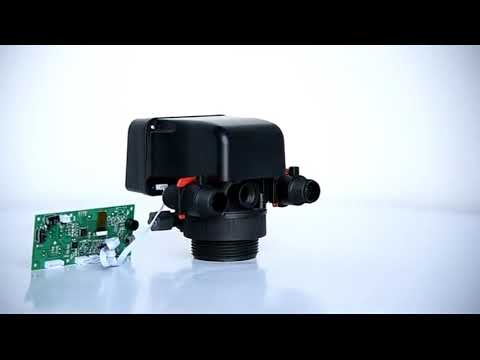
- Pressure filters can sometimes use remaining system pressure or a compact backwash pump on the same skid, with the valve train mounted on the vessel. On small industrial units, a single multiport-style control valve on top of the vessel cycles service, backwash and rinse automatically — which is why softening and filtration control valves, with published Cv, service and backwash flow ratings and adjustable cycle structures, are the real purchasing decision on this class of equipment. Ion exchange and particle capture in a single body extends the same logic to combined softening-filtration duty.
Either way, backwash water is not free. The 2% wash-water ceiling cited above [4] is a useful contract number to hold your equipment vendor to.
Application Scenarios: A Side-by-Side Summary
| Dimension | Gravity (open) filter | Pressure filter | Where each fits |
|---|---|---|---|
| Vessel | Open concrete/steel basin at atmospheric pressure [2] | Closed steel shell, full of water under pressure [1] | Gravity: municipal works with civil budget; Pressure: industrial skids, wells, retrofits |
| Driving head | Static water column above media | Pump/system pressure | Flat sites with space choose gravity; pressurised networks choose pressure |
| Typical filtration rate | 5–7.5 m/h conventional sand; 7.5–12.5 m/h uniform sand [3] | 15–30 m/h [2] | Higher rates shrink pressure vessels for the same flow |
| Visibility | Bed and wash visible for direct inspection [2] | Vessel must be opened | Remote or unstaffed sites favour pressure with instrumentation |
| Monitoring | Basin level, head loss, effluent turbidity | Differential pressure, effluent turbidity | Identical instruments, different housing |
| Backwash | Dedicated pump or elevated tank; trough sequencing | Skid pump or system pressure; valve-automated | Small plants minimise civil works with pressure |
| Footprint | Large rectangular cells, multiple units in parallel | Compact cylinders, shop-fabricated | Tight sites favour pressure |
| Energy | No filter pumping, but deep basins/elevation needed | Pump energy, single-stage pumping possible [1] | Compare whole-train pumping, not the filter alone |
| Typical duty | Large municipal rapid filtration ahead of disinfection | RO pretreatment, iron/manganese removal, process water, emergency kits [2] | Match to staffing level and automation ambition |
A Procurement Checklist Before You Commit
- Fix the hydraulic profile first. Plot available head, discharge pressure and the elevation of every tank. The filter type usually falls out of that drawing rather than out of a catalogue.
- Compare rates on equal area. A 15–30 m/h pressure rating [2] only helps if the media, underdrain and backwash system are designed for that rate.
- Demand the backwash triangle. Published service rate, backwash rate and wash-water percentage — and hold the vendor to the ≤2% wash-water standard [4].
- Instrument the effluent. Online turbidity on every cell or vessel, with RS-485/Modbus output into SCADA, converts a 1-NTU promise into a continuous record.
- Ask for the automation story. If the plant runs unattended at night, pressure filtration with automated valve cycling usually beats gravity cells that expect an operator’s eyes.
Shanghai ChiMay builds both the control valves that automate softening and filtration duty and the online water quality analyzers — including online turbidity testers — that verify filter performance around the clock. The product pages list hydraulic and communication specifications openly, so your comparison starts with data instead of phone calls.
References
- World Health Organization — “Slow Sand Filtration” (monograph). Defines the two families of filters (pressure vs gravity), describes pressure filters as closed steel vessels forced under pressure, and their suitability for automated, remote, single-stage-pumping installations. https://apps.who.int/iris/bitstream/handle/10665/38974/9241540370.pdf
- Emergency WASH Knowledge Portal — “Rapid Sand Filtration” (compendium sheet). Sand effective size 0.4–1.2 mm, flow by pumping or gravity, pressure filters operated at 15–30 m/h, gravity filters open to atmosphere, and pressure filters enabling longer runs in industrialized and emergency settings. https://www.emergency-wash.org/water/files/pdf/compendium/en-GB/t2.pdf
- SamSamWater Foundation — “Rapid filtration” (Technical Paper series, TP40 ch. 17). Indicative design ranges for rapid filtration: filtration rate 5–7.5 m/h for downflow conventional sand and 7.5–12.5 m/h for uniform sand, bed thickness 0.6–0.8 m / 0.8–1.2 m, supernatant depth 0.6–2.0 m. https://www.samsamwater.com/library/TP40_17_Rapid_filtration.pdf
- Engineering Notes — “Classification of Filters Used for Purification of Water.” Recommended performance standards for rapid gravity filters: filtrate turbidity 1 NTU or less, filter runs not less than 24 hours, head loss not exceeding 2 m, wash water not exceeding 2% of filtered volume; pressure filters described as closed steel cylindrical tanks. https://www.engineeringenotes.com/water-engineering-2/water-purification/classification-of-filters-used-for-purification-of-water-water-engineering/44214
- Skill-Lync Resources — “What are the design criteria for a rapid sand filter?” Design values: 4–6 m³/m²/hr service operation, sand effective size 0.45–0.7 mm, head loss from 0.3 m clean to 2.5 m terminal, backwash at 36–48 m³/m²/hr for 5–10 minutes, multiple units for continuous operation. https://resources.skill-lync.com/branches/civil-engineering/questions/environmental/rapid-sand-filter-design
- Shanghai ChiMay — online turbidity tester product page (verified November 2026): 90°/180° optical measurement principle and RS-485 digital communication for online turbidity monitoring in water and wastewater treatment. http://chimaytech.com/product%20page/WNTU1800.html
About the author: Written by the Shanghai ChiMay Technical Editorial Team — the editorial group behind Shanghai ChiMay’s control valve and water quality analyzer lines, covering softening and filtration control, backwash automation, and online turbidity and conductivity monitoring for municipal and industrial treatment trains.