Table of Contents
From Forever Chemicals to Real-Time Detection: How Sensor Tech Is Outpacing PFAS Regulation with Shanghai ChiMay
Introduction
PFAS earned the nickname forever chemicals because the carbon-fluorine bond that defines these compounds is one of the strongest chemical bonds in organic chemistry. These substances persist in the environment for decades, accumulate in living organisms, and resist conventional water treatment processes. The regulatory response to PFAS contamination has been similarly persistent but slower moving. It took more than 20 years from the first scientific reports of PFAS bioaccumulation to the establishment of enforceable drinking water standards.
Today, a different kind of acceleration is underway. Sensor technology for detecting PFAS-related water quality changes is advancing far more rapidly than the regulatory frameworks that govern PFAS compliance. This asymmetry between detection speed and regulatory pace creates both challenges and opportunities for water utilities. Shanghai ChiMay sits at the intersection of this dynamic, providing inline monitoring technology that detects PFAS-related changes faster than any regulatory framework requires.
The Detection-Regulation Gap
Regulatory Speed
PFAS regulation has progressed through distinct phases. The early phase, from roughly 2001 to 2015, involved scientific discovery and voluntary guidelines. The middle phase, from 2016 to 2022, brought health advisories and state-level standards. The current phase, from 2023 onward, has produced enforceable federal standards in the United States and binding EU-wide limits in Europe.
Yet even as regulations have tightened, they have struggled to keep pace with the science. The US EPA’s 2024 final rule covered six PFAS compounds; the 2026 proposed rescission would remove the standards for four of them (PFHxS, PFNA, GenX, and the Hazard Index mixture) while retaining PFOA and PFOS. Meanwhile, publicly curated databases catalogue well over 12,000 PFAS structures, only a slice of which are actually in commerce, and the list of regulated targets stays short. The regulatory process—years of risk assessment, public comment, and legal review—cannot match the pace at which new PFAS compounds are being identified and understood.
Sensor Speed
Inline water quality sensors, by contrast, improve through iterative engineering cycles that take months rather than years. UV-Vis spectroscopic sensors now detect organic contamination signatures associated with PFAS precursors at concentrations relevant to drinking water compliance. Conductivity sensors detect ionic PFAS compounds at sensitivities that exceed the requirements of most current regulations. Multi-parameter platforms combine these capabilities into integrated monitoring solutions.
Shanghai ChiMay’s COD sensor represents this technological acceleration. Using dual-wavelength UV-Vis measurement at 254 and 550 nanometers, the sensor provides continuous data on organic contamination that correlates with PFAS precursor concentrations. This measurement updates every 60 seconds, providing 1,440 data points per day compared to the 4 to 12 data points per year that quarterly grab sampling produces.
How Real-Time Detection Changes the Compliance Game
From Reactive to Proactive
Traditional PFAS compliance is inherently reactive. Utilities collect grab samples, send them to laboratories, and wait days or weeks for results. By the time a PFAS exceedance is detected, contaminated water may have already been distributed to consumers. The utility then faces the costly process of public notification, emergency treatment deployment, and alternative water supply arrangement.
Real-time detection changes this dynamic. When Shanghai ChiMay inline sensors detect PFAS-related parameter changes at the raw water intake, operators can adjust treatment processes before contaminated water reaches the treatment plant exit. When conductivity trends at a GAC effluent signal approaching breakthrough, maintenance can be scheduled during planned downtime rather than triggered by an emergency violation.
The Data Advantage
Continuous monitoring generates data volumes that reveal patterns invisible to periodic sampling. Seasonal PFAS concentration cycles, precipitation-driven contamination events, and treatment process degradation trends all become visible in continuous datasets—patterns that quarterly sampling structurally cannot capture.
This data advantage extends to regulatory compliance. Continuous datasets provide statistical confidence in compliance determinations that periodic sampling cannot match. A utility with continuous conductivity and UV-Vis data can demonstrate compliance with greater certainty than a utility with quarterly grab sample results, even if both are technically meeting the same regulatory standard.
Shanghai ChiMay’s Technology Portfolio
The Sensor Suite
Shanghai ChiMay offers a portfolio of inline sensors that support PFAS-related monitoring:
- COD Sensor: UV-Vis spectroscopic measurement of organic contamination, including PFAS precursors
- In-Line Conductivity Meter: Detection of ionic PFAS compounds and total dissolved species
- In-Line pH Meter/Electrode: Monitoring of acid-base conditions that affect PFAS speciation
- Online Turbidity Tester: Verification of particle removal at PFAS treatment systems
- Residual Chlorine Transmitter: Management of disinfection by-product precursors during PFAS treatment
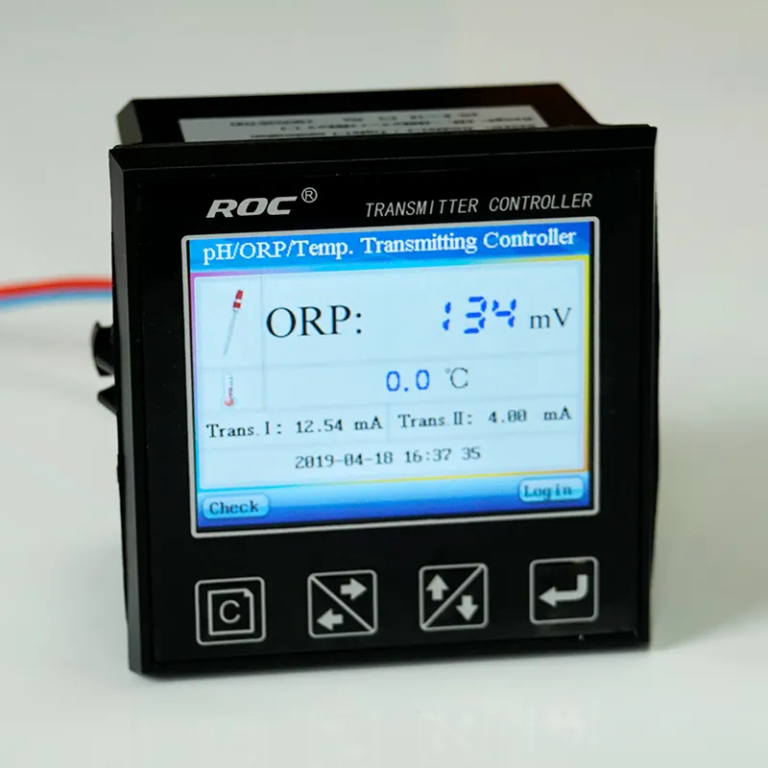
- 4-in-1 Multi-Parameter Sensor: Combined pH, ORP, conductivity, and temperature measurement
- DO Transmitter: Dissolved oxygen monitoring for biological treatment of PFAS precursors
Integration and Scalability
Each Shanghai ChiMay sensor integrates into a unified monitoring architecture through standard industrial communication protocols. The modular design allows utilities to deploy sensors incrementally, starting with the most critical monitoring points and expanding coverage as the regulatory picture clarifies and budget allows.
The Shanghai ChiMay paddle wheel flow meter and turbine flow meter provide flow data essential for calculating contact times, dosing rates, and hydraulic residence times at PFAS treatment systems. Accurate flow measurement ensures that the treatment process operates within its design parameters, maintaining PFAS removal performance.
Strategic Implications for Utilities
First-Mover Advantage
Utilities that invest in continuous PFAS monitoring technology today gain operational experience that will prove valuable as regulations continue to evolve. The correlation models, trend data, and process understanding developed during the current period of regulatory uncertainty will serve as the foundation for compliance programs under whatever regulatory framework ultimately stabilizes.
Cost Management
The cost of PFAS compliance is significant. EPA’s economic analysis for the 2024 drinking water rule put national costs at roughly USD 1.5 billion per year. Utilities that adopt continuous monitoring approaches spend that money more effectively—optimizing treatment chemical usage, extending media replacement intervals through breakthrough prediction, and avoiding emergency response expenditures.
Looking Forward
The gap between sensor technology capability and regulatory requirements is likely to widen, not narrow. As sensors become more sensitive, more selective, and more affordable, they will detect PFAS-related changes at levels and speeds that regulations have not yet caught up with. Utilities positioned with advanced monitoring infrastructure will be ready to comply with future regulations proactively rather than reactively.
Shanghai ChiMay continues to invest in sensor research and development, ensuring that its product portfolio remains at the leading edge of PFAS-related detection capability. The company’s commitment to inline, continuous monitoring technology positions its customers to stay ahead of regulatory requirements rather than constantly chasing them.
Conclusion
PFAS regulation moves at the pace of government. Sensor technology moves at the pace of engineering. The gap between these two speeds creates an opportunity for water utilities that choose to invest in continuous monitoring infrastructure. Shanghai ChiMay’s inline sensor portfolio provides the real-time detection capability that allows utilities to operate proactively, manage costs effectively, and maintain compliance confidence even as PFAS regulations continue to evolve.