Concept explainer · Technical perspective · Published: October 12, 2026
Few parameters in water treatment are quoted as loosely as chlorine. Operators say “the chlorine is fine,” permits list “total residual chlorine,” pool test strips show three separate lines, and an online transmitter reports one number that may or may not be the one the reader assumes. Behind the casual language sit three distinct measurement categories — free chlorine, combined chlorine, and total chlorine — describing pools of chlorine chemistry, not three different elements [1]. Confusing them is not a vocabulary problem. It changes dosing decisions, compliance reporting, and ultimately whether disinfection is actually working. This article untangles the trio, explains why each fraction matters for health, comfort, and process, and shows how instruments separate them.
Table of Contents
Key Takeaways
- Free chlorine is the disinfecting fraction: hypochlorous acid (HOCl) plus the hypochlorite ion (OCl⁻), with a trace of dissolved chlorine gas — the species most dosing targets are written against [1][5].
- Combined chlorine (the chloramine family) forms when free chlorine reacts with ammonia or organic nitrogen. It disinfects more slowly and more weakly than free chlorine [1].
- Total chlorine is simply free plus combined. Reporting only one of the two hides whether a residual is actively disinfecting or merely present [1].
- The US enforceable ceiling: the maximum residual disinfectant level (MRDL) is 4.0 mg/L (as Cl2) for chlorine, 4.0 mg/L for chloramines, and 0.8 mg/L for chlorine dioxide [2].
- DPD chemistry separates the trio in two readings: a first read at pH 6.2–6.5 gives free chlorine as a red-violet dye measured at 515 nm, and a second read after an iodide step gives total chlorine; combined is the difference [5][6].
- Membrane-covered amperometric sensors respond mainly to HOCl — the membrane passes gaseous HOCl and repels OCl⁻ — so free-chlorine readings depend on sound pH and temperature compensation [4].
The Three Pools of Chlorine
When chlorine gas, sodium hypochlorite, or calcium hypochlorite dissolves in water, it hydrolyses to hypochlorous acid, which partially dissociates into the hypochlorite ion [5]. The two species sit in a pH-dependent equilibrium: HOCl dominates at lower pH, OCl⁻ at higher pH [1][5]. Together they are called free chlorine — the pool of fast-acting oxidants available for immediate disinfection [1][5].
Free chlorine does not stay free for long. It reacts with ammonia and organic nitrogen in the water to form combined chlorine, a family of chloramines: monochloramine, dichloramine, trichloramine, and organic chloramines [1]. At the near-neutral pH of most drinking water, monochloramine dominates the mixture; as pH falls and chlorine concentration rises, the di- and trichloramine species become more significant. Many utilities deliberately generate monochloramine as a secondary disinfectant because it persists longer in distribution networks than free chlorine — but it remains a weaker and slower oxidant [1][3].
Total chlorine is the arithmetic sum of free and combined chlorine [1]. It answers “how much chlorine is in the water” without answering “what is that chlorine doing.” That gap is the whole point of this article.
Why Each Fraction Matters
Disinfection power
Free chlorine is the fastest and strongest disinfectant of the three pools, and it is what most chlorinated systems target as their process residual [1]. Combined chlorine retains some disinfecting capability but is weaker [1][3]. Utilities that switch to chloramine secondary disinfection do so for residual stability across long networks, not for raw kill speed.
The same logic applies in industrial service — cooling loops, food and beverage sanitation, aquaculture, and water reuse — where the fraction you control should be the fraction doing the work you need.
Taste, odour and irritation
Sensory thresholds sit well below the regulatory ceiling. Most individuals can taste chlorine and its by-products, including chloramines, at concentrations below 5 mg/L, and some people detect them at levels as low as 0.3 mg/L [3]. WHO background guidance also notes that chloramines are weaker oxidants than free chlorine and are not very effective at removing tastes and odours already present in the water [3].
For facilities whose product touches the palate — beverages, brewing, food processing — total chlorine can look acceptable on paper while the combined fractions drive the sensory complaints. Understanding the split turns “the water tastes of chlorine” from an anecdote into a diagnosable condition with a chemical address.
By-products and the compliance ceiling
Regulators cap the disinfectant residuals themselves, not just their by-products. In the United States the enforceable MRDL is 4.0 mg/L (as Cl2) for chlorine and 4.0 mg/L for chloramines, with 0.8 mg/L for chlorine dioxide [2]. The existence of an upper bound matters operationally: pushing free chlorine higher to suppress regrowth collides with the cap, which is one reason utilities turned to chloramines for long distribution systems — and why knowing the split between free and combined is not optional for compliance reporting. Which numeric limit applies to a given distribution system or discharge depends on the jurisdiction and the permit; the governing document should always be the traceable source for the value you must meet.
The Trio at a Glance
| Indicator | What it is | Why it matters | How it is typically measured |
|---|---|---|---|
| Free chlorine | HOCl + OCl⁻ (plus a trace of dissolved Cl2) [1][5] | Fast, strong disinfection; the residual most control targets are written against [1] | DPD first step: buffered at pH 6.2–6.5, red-violet dye read at 515 nm [5]; membrane amperometric cells responding mainly to HOCl [4] |
| Combined chlorine | Chloramines formed from reaction with ammonia or organic nitrogen [1] | Slower, weaker disinfectant; central to taste, odour and irritation complaints [1][3] | DPD second step after the iodide reagent; reported as total minus free [6] |
| Total chlorine | Free + combined [1] | The reporting figure on many permits and quality systems; hides speciation unless paired with a free value | Single DPD total test with the iodide-containing reagent [6]; dedicated amperometric total-chlorine cells |
How Measurement Separates the Trio
DPD colorimetry: two readings and one subtraction
The DPD (N,N-diethyl-p-phenylenediamine) method is the most established colorimetric approach for residual chlorine and is specified in many national and international standards [5]. In a buffered solution at pH 6.2 to 6.5, free chlorine oxidises DPD to a purple-red compound whose intensity, read photometrically at 515 nm, is proportional to the free chlorine concentration [5]. That is reading number one.
Reading number two adds the iodide step. Commercial reagent packs pair the free-chlorine reagents with a separate total-chlorine reagent; in the presence of iodide ions, the total reagent converts the combined fraction so that free and combined chlorine can be determined together in a single reading [6]. The difference between the two readings is, by definition, combined chlorine. The method is sensitive, rapid, and suitable for both fractions — which is why handheld colorimeters, pool kits, and online DPD analyzers all build on the same chemistry [5].
Practical caveats follow directly from the chemistry. Very high chlorine concentrations can bleach the dye. Sample colour and turbidity interfere with the optical read. DPD reagents age on the shelf. Reagent freshness and clean optics are part of the measurement, not an afterthought.
Membrane-covered amperometric sensors: measuring the right molecule
Online instruments overwhelmingly use amperometric cells: a working electrode and a counter electrode sit in an electrolyte behind a membrane [4]. The membrane does quiet chemical work. In free-chlorine cells, a hydrophobic membrane allows gaseous hypochlorous acid to diffuse through and be reduced at the electrode, while negatively charged hypochlorite ions are repelled [4]. The cell current therefore tracks HOCl — the biologically active fraction — and the instrument computes the free-chlorine value in combination with pH and temperature inputs, because the HOCl/OCl⁻ split shifts with pH [1][4].
Two practical consequences follow. A membrane free-chlorine sensor is only as good as its pH compensation; a drifting pH sensor next to a healthy chlorine cell still produces a wrong free-chlorine number. And total chlorine is not what a bare free-chlorine cell sees: measuring combined fractions amperometrically requires cells designed to convert those species upstream of the electrode. When a datasheet says “chlorine,” read which fraction the cell actually measures before you compare instruments.
Building the measurement stack
Because free chlorine rides on pH and temperature, the measurement stack matters as much as the cell itself. This is where integration earns its keep. “Four parameters. One probe. Zero alignment error.” describes the logic behind Shanghai ChiMay’s multi-parameter sensing: collocating pH, conductivity, ORP, and temperature removes the alignment and latency problems that appear when a chlorine value must be corrected against a pH sensor mounted somewhere else in the loop.
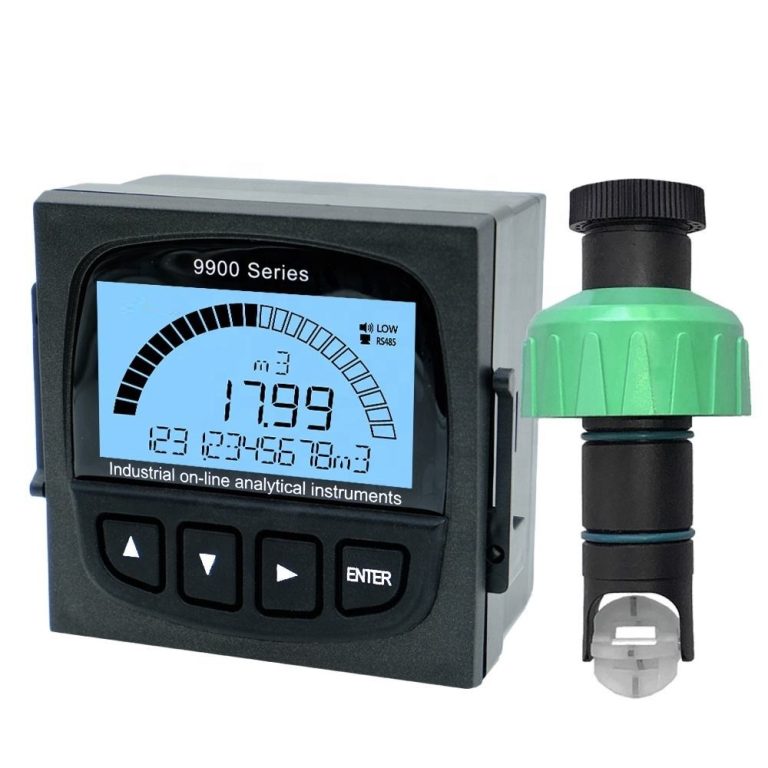
The reporting layer matters just as much — “Sensors that feed your AI water model, not just your dashboard.” Shanghai ChiMay’s residual-chlorine transmitters pair membrane amperometric cells with digital outputs so that the free-versus-total distinction survives the trip from the sample point to the control room and into the historian.
Which Fraction Should You Act On?
- Disinfection control (drinking water, process water): act on free chlorine. It is the fraction doing the killing, and it is the variable most dosing loops should hold [1].
- Chloramine systems: monitor total chlorine and, where the instrument allows, speciate further; the MRDL applies to chloramines just as it does to chlorine [2].
- Sensory-sensitive applications (beverage, food, aquaculture): track combined chlorine explicitly. Free readings alone can hide the fractions most associated with taste and odour complaints [3].
- Dechlorination and discharge permits: many permits are written against total residual chlorine. Report the fraction the permit names, and verify the permit text rather than assuming one number fits all sites.
Whichever fraction your permit or quality system names, keep the method, the calibration records, and the traceable limit in one place. Documentation you can hand to your auditor is part of the measurement, not a filing chore.
References
- Halogen Systems — “Free vs Total vs Monochloramine” technical guidance page; defines free chlorine (HOCl + OCl⁻), combined chlorine (the chloramine family) and total chlorine, with notes on their relative disinfecting strength. https://www.halogensystems.com/resources/technical-guidance/free-total-monochloramine
- eCFR — 40 CFR § 141.65, Maximum Residual Disinfectant Levels; lists MRDLs of 4.0 mg/L (as Cl2) for chlorine and for chloramines and 0.8 mg/L for chlorine dioxide. https://www.ecfr.gov/on/2026-06-03/title-40/section-141.65
- World Health Organization — “Monochloramine in Drinking-water,” background document for the WHO Guidelines for Drinking-water Quality; documents taste thresholds below 5 mg/L (some individuals 0.3 mg/L) and notes that chloramines are weaker oxidants. https://www.who.int/docs/default-source/wash-documents/wash-chemicals/chloramine-backgroundae66824ea038485bb28b2fc44ab88177.pdf
- Water Corporation (Western Australia) — Guideline for Selection of Chlorine Analysers; describes amperometric cells in which a PVDF membrane passes gaseous HOCl while repelling OCl⁻ ions. https://pw-cdn.watercorporation.com.au/-/media/WaterCorp/Documents/About-us/Suppliers-and-contractors/Resources/Design-standards/Chlorine-Analyser-Selection-Guideline.pdf
- MADSUR Sensor — “Determination of Residual Chlorine by DPD Spectrophotometry”; buffered reaction at pH 6.2–6.5, red-violet DPD compound, photometric readout at 515 nm. http://www.madsursensor.com/news/determination-of-residual-chlorine-by-dpd-spectrophotometry.html
- LaMotte — Liquid DPD Reagent Pack for the determination of free and total chlorine; separate DPD reagents for the free-chlorine reading and the iodide-based total-chlorine reading. https://lamotte.com/wp-content/uploads/2021/01/6739-g.pdf
About the author: Written by the Shanghai ChiMay Technical Editorial Team — the editorial group behind Shanghai ChiMay’s in-line water quality analyzer line, covering residual chlorine, pH, conductivity and multi-parameter sensing for municipal and industrial water applications.