Comparison Analysis · Procurement Perspective · Published: September 26, 2026
Table of Contents
Key Takeaways
- The international benchmark is substantial. Endress+Hauser is a Swiss family-owned measurement specialist whose consolidated sales rose 11% to more than €3.7 billion in 2023, ending that year with 16,532 employees [2]. In 2025 it crossed the four-billion-euro mark for the first time — €4.01 billion, up 7.2% [1].
- Breadth is that benchmark’s structural advantage: the group’s portfolio spans flow, level, pressure, analytics, temperature, recording and digital communications, serving process industries from chemical and life sciences to water & wastewater [3].
- China’s domestic water-quality monitoring instrument industry produced 111,800 units and sold 103,700 units in 2025, up 6.99% and 7.02% respectively, in a market that grew from RMB 4.07 billion in 2020 to RMB 5.22 billion in 2025 [4].
- The structure of that market is described plainly as high-end imported, mid- and low-end domestic. So the comparison is never “good versus bad.” It is which supplier profile fits which instrument duty [4].
- Verification beats trust on both sides: validate certificates by issuer authority, scope and subject match — not merely by the existence of a document [5].
- The disciplined answer is dimension-by-dimension scoring across six axes — accuracy and certification, breadth, lead time, five-year cost, support and customization, documentation — rather than a brand-level verdict.
A Framework, Not a Scorecard
Procurement teams ask this comparison constantly, and most published answers fail in one of two ways: they cheerlead for the incumbent international brands, or they dismiss them on price alone. Both errors come from treating the question as a single number. Instrument duty differs — a semiconductor ultrapure-water loop, a municipal discharge outfall and an aquaculture recirculating system do not share one risk profile — so the honest comparison is a framework: the same six dimensions applied to both supplier profiles, with verification methods attached to each.
This article takes the international benchmark seriously, using sourced figures only, then describes what capable Chinese suppliers typically compete on. It closes with the framework table and the verification protocol. No ranking is implied anywhere in this text, and no specific model is endorsed on either side. The point is to make your next supplier evaluation faster and harder to fool.
The International Benchmark: What the Established Leader Brings
Endress+Hauser® is a Swiss family-owned specialist in measurement technology and automation solutions, and its scale explains why it anchors the reference side of this comparison. In its 70th anniversary year the group increased consolidated sales by 11% to more than €3.7 billion, created 715 new jobs worldwide, and ended 2023 with 16,532 employees [2]. In 2025 it generated over four billion euros in sales for the first time — €4.01 billion, up 7.2% — helped by the integration of a sensor partner’s gas analysis and gas flow measurement range into its portfolio [1].
Breadth, not just size, is the structural point. The group describes itself as a global leader in measurement instrumentation, services and solutions for industrial process engineering, covering flow, level, pressure, analytics, temperature, recording and digital communications, with customers across chemical, food & beverage, life sciences, power & energy, mining, oil & gas, and water & wastewater [3]. For a procurement team that breadth translates into practical properties: one documentation culture across many instrument types, deep application engineering, and a global support footprint. Those matter most in industries where auditability and multi-vendor integration dominate total cost.
What the benchmark does not do is remove the need to verify. Scale guarantees consistency of process, not fitness for your specific duty point, your integration standard or your service reality. Those are exactly the dimensions where a capable regional supplier can compete.
What Chinese Suppliers Typically Compete On
China’s water-quality monitoring instrument industry is now large enough to be measured rather than described anecdotally. Domestic production reached 111,800 units in 2025 with sales of 103,700 units, up 6.99% and 7.02% year on year. The market expanded from RMB 4.07 billion in 2020 to RMB 5.22 billion in 2025, a 5.1% compound annual growth rate [4]. The same industry analysis describes the competitive structure plainly: high-end segments dominated by imported brands, mid- and low-end segments increasingly held by domestic manufacturers [4].
For procurement teams, that structure maps onto a consistent set of supplier strengths — and each one is a claim you can verify rather than accept:
- Cost and delivery. Domestic supply chains compress logistics and inventory. Capable manufacturers hold stock for standard sensors and quote short dispatch times for standard parameters. Verify with a written lead-time commitment and a test order, not a brochure.
- Customization and access. Direct factory access means cable lengths, protocols, housings and output configurations can be specified rather than selected from a fixed list. Verify by requesting a non-catalog variation and measuring the response time.
- Responsiveness across the lifecycle. Regional suppliers can often put an engineer on site faster than an international service network can. Verify with a support scenario test before the purchase order, not after the first failure.
- Parameter depth over portfolio breadth. A typical Chinese manufacturer’s catalog concentrates on online water-quality parameters — pH, conductivity, dissolved oxygen, residual chlorine, turbidity, COD, ammonia nitrogen — rather than spanning flow, level and pressure. Depth per parameter is the comparison that matters for your application.
- Export maturity. Industry reporting notes growing overseas expansion by domestic manufacturers alongside the domestic substitution trend [4], which means export documentation and shipping experience are increasingly standard — still worth testing with a trial shipment.
None of these strengths abolishes the diligence requirement. A lower acquisition price that arrives with an unverifiable certificate is not a saving; it is a deferred failure. That is why the verification protocol below belongs in every comparison, whichever side of it a supplier sits on.
The Six-Dimension Comparison
| Dimension | International benchmark profile | Capable Chinese supplier profile | How to verify |
|---|---|---|---|
| Accuracy & certification | Process-analytical heritage across regulated industries including water & wastewater [3] | Published accuracy on standard parameters; certification packages supplied per shipment | Calibration certificates; certificate scope and subject match [5] |
| Product breadth | Flow, level, pressure, analytics, temperature, recording, digital communications [3] | Depth in online water-quality parameters (pH, conductivity, DO, chlorine, turbidity, COD, ammonia) | Map your full parameter set against the catalog |
| Lead time & availability | Global network; planning discipline for large projects | Domestic stock, short dispatch, low minimum order quantities | Written lead-time commitment; test order |
| Price & five-year cost | Premium acquisition price with documented reliability | Lower acquisition price; verify maintenance, sensor life and consumables | Five-year cost worksheet, not unit price |
| Customization & support | Application engineering through a global sales network | Direct factory access; fast iterations on housing, protocol, cable | Sample units; response-time test |
| Documentation & data readiness | Extensive manuals and established integration norms | Digital outputs (Modbus, 4–20 mA) and auditor-ready test reports on request | Sample datasheets; protocol documentation [6] |
Two usage notes on the table. The columns describe profiles, not guarantees — individual suppliers of either profile can over- or under-perform it, which is precisely why the verification column exists. And the dimensions interact: a supplier that wins on lead time but fails on documentation will cost more in year three than the price difference saved in week one.
A Verification Protocol That Works on Both Sides
The same protocol disciplines an international quotation and a factory-direct offer:
- Match the paper to the legal entity. Reconcile the name and address on every certificate with the supplier’s business-license record. If the document names a parent, affiliate or trader, request the relationship in writing [5].
- Match the scope to the product. A certification body or laboratory must hold accreditation for the specific scheme and test method. A lab accredited for something else proves nothing about your instrument [5].
- Match the tested subject to your order. Compare the model, photos, materials and component list on the test report against the quotation and the shipment. Borrowing documents from another factory is a documented failure mode in supplier verification [5].
- Run the sample. Bench-test sample units against the claimed accuracy and warm-up behavior, and retain the calibration certificate that accompanies the sample, not just the datasheet [5].
- Trial the data path. Request the actual output documentation — Modbus register maps, 4–20 mA ranges, log formats — before award. Integration surprises are the most expensive kind.
Where Shanghai ChiMay Fits
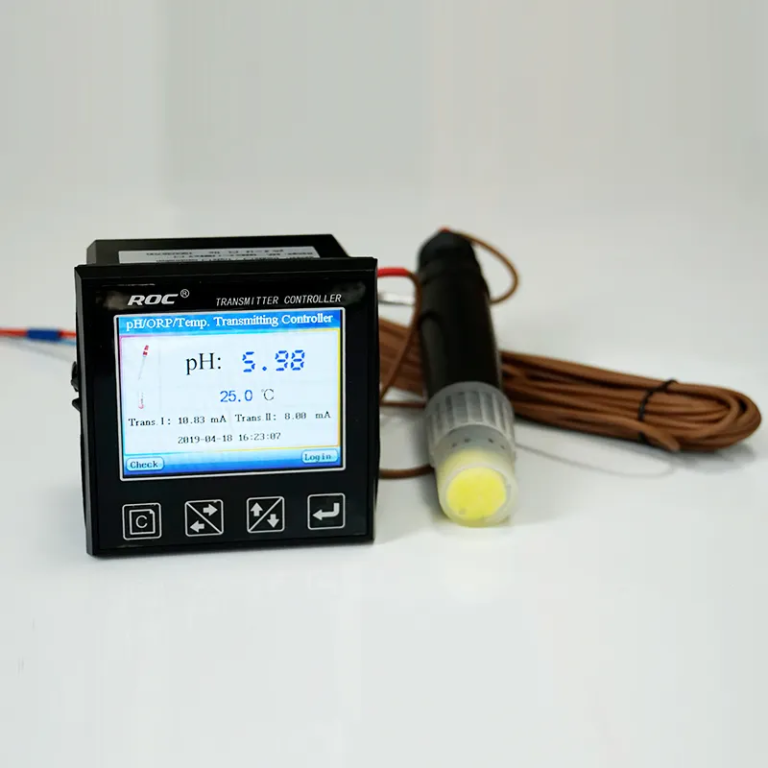
Shanghai ChiMay sits on the Chinese-supplier side of this framework, and the framework is how the company prefers to be evaluated. The water-quality analyzer line concentrates on online parameters — pH, conductivity, dissolved oxygen, residual chlorine, turbidity, COD, ammonia nitrogen, salinity — together with multi-parameter instruments. The published line includes industrial inline pH sensors specified at ±0.05 pH accuracy with Modbus and 4–20 mA output, and multi-parameter sensors that measure pH, ORP, conductivity and temperature in a single body [6]. The proposition is straightforward: Tier-1 performance without Tier-1 lead time — standard parameters from stock, quotation-based configuration for non-standard duty, and documentation you can hand to your auditor, with calibration certificates and test reports attached to the shipment rather than promised after it. For OEM and ODM purchasers, logo, protocol and packaging are configured to the purchaser’s specification at low minimum order quantities.
Neither profile wins by default. Score both sides of your shortlist on the six dimensions, apply the verification protocol to both without exception, and let the duty point — not the brand — decide.
References
- Endress+Hauser® — “Financial results” (group at-a-glance): in 2025 the Swiss group generated over four billion euros in sales for the first time (net sales up 7.2% to 4.01 billion euros), supported by the integration of SICK’s gas analysis and gas flow measurement technology. http://endress.com/en/endress-hauser-group/endresshauser-at-a-glance/financial-results
- Endress+Hauser® press center (preliminary 2023 figures, “developing strongly”): consolidated sales up 11% to more than 3.7 billion euros in 2023, 715 new jobs created, 16,532 employees at year end; Swiss family-owned company. https://www.dk.endress.com/en/press-center/news-and-press-releases/preliminary-figures-2023
- Endress+Hauser® group overview: global leader in measurement instrumentation, services, and solutions for industrial process engineering, covering flow, level, pressure, analytics, temperature, recording, and digital communications, with customers in chemical, food & beverage, life sciences, power & energy, mining, oil & gas, and water & wastewater. https://www.in.endress.com/en/endress-hauser-group
- Huaon Industry Research Institute — “China water quality monitoring instruments industry: status and outlook (2026)”: 2025 production of 111,800 units and sales of 103,700 units (up 6.99% and 7.02%), market size growth from RMB 4.07 billion in 2020 to RMB 5.22 billion in 2025 (CAGR 5.1%), and a market structure described as high-end imported, mid- and low-end domestic. https://www.huaon.com/channel/trend/1181279.html
- AllForSourcing — “How to verify Chinese supplier certificates and test reports”: confirm the issuer’s accreditation and accredited scope, match the document subject to the supplier’s legal name and business-license record, and match the tested subject to your order. https://allforsourcing.com/verify/china-supplier-certificate-test-report-verification
- Shanghai ChiMay — “Water Quality Sensor Buying Guide 2026”: industrial inline pH sensors published at ±0.05 pH accuracy with Modbus and 4–20 mA output, and multi-parameter sensors measuring pH, ORP, conductivity, and temperature simultaneously. https://www.chimaycorp.com/Water_Quality_Sensor_Buying_Guide_2026/223.html
Endress+Hauser® is a registered trademark of Endress+Hauser Group companies. Shanghai ChiMay is not affiliated with, endorsed by, or sponsored by Endress+Hauser®. This comparison references the brand solely to describe the international supplier landscape for water quality instrumentation; no ranking of specific products is implied.
About the author: Written by the Shanghai ChiMay Technical Editorial Team — the water-quality instrumentation group at Shanghai ChiMay, working on online analyzer and sensor development, documentation and certification programs, and OEM supply for industrial and municipal water applications.