Key Takeaways:
– USP <645> conductivity testing works in three stages; passing Stage 1 on-line at ≤1.3 μS/cm (25°C) is the goal of a well-run system
– In-line conductivity monitoring catches excursions in seconds and cuts manual sampling work substantially compared with benchtop-only testing
– Shanghai ChiMay in-line conductivity meters hold pharmaceutical-grade accuracy and integrate with SCADA, DCS, and electronic batch records
– Data integrity under 21 CFR Part 11 is the real reason continuous monitoring beats grab samples
Table of Contents
Introduction
Pharmaceutical water is the most widely used raw material in drug manufacturing, and FDA warning letters show what happens when water systems slip — sampling programs that miss worst-case points, monitoring that exists only on paper. ISPE’s Baseline Guide: Water and Steam Systems frames the expectation clearly: the water system must consistently produce water meeting predetermined specifications, and you need the data to prove it.
Understanding USP <645> Conductivity Requirements
USP <645> defines a three-stage conductivity test for Purified Water and Water for Injection:
- Stage 1: on-line, non-temperature-compensated measurement checked against the official temperature/conductivity table. At 25°C the limit is 1.3 μS/cm. Pass here and you’re done.
- Stage 2: if Stage 1 fails, a laboratory sample is brought to 25°C, allowed to stabilize (drift <0.1 μS/cm per 5 minutes), and remeasured. The Stage 2 limit is 2.1 μS/cm.
- Stage 3: if Stage 2 fails, pH is measured and conductivity is compared against the pH-dependent table; the pH must be within 5.0–7.0 for the water to pass.
The practical point: manual benchtop testing introduces sampling delays and transcription risk that a continuous system eliminates. Continuous monitoring also supports the data completeness and traceability expected under 21 CFR Part 11, and GAMP-based validation approaches make that data trail part of the qualification package.
Technical Specifications for Pharmaceutical-Grade Conductivity Monitoring
Sensor Technology Requirements
Sensors for pharmaceutical water should meet these criteria:
- Measurement range: 0.01 to 500 μS/cm with automatic range switching
- Accuracy: ±0.5% of reading or ±0.1 μS/cm, whichever is greater
- Temperature compensation: built-in PT1000 sensor with ±0.1°C accuracy
- Cell constant: factory-calibrated with NIST-traceable reference solutions
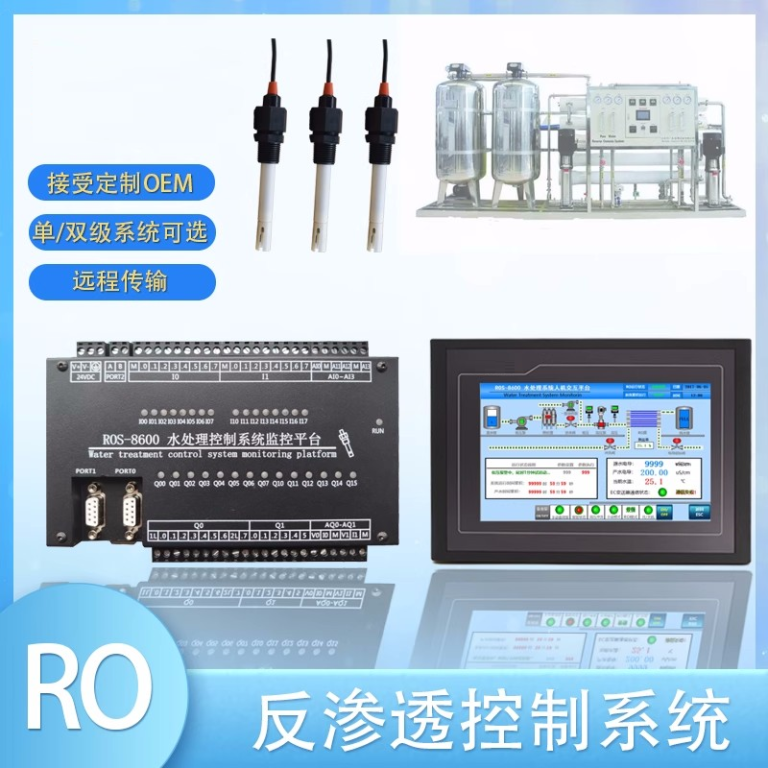
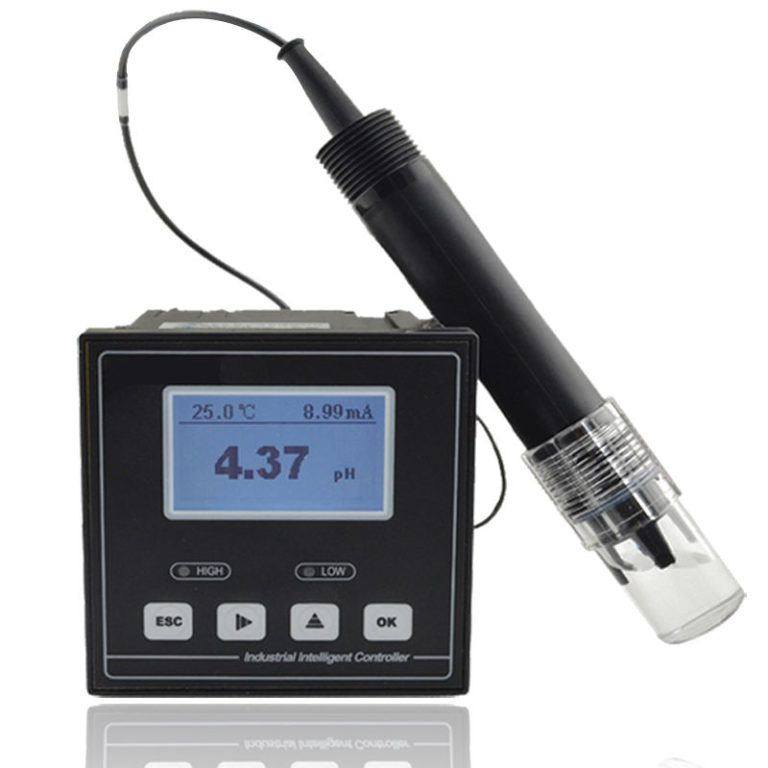
The Shanghai ChiMay in-line conductivity meter uses four-electrode technology to eliminate the polarization effects that plague two-electrode cells at low conductivity. In practice that means longer intervals between calibrations and steadier readings across extended deployments — the kind of stability water system validation protocols depend on.
Integration with Pharmaceutical Control Systems
Conductivity monitoring only pays off if it plugs into your control and records infrastructure. Modern transmitters support:
- Modbus RTU/TCP for legacy systems
- HART for smart instrumentation
- 4-20 mA analog output for basic control
- OPC-UA for Industry 4.0 environments
Tied into electronic batch records through SAP MES or similar platforms, automated data capture removes the manual transcription step — historically a real source of documentation discrepancies in pharma QC records.
Continuous vs. Intermittent Monitoring
| Parameter | Continuous Monitoring | Intermittent Testing |
|---|---|---|
| Data points per day | 1,440+ (1-minute intervals) | 1-4 samples |
| Excursion detection | Within seconds | Hours, on the next sample |
| Labor | Minimal (remote review) | Significant (sampling + analysis) |
| Audit trail | Fully electronic | Mixed paper/electronic |
| Regulatory standing | Preferred by FDA | Minimum requirement |
Compliance Implementation Strategy
Risk-Based Sensor Placement
Per ICH Q9 Quality Risk Management, work out sensor locations from a risk assessment, not convenience. The usual critical points:
- Points of use and distribution loop returns — each loop return should have dedicated monitoring
- Generation system outlet — quality verification right after production
- Storage tank boundaries — compartment integrity
Water-system warning letters repeatedly cite inadequate sampling locations and failure to monitor worst-case points. Place sensors where the risk is, and document why.
Calibration and Maintenance Protocols
Align calibration procedures with USP <1220> (Analytical Instrument Qualification):
- Semi-annual calibration verification with NIST-traceable standards
- Annual full calibration with certificates
- Real-time drift monitoring to catch sensor degradation
- Change control for any sensor replacement
Shanghai ChiMay conductivity systems include calibration reminders and drift compensation that alert quality departments before a sensor goes out of date — the failure mode that hurts most in a 24/7 GMP operation.
ROI Analysis: Continuous Monitoring Investment
Facilities that move from grab-sample programs to continuous monitoring typically report:
- Meaningful reductions in laboratory testing labor
- Fewer out-of-specification investigations, because excursions are caught early and traceably
- Shorter water-system shutdowns during investigations, since the electronic record answers questions quickly
- Faster audit preparation when the data is already electronic and time-stamped
The avoided downside matters too: a single FDA warning letter — with its remediation program, production delays, and reputational cost — can easily outweigh the investment in a full monitoring package.
Conclusion
Meeting USP <645> while keeping operations efficient comes down to one decision: measure continuously, with instruments built for the job. Shanghai ChiMay in-line conductivity meters meet USP <645>, EP 2.2.38, and Japanese Pharmacopoeia requirements, and are suitable for Purified Water, Water for Injection, and highly purified water systems across global operations.
For technical specifications and validation support documentation, contact the Shanghai ChiMay water quality monitoring solutions team.