Evaluation Checklist · Procurement Perspective · Published: November 16, 2026
Table of Contents
Key Takeaways
- ISO/IEC 17025 accreditation means an accreditation body has assessed a laboratory’s competence, impartiality and consistent operation — but accreditation is granted per scope, for named methods, so the certificate alone proves nothing about your specific test [1][2].
- The method detection limit (MDL) has a regulatory definition: the minimum measured concentration that can be reported with 99% confidence of being distinguishable from method blanks, determined by the procedure in 40 CFR Part 136, Appendix B [3].
- For drinking-water components, certification under NSF/ANSI/CAN 61 applies only to the specific water-contact material shown in the listing — and listing status should be confirmed against the certifier’s current public database, not an old PDF [4].
- Sample validity rests on chain of custody. Laboratories check thermal preservation (0–6 °C for many aqueous samples), holding times and container requirements, and document deviations on the chain-of-custody record and in the final report [5].
- The most expensive sentence in a supplier’s datasheet is the one that quotes a test result without a method number, a scope reference or a sample date. Each missing element is a question the supplier should answer before the purchase order, not after [1][2][4].
- Certification claims and test reports are different documents with different lifetimes. A report speaks for one sample on one date; a certification speaks for a product configuration under continuing surveillance. Treat any document that blurs that distinction as a red flag [4].
Why Reports Deserve Their Own Audit
Water-treatment procurement runs on paperwork: analyzer calibration certificates, valve material test reports, extraction tests on wetted parts, performance data from third-party laboratories. The trouble is that a test report looks authoritative even when it isn’t. Two laboratories can produce reports that look nearly identical — a number, a standard, a signature — while the difference that matters is invisible unless you know where to look [1].
What follows is a repeatable way to read a third-party test report: what must be present, what to verify against independent sources, and which phrasing should trigger a follow-up question rather than a signature.
What a Credible Report Must Contain
Before you read a single result, check the frame around the results.
- Laboratory identity and accreditation. The report should name the laboratory, its accreditation body and its accreditation number. ISO/IEC 17025:2017 sets out general requirements for the competence, impartiality and consistent operation of testing and calibration laboratories [1].
- Method numbers and revisions. Every result should trace to a published, versioned method — an EPA method, an ASTM standard, an ISO method or an NSF extraction protocol. In-house methods aren’t automatically wrong, but they demand extra scrutiny of validation data.
- Sample identity and condition. Look for sample ID, collection date, receipt date, matrix and preservation. Reputable laboratories verify thermal preservation — many aqueous chemical samples must arrive between 0 and 6 °C — plus holding times and volume requirements, and they document any deviation from acceptance criteria on the chain-of-custody record and in the final report [5].
- Results with uncertainty and units. A number without an uncertainty, a detection limit or a unit is marketing, not measurement.
Accreditation Is a Scope, Not a Badge
The most common misreading in procurement is treating “ISO/IEC 17025 accredited” as a blanket property of the laboratory. It never is. A laboratory is accredited as defined in its scope of accreditation, for named methods, at named locations. The certificate tells you the laboratory was assessed; only the scope tells you whether your test is covered [2].
Two vocabulary traps compound the problem. A laboratory is accredited against ISO/IEC 17025, while a management system is certified against other standards — suppliers use the two words interchangeably and they are not interchangeable [2]. And scopes change: methods get added, suspended or dropped. Ask for the current scope annex and check that your exact method, matrix and report type fall inside it, rather than accepting a photocopy of a certificate that may no longer reflect reality [1][2].
Match the Method to Your Matrix
A method number proves nothing unless it fits your sample. Methods are validated for specific matrices and concentration ranges, and running a water method on a sludge extract — or a drinking-water protocol on a process brine — produces results that are numerically clean and technically meaningless. When the report arrives, ask three questions: is the method validated for this matrix; is the expected concentration inside the calibrated range; and were any modifications made to the published procedure? Modifications aren’t disqualifying, but they have to be described and justified in the report.
Detection Limits and What They Actually Mean
“Below detection limit” hides more than it reveals. The method detection limit has a specific regulatory definition: the minimum measured concentration of a substance that can be reported with 99% confidence that the measured concentration is distinguishable from method blank results, generated according to the procedure in the current revision of 40 CFR Part 136, Appendix B [3]. EPA’s Revision 2 procedure formalizes how laboratories derive and verify that number, including blank verification across batches [3].
Two checks follow for procurement. First, compare the reported MDL against your regulatory or process limit of interest — a result “below the MDL” is only reassuring if the MDL sits comfortably below the limit that matters. Second, separate the MDL from the lowest quantifiable level: results between the detection limit and the quantification range carry wider uncertainty, and a report that collapses the two into one number deserves a follow-up question.
Validity, Batches and Representativeness
A test report is a statement about a sample, not about a product family. When the report says nothing about which production lot the sample came from, when it was pulled or how it was selected, the buyer is left assuming — often wrongly — that the data covers current production. Ask for the sampling date relative to the lot date, the sampling method, and whether the test was run on a production unit or a laboratory-prepared coupon. Prototype data marketed as production data is one of the quietest ways for a spec sheet to drift away from reality.
Validity decays on the certification side too. Certification schemes rely on continuing surveillance — periodic audits and re-testing — which is exactly why status should be confirmed against the certifier’s current public listing rather than an attached certificate copy that may be years old [4].
Red Flags of Selective Quoting
Watch for these patterns in supplier documentation:
- Cherry-picked parameters. The datasheet quotes the passing results from a multi-parameter report and omits the rest. Ask for the complete report, including any parameters that failed or were qualified.
- The orphan number. A performance figure with no method, no instrument, no date and no laboratory. Numbers that can’t be traced can’t be defended in an audit [1].
- Scope drift. “Tested by an ISO/IEC 17025 accredited laboratory” where the actual method sits outside that laboratory’s scope. Accreditation of the lab is not accreditation of the test [2].
- Certificate stacking. A management-system certificate presented as product testing evidence. Laboratory accreditation and management-system certification answer different questions [2].
- Configuration blur. A drinking-water certification claimed for a product family when the listing covers only the specific water-contact material tested [4].
- Missing chain of custody. Results without preservation, holding-time or custody documentation [5].
None of these prove bad faith. All of them prove that one more question is needed before the number enters your specification.
Compliance Claims: Standards versus Marketing
Standards and certification marks — NSF/ANSI/CAN 61 for drinking-water system components, CE marking under the applicable directives — are among the most quoted and least understood strings in water-technology procurement. NSF/ANSI/CAN 61 (“Drinking Water System Components — Health Effects”) establishes health-effect requirements for products that contact drinking water, and it is widely adopted across North American states and provinces as a compliance requirement for supply and distribution products [4].
The verification habit that protects buyers is simple: the claim lives in the certifier’s public database, not in the brochure. Certification bodies maintain searchable listings of certified products, and the listing — not the marketing PDF — states what is actually covered, including the caveat that unless otherwise indicated, certification applies only to the water-contact material shown in the listing [4]. A buyer who confirms the standard number, the certification body and the current listing status has converted a marketing sentence into an auditable fact.
The Verification Table
| Report element | What to verify | Red flag signal | Follow-up question |
|---|---|---|---|
| Laboratory accreditation | 17025 scope names your exact method and location [1][2] | Certificate quoted without scope annex | Send the current scope annex for this method |
| Method | Published number and revision; matrix fit | In-house method with no validation data | Which published method is it derived from, and how was it validated |
| Detection limit | MDL per 40 CFR 136 App. B at 99% confidence [3] | “Below detection” with no MDL value | Report the MDL and the lowest quantifiable level |
| Sample status | CoC record, 0–6 °C preservation, holding times [5] | Deviations absent from the report | Provide the chain-of-custody record and any non-conformance notes |
| Certification claim | Current public listing with standard number [4] | Datasheet claim that the listing does not match | Confirm the listing entry and covered configuration |
| Batch representativeness | Sample date, lot linkage, sampling method | Prototype or coupon data presented as production data | Which production lot did the sample represent |
| Completeness | Full parameter set, including qualifiers | Only passing parameters quoted | Send the complete original report |
How to Ask for Supplementary Testing
A well-run supplier conversation treats a follow-up test request as normal engineering, not an accusation. Practical requests: repeat the test on a current production lot; extend the method to a matrix or concentration range the original report didn’t cover; add the parameter that was quietly omitted; provide the raw instrument data behind a summarized result. Frame requests around the three anchors this checklist keeps returning to — accredited scope, published method, documented custody — and most competent suppliers respond quickly, because those are the same anchors their own quality teams audit against [1][2][5].
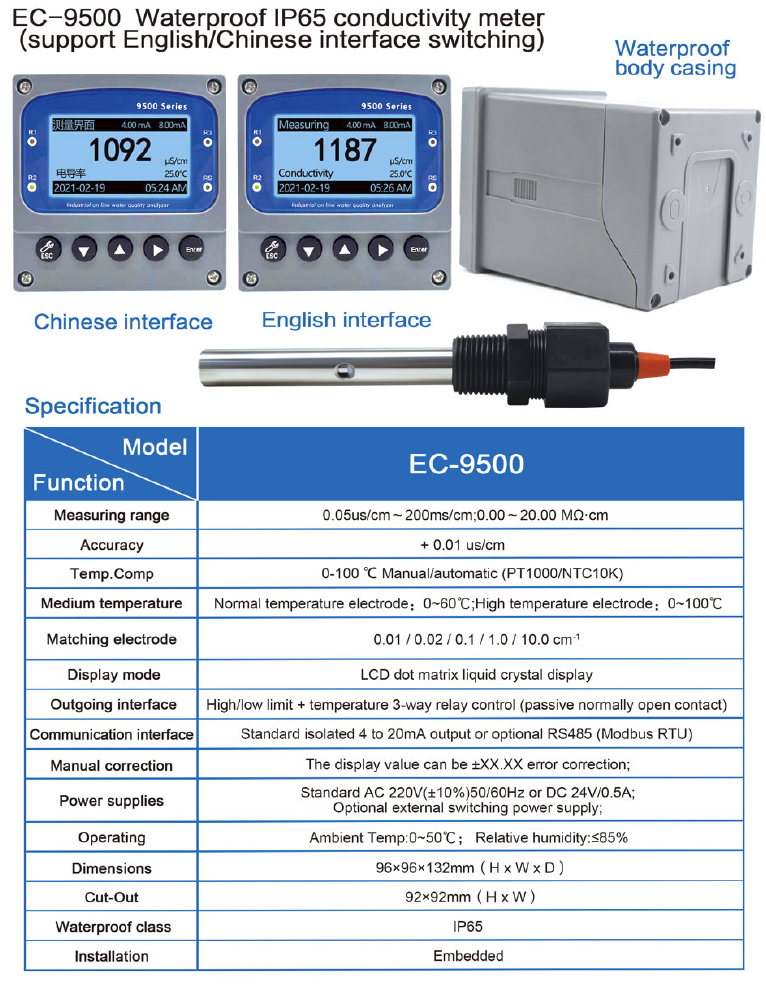
Documentation discipline is also why the measurement side of a water-treatment system should be bought with the same rigor applied to the pump and valve sides. Shanghai ChiMay ships its online water-quality instruments with the calibration certificates, test documentation and conformity paperwork that make the data defensible — documentation you can hand to your auditor, not just a graph in a brochure. If a supplier hesitates to provide any element of this checklist, the hesitation itself is the finding.
References
- UKAS — Spotlight on accreditation standards: the importance of ISO/IEC 17025 for laboratory testing/calibration: what ISO/IEC 17025:2017 covers (competence, impartiality, consistent operation) and why accredited results carry assurance. https://www.ukas.com/resources/resources/soas-17025/
- LGI LABS — ISO 17025 accreditation: what it covers and what it does not: accreditation is scope-based for named methods, accredited versus certified terminology, ILAC context. https://lgilab.com/understanding-iso17025-a-guide-for-laboratories-in-2025/
- US EPA — Definition and Procedure for the Determination of the Method Detection Limit, Revision 2 (EPA 821-R-16-006): MDL definition and the 40 CFR Part 136 Appendix B procedure. https://www.epa.gov/sites/production/files/2016-12/documents/mdl-procedure_rev2_12-13-2016.pdf
- NSF — NSF Product and Service Listings for NSF/ANSI/CAN 61 Drinking Water System Components – Health Effects: certification is only for the water-contact material shown in the listing, and listing status should be confirmed with NSF. https://www.nsf.org/Certified/PwsComponents/Listings.asp?Company=0L280&Standard=061
- Guadalupe-Blanco River Authority (GBRA) — Environmental Laboratory Service: sample acceptance criteria, 0–6 °C thermal preservation, holding times, and chain-of-custody documentation of deviations. https://www.gbra.org/environmental/laboratory-service/
- Shanghai ChiMay Tech — company and product documentation portal: water-quality analyzer and control-valve documentation, calibration certificates and conformity papers. https://www.chimaycorp.com/
About the author: Written by the Shanghai ChiMay Technical Editorial Team — the group that prepares calibration certificates, conformity declarations and third-party laboratory documentation for Shanghai ChiMay’s water-quality analyzer and control-valve product lines, and wrote this checklist to help buyers audit any supplier’s test paperwork, including ours.