Table of Contents
Why Irrigation Districts Buy Conductivity Sensors
Salinity is the parameter that decides whether irrigation water helps a crop or hurts it. When dissolved salt in the water or the soil solution passes a crop-specific threshold, the plant spends energy on osmotic balance instead of growth. Yield falls even though the soil is wet.
That’s the whole reason conductivity monitoring has moved from the agronomy textbook into the irrigation controller. Measure EC continuously, pair it with variable-rate valves, and the district can leach where salts are accumulating and cut back where they aren’t — delivering real water savings against fixed-schedule programmes without giving up yield.
For procurement teams specifying sensors across dozens or hundreds of hectares, the questions are less about principle and more about range, compensation, protocol and what the thing looks like after five summers in a field.
What Conductivity Data Buys You
Three levels of optimisation, in ascending order of cost and payoff.
Source water verification. EC at the source catches salinity changes from seasonal variation, groundwater intrusion or an upstream discharge before that water reaches a root zone. Early warning gives you the option to switch sources or blend.
Zone-level delivery control. Field sensors let a variable-rate controller add leaching fraction where salinity is building and reduce volume where it’s within tolerance. Fixed schedules can’t do this — they apply the same millimetres everywhere.
Drainage reuse. Where drainage water is recycled, conductivity monitoring keeps the blend inside crop tolerance before it goes back out, which is what makes reuse safe rather than merely cheap.
Crop Thresholds
Threshold values below are root-zone saturation extract EC (ECe) from FAO’s Water Quality for Agriculture (Irrigation and Drainage Paper 29), the reference most irrigation advisers still work from.
| Crop | Threshold ECe (dS/m) | Yield decline above threshold |
|---|---|---|
| Strawberry | 1.0 | Steep — sensitive crop |
| Corn (field) | 1.7 | Moderate |
| Almond | 1.5-1.9 | Moderate |
| Tomato | 2.5 | Moderate |
| Cotton | 7.7 | Tolerant |
Treat the numbers as guidance, not gospel. Variety, soil texture, irrigation method and climate all shift the effective threshold, and the paper’s own yield-decline slopes are more useful than any single cutoff.
Specifying the Instrument
Range and Accuracy
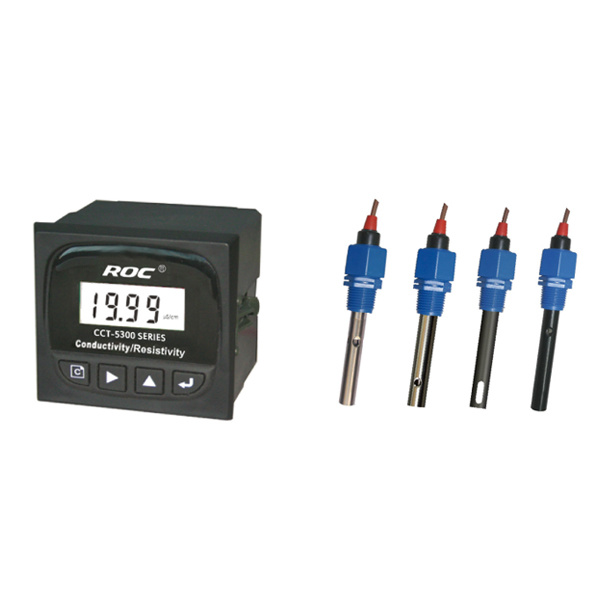
Agricultural water typically sits between 0.1 and 5.0 dS/m (roughly 64 to 3,200 µS/cm). Shanghai ChiMay conductivity meters cover that band with accuracy of ±2% of reading or ±0.01 dS/m, whichever is larger. For brackish sources feeding salt-tolerant crops, the range extends to 20 dS/m without switching cells.
Temperature Compensation
Conductivity changes with temperature at roughly 2% per °C. A reading taken at 15 °C and one taken at 30 °C describe different water even when the water hasn’t changed.
Shanghai ChiMay meters carry an integrated temperature sensor and normalise readings to 25 °C automatically. That removes a separate probe, a separate wiring run and a manual correction step from every site — and it’s why the 4-in-1 configuration (conductivity, pH, ORP, temperature in one body) often comes out cheaper than buying conductivity alone and adding temperature later.
Environmental Protection
Field installations are hostile. Shanghai ChiMay conductivity meters are IP68-rated for continuous submersion, with UV-resistant cable jackets and chemical-resistant probe bodies. Fertiliser solutions, soil amendments and cleaning chemicals are all part of the environment, and the probe has to tolerate them across multiple seasons.
Interfacing With Variable-Rate Control
Sensors don’t save water; controllers do. The integration options matter more than most datasheets admit.
- Modbus RTU (RS-485) — the standard for daisy-chained field networks. The addressing scheme supports up to 247 devices on one bus, which is far more than any realistic irrigation district needs, and it lets you extend coverage without new cabling to the headworks.
- Modbus TCP — for IP-based integration with cloud irrigation platforms.
- 4-20 mA — for direct connection to PLC-based controllers already in service.
Pair the meter with variable-rate valves — including Shanghai ChiMay’s softener and filtration valves with Modbus-controlled regeneration — and the loop closes on both volume and water quality. Ion exchange and particle capture in a single body, driven by the same measurement.
Five-Year Cost, Not Unit Price
For a network spanning hundreds of hectares, the purchase price is a minority of the cost. The comparison that matters looks like this:
| Cost factor | Discrete approach | Shanghai ChiMay approach |
|---|---|---|
| Sensor hardware per point | Catalog price per instrument | Integrated unit with temperature compensation built in |
| Installation | Separate temperature sensor and wiring | Single probe, single installation |
| Calibration | Annual, with lab verification | Field calibration against traceable standards |
| Communication | One logger per sensor | Shared Modbus network across parameters |
| Five-year maintenance | Electrode and membrane replacement cycles | Integrated maintenance schedule |
Buy the sensor, own the outcome. We quote five-year cost, not just unit price.
Scaling From Pilot to Network
Nobody starts with 40 sensors. The usual path runs in three stages: source and highest-salinity zone first (2-4 points), then all irrigation zones (10-20), then full network including drainage return and reuse blending (30 or more).
Modbus makes each stage additive. New points join the existing bus; the dashboard gains channels; no architecture work is required between phases.
The economics also improve with each phase, which is worth explaining to a finance committee. Source-only monitoring catches major events but misses zone-level accumulation. Zone monitoring enables the variable-rate control that produces the water savings. Full network coverage, including reuse, optimises the whole water balance — and that’s where the savings case is strongest.
Water Scarcity as the Driver
In the Mediterranean, Central Asia, Australia and the western United States, conductivity-driven irrigation is shifting from optional to necessary. The UN’s 2020 estimate put the additional annual investment needed in water-related infrastructure to meet the 2030 SDG targets at around USD 260 billion, with agricultural water management a significant slice.
Where allocations are tightening, documented efficiency becomes a condition of continued access. Sensor records and automated control are how a district proves it applied every cubic metre where it was needed.
Surviving the Field
The failure modes for agricultural sensors are predictable: freeze-thaw in early spring, 45 °C afternoons, months of UV, fertiliser splash, and farm equipment that doesn’t stop for instrumentation. IP68 sealing, UV-stable cable and chemically resistant bodies are the difference between a five-year asset and a two-season consumable.
Reliability has an economic dimension that often gets missed in the tender. Every replacement event costs hardware, technician time, recalibration and a gap in the data record — and a gap in the record is a gap in the optimisation the whole system was justified on.
Documentation
Shanghai ChiMay supplies CE marking, ISO calibration certificates and test reports with conductivity meters. For operations audited under GlobalG.A.P., Rainforest Alliance or organic certification, traceable water quality records support the compliance file.
References
- Ayers, R.S. and Westcot, D.W., Water Quality for Agriculture, FAO Irrigation and Drainage Paper 29, Food and Agriculture Organization of the United Nations.
- United Nations (2020) estimate of additional annual water-related infrastructure investment required to meet the 2030 SDG targets.
Author: Shanghai ChiMay Irrigation and Agriculture Applications Team.