Technical deep dive · Engineering perspective · Published: October 12, 2026
When a softener or filter underperforms, attention usually goes to the valve electronics or the media. Very often the real culprit is geometry: the physical handshake between tank and valve. A control valve seats onto a tank neck, seals against an opening cut to a specific thread, and drives service and backwash flows through a riser pipe whose diameter the valve expects and the tank must accept. Get any one of those numbers wrong and the symptoms look mysterious — a weeping base, a crushed O-ring, a channelled bed, resin escaping to drain. This article walks through the geometric interfaces that decide whether a valve and a tank become one machine, where the specifications come from, and how to check them before ordering or retrofitting.
Table of Contents
Key Takeaways
- The dominant interface in residential and light-commercial service is a 2.5-inch top opening cut with an 8-threads-per-inch thread — the “2.5-in.-8” base — which tank makers describe as fitting most standard softener and filter valves [1][2].
- Larger commercial valves move to a 4-inch base (commonly specified as 4-in.-8) with correspondingly larger riser pipes [3][4].
- Riser outside diameter must match the valve’s sealing bore: roughly 1.05 in. OD for a typical 1-inch valve class and about 1.9 in. OD for the 1.5-inch class [3].
- Tanks are pressure vessels first. Common composite mineral tanks carry ratings around 150 psi, and any valve swap has to respect that envelope [1].
- A gravel under-bed plus the internal distributor system is part of the machine, protecting the bottom collector and keeping the bed hydraulic — a detail specifiers should not leave to chance [5].
- Mismatch failures are predictable — weeping threads, damaged seals, uneven flow distribution, media loss — and all of them are preventable with a five-line checklist.
Why Geometry Decides the Whole Build
A softener is a pressure vessel, a bed of ion-exchange resin, a water-distribution system, and a control valve bolted into a single hydraulic assembly. The valve is the only part of that assembly you can see working, but the geometry underneath it decides whether water moves the way the valve assumes.
Two valves with identical flow ratings will behave differently on the same tank if one seats deeply on the neck and the other bottoms out early. Two identical tanks will backwash differently if one has a concentric, well-threaded neck and the other a warped or off-centre opening. Geometry is not a detail of the build. It is the build.
The Opening: Diameter and Thread
The single most common top opening in this industry is a 2.5-inch bore threaded at eight threads per inch. Tank suppliers describe it plainly: a “standard 2.5-inch top opening with #8 thread fits most standard filter/softener valves including backwash heads” [1]. A popular 8-inch by 44-inch softener tank listing states it from the valve side: the 2.5-in.-8 top tank thread “fits most residential control valves,” with a handful of proprietary-brand exceptions noted by the seller [2]. In valve specification tables the same interface appears as a mounting base of 2-1/2-in.-8 NPSM — a straight pipe thread form — on the 1-inch commercial valve class [3].
Two practical notes follow. First, the thread is a straight (parallel) thread, so the seal is made by a gasket or O-ring compressed against the tank neck, not by wedging a tapered thread tighter. Over-tightening cannot save a missing gasket; it can only crack a neck. Second, the fitment is de-facto, not universal. The exceptions named in tank listings are a reminder that some proprietary systems use their own interfaces, and a buyer who assumes “2.5-inch = fits everything” without checking the specific valve will find out during installation instead of during procurement [2].
Above the 1-inch class the geometry changes. The 1.5-inch commercial valve class commonly mounts on a 4-inch base — a 4-in.-8UN thread in the specification tables — with a larger drain and riser to match [3]. Stainless tank fabricators make the same point from the vessel side: they thread tanks to “2-1/2 in. #8” as standard with a “4 in. #8” available, cut on a welded ring so the thread runs true to the shell [4].
Neck Height, Adapters and Sealing
Diameter and thread define the connection; neck height defines how the valve sits. A top-mount valve threads down onto the neck until its internal distributor connection bottoms against the riser, and the sealing element compresses somewhere in between. If the neck is short relative to the valve’s expected stack-up, the seal never compresses. If it is long, the valve can bottom out on the riser or the neck shoulder before the seal seats — and an installer who keeps turning will crack something. Adapters and spacer kits exist precisely because the market’s neck heights vary, and a valve sold with a “universal” adapter still expects the installer to choose the right spacer combination.
Concentricity matters as much as height. A thread cut on a welded ring, true to the shell, keeps the valve square over the bed. A thread that wanders off-axis loads the sealing element unevenly and starts leaks that look like gasket failures but are alignment failures [4]. When replacing a tank, inspect the neck for ovality and weld-ring condition before blaming the valve that used to sit on it.
Distributor and Riser Sizing
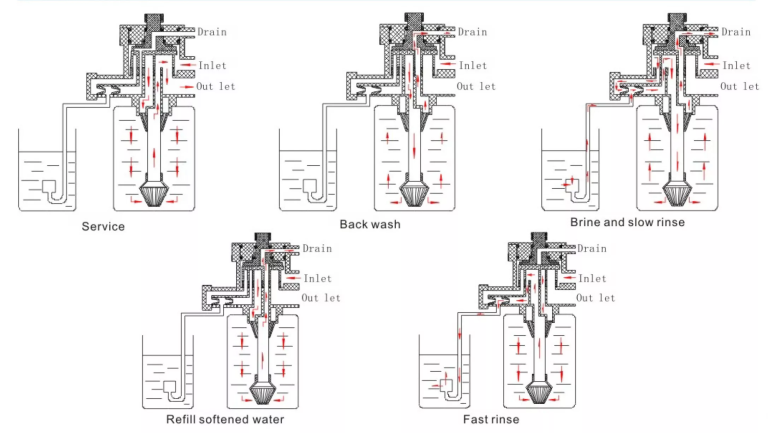
Inside the tank, the riser pipe is the highway for every service, backwash, and brine cycle. Valve specification tables make the diameter explicit: the 1-inch commercial class expects a riser of about 1.05 in. outside diameter, while the larger class expects roughly 1.9 in. OD [3]. High-flow softening platforms in the multi-tens-of-cubic-metres-per-hour range move to a 1.5-inch riser on a 4-inch mounting base and are matched to tank diameters in the 24-to-42-inch band — a reminder that riser, base, and tank diameter form one coherent ladder of sizes, not independent choices [6].
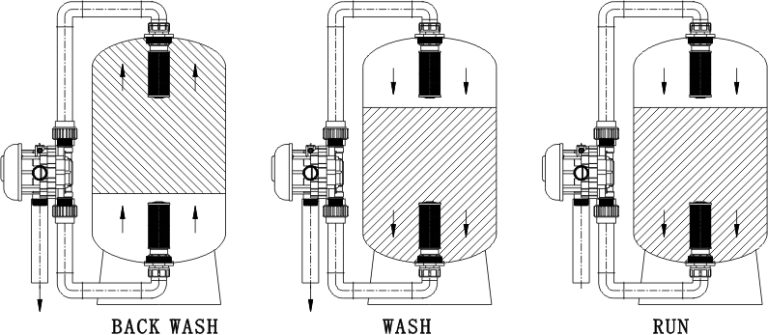
The riser usually carries a lower distributor — a screened basket or a hub with lateral slots — and often an upper distributor at the top of the bed. A complete system specification reads like a parts list of hydraulics: mineral tanks, ion-exchange resin, gravel under-bedding, internal distributor system, control valve, meter, backwash flow control, and brine tank with air check [5]. The gravel under-bed is the unfashionable part of that list, and skipping it in a tank with a slotted collector is how resin finds the drain during backwash.
Bed Depth and Freeboard
Above the bed, geometry turns into headroom. Resin beds expand substantially during backwash — that expansion is what scours the bed clean — and the freeboard between the bed surface and the valve’s underbody must absorb it. A tank filled to the neck leaves the expansion nowhere to go: backwash lifts media into the valve, screens blind, and the drain carries away exactly the resin the plant paid for. When sizing media fills, leave the freeboard the valve’s backwash rating assumes, and treat any filling instruction that ignores expansion as a false economy. The published backwash capabilities of a valve class — which tank diameters it can scour — are the specification that ties bed depth to valve choice [2][3].
The Geometry Table
| Geometry item | Where the specification comes from | Typical mismatch consequences |
|---|---|---|
| Tank opening and thread | Tank datasheet: 2.5-in. top opening with #8 thread [1]; 2.5-in.-8 top tank thread [2]; valve base listed as 2-1/2-in.-8 NPSM [3] | Cross-threading, weeping base, stripped neck |
| Valve base size class | Valve spec table: 2-1/2-in.-8 NPSM for the 1-in. class; 4-in.-8UN for the 1.5-in. class [3]; 4-in. #8 option from tank fabricators [4] | Valve simply will not seat; stacked adapters that fail in service |
| Neck height and sealing | Tank drawing plus valve adapter/spacer options; welded-ring threading for concentricity [4] | Under-compressed or over-compressed seal; leaks that look like gasket failures |
| Riser (distributor) OD | Valve spec: about 1.05 in. OD for the 1-in. class, about 1.9 in. OD for the larger class [3]; 1.5-in. riser on high-flow platforms [6] | Leaks past seals; riser lifts or cracks the lower basket in backwash |
| Under-bed and internal distributor | Complete system spec incl. gravel under-bedding and distributor system [5] | Resin loss to drain; channelled beds; rising pressure drop |
| Pressure and temperature rating | Tank datasheet: ratings around 150 psi for common composite tanks [1] | Vessel fatigue and shell failure — the one failure with no cheap repair |
When Replacing a Tank: The Five-Line Checklist
- Opening and thread. Confirm 2.5-in.-8 versus 4-in.-8 against both the tank datasheet and the valve base spec — do not infer one from the other [1][2][3].
- Neck height and adapter. Ask the valve supplier which spacer combination matches the neck, and verify the seal compresses mid-travel, not at the stop.
- Riser diameter and length. Match the riser OD to the valve class (about 1.05 in. or 1.9 in. for the two common classes) and cut the length so the lower distributor sits on true under-bed, not on a dome [3][5].
- Freeboard. Fill to leave the backwash expansion volume the valve rating assumes; check the backwash capability against the tank diameter [2][3].
- Ratings. Keep pressure and temperature inside the tank datasheet envelope — a valve upgrade never justifies exceeding the vessel [1].
Run that list before ordering and the retrofit is a two-hour job. Skip it and the same five items become five separate service calls.
Compatibility Across the Installed Base
Long-running valve platforms — Fleck® and Clack® families among them — are widely used across residential and commercial softening, and much of today’s tank-and-valve convention follows the interfaces those platforms standardized. That installed base is exactly why the 2.5-in.-8 opening persists: valves designed to fit Fleck®-series and Clack®-series installations plug into the same necks and risers the industry has been building around for decades [1][2][3].
Shanghai ChiMay approaches the interface with its specifications in the open — base sizes, riser diameters, flow rates, and pressure data published rather than held behind a request form, because “we publish the numbers other suppliers make you ask for.” Its replacement valves are engineered as drop-in conversions — “drop-in compatible. Same port size, same flow, same footprint.” — designed to fit Fleck®-series and Clack®-style tank connections so that a fleet owner standardizing on one valve platform does not have to re-purchase tanks to do it.
References
- WECO Filters — mineral tank product page (9 in. x 48 in., 2.5-in. standard top port); states the standard 2.5-in. top opening with #8 thread fits most standard filter/softener valves, with a 150 psi rating. https://www.wecofilters.com/mtbk0948.html
- Affordable Water — 8 in. x 44 in. water softener tank listing; 2.5-in.-8 top tank thread fits most residential control valves, with a few proprietary-brand exceptions. https://affordablewater.us/collections/water-softener-and-filter-tanks/products/8-inch-x-44-inch-water-softener-tank
- Aqua Prime Water (regional distributor) — control valve technical data listing; documents a 2-1/2-in.-8 NPSM mounting base with 1.05-in. OD riser for the 1-in. commercial valve, a 4-in.-8UN base with larger riser for the 1.5-in. class, and matching tank diameter ranges. https://www.aquaprimewaters.com.ph/products/control-valves/fleck-sed-soft-control-valves-1/
- Solartanks — stainless steel softener tank fabrication page; 2-1/2-in. #8 thread as standard with 4-in. #8 available, threaded on a welded ring for concentricity. https://www.solartanks.com/products/softener-tanks
- Watts — written specification for a twin alternating sodium-regenerated ion-exchange softener; enumerates mineral tanks, resin, gravel under-bedding, internal distributor system, control valve, meter, backwash flow control and brine tank as one complete assembly. https://www.watts.com/dfsmedia/0533dbba17714b1ab581ab07a4cbb521/204100-source/638965754570000000/written-specification-pws10t-pws15t.pdf
- Filtervn — high-flow automatic softening valve listing (18 m3/h class); 1.5-in. riser, 4-in. mounting base, suited to 24-to-42-inch tanks, illustrating the larger geometry class. https://filter.vn/product/automatic-softener-valve-18m3-h-n77a1/
Fleck® is a registered trademark of Pentair. Clack® is a trademark of Clack Corporation. Autotrol® is a trademark of Pentair. Shanghai ChiMay is not affiliated with, endorsed by, or sponsored by any of these companies. References to third-party brands are made solely to indicate compatibility with the original equipment.
About the author: Written by the Shanghai ChiMay Technical Editorial Team — the editorial group behind Shanghai ChiMay’s softener and filtration control valve line, covering valve selection, tank-and-valve compatibility and softening-system design for commercial and industrial installations.