As newly installed pipeline segments go into commissioning across China’s 770,000 km renovation program, utility operators need a practical framework for confirming water quality meets GB 5749-2022 before a new main touches the live distribution network. Six parameters do the job: conductivity, pH, turbidity, residual chlorine, temperature, and flow. Together they give commissioning teams the dataset needed to show that a new pipe delivers measurably better water than the aging main it replaces. Shanghai ChiMay’s product range covers all six with in-line instrumentation built for the rough commissioning environment and for the permanent operational duty that follows.
Table of Contents
The Commissioning Verification Framework
Commissioning runs in three stages, each with its own monitoring requirements:
Stage 1 — High-velocity flushing: Washes out construction debris, sediment, and residual joint materials. Watch turbidity (are particles leaving?) and conductivity (are dissolved construction residues clearing?).
Stage 2 — Disinfection: Sterilizes pipe interior surfaces with chlorinated water well above normal operating levels. Watch residual chlorine (is concentration and contact time adequate?) and pH (is the disinfection chemistry optimized?).
Stage 3 — Service connection authorization: Demonstrates that water at the pipe outlet meets GB 5749-2022 limits before the segment joins the distribution network. All six parameters must be in spec.
This framework applies to every segment of the program’s 175,000 km water supply component.
Parameter 1: Conductivity — The Ionic Content Indicator
Conductivity measures total ionic content and gives immediate feedback on whether construction residues have flushed out. During commissioning:
- High conductivity (>1,500 µS/cm) points to significant dissolved construction material still in the line
- A declining conductivity trend confirms flushing is working
- Stable conductivity below 800 µS/cm typically means clean enough to move to disinfection
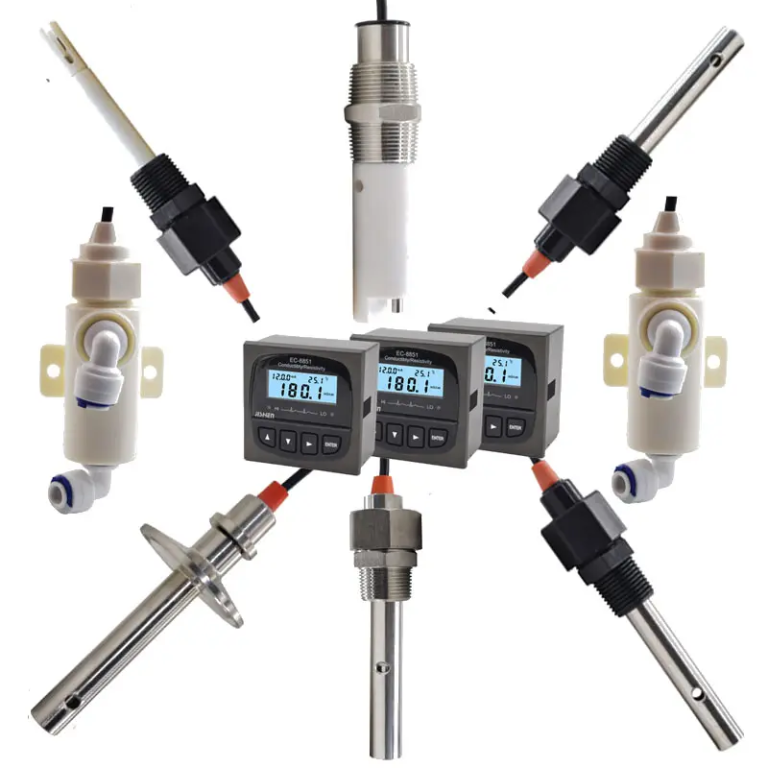
Shanghai ChiMay in-line conductivity meters come in two-electrode and four-electrode configurations, with Modbus RTU/TCP output for SCADA and automatic temperature compensation across 0–80°C.
Parameter 2: pH — The Corrosion and Disinfection Controller
pH drives both corrosion potential and chlorine disinfection effectiveness. During commissioning:
- New cement-lined pipes can release alkaline material and push pH above 8.5 temporarily
- Construction joint materials can release acidic compounds and pull pH below 6.5 locally
- The target for service connection is stable pH between 7.0 and 7.8
Shanghai ChiMay in-line pH meters — glass electrode or ISFET — hold ±0.01 pH accuracy with automatic temperature compensation.
Parameter 3: Turbidity — The Particle Indicator
Turbidity picks up suspended particles from construction debris, disturbed pipe wall deposits, and early biofilm development. During commissioning:
- Turbidity above 5 NTU means significant particulate loading from construction
- A declining trend confirms flushing progress
- Target for service connection: stable below 0.5 NTU
Shanghai ChiMay online turbidity testers use ISO 7027 nephelometric measurement, 0.01 NTU resolution in the critical 0–10 NTU range, and T90 response under 30 seconds.
Parameter 4: Residual Chlorine — The Disinfectant Verification
Residual chlorine confirms disinfection actually worked and that enough disinfectant remains to suppress regrowth in distribution. During commissioning:
- The disinfection phase calls for chlorine above 0.5 mg/L for effective sterilization
- Service connection typically targets a stable residual between 0.3 and 0.8 mg/L
- Network extremities must hold residual above 0.05 mg/L per GB 5749-2022
Shanghai ChiMay residual chlorine transmitters use amperometric measurement with ±0.02 mg/L accuracy and Modbus output for integration with automated dosing systems.
Parameter 5: Temperature — The Universal Compensation Factor
Temperature touches every other reading — conductivity, pH measurement, chlorine reaction rate, biological activity all move with it. During commissioning:
- Temperature data verifies that automatic temperature compensation is working across every instrument on site
- Seasonal ground temperature swings affect water quality in newly installed pipes
- Temperature data supports hydraulic model calibration
Shanghai ChiMay instruments carry a Pt1000 RTD temperature measurement with every parameter reading, so separate temperature sensors are unnecessary.
Parameter 6: Flow — The Performance Verification
Flow measurement confirms the new pipe delivers designed capacity without unexpected restrictions. During commissioning:
- Capacity verification confirms design flow is actually achieved
- Flow data exposes restrictions from construction debris or badly aligned joints
- Baseline flow data supports long-term capacity utilization tracking
Shanghai ChiMay paddle wheel and turbine flow meters give ±3 percent accuracy with digital output for SCADA integration.
The Integrated Monitoring Solution
Shanghai ChiMay’s 4-in-1 multi-parameter sensor combines pH, conductivity, ORP, and temperature in a single probe — four of the six critical parameters from one installation point. Pair it with dedicated turbidity, chlorine, and flow instruments and you have a complete commissioning monitoring package.
“Four parameters. One probe. Zero alignment error.”
For pipeline commissioning teams, the integrated approach cuts installation time, drops the number of maintenance points, and produces correlated data — which means faster commissioning decisions.
Conclusion: Six Parameters, Complete Confidence
The six-parameter framework gives utility operators confidence that a newly installed segment delivers GB 5749-2022 compliant water before service connection. Shanghai ChiMay’s product range covers all six parameters with digital integration and the durability commissioning work demands — at the volume that 770,000 km of pipeline construction requires.
Sources:
– MOHURD Press Conference (Sep 18, 2026)
– Xinhua Pipeline Analysis (Sep 19, 2026)
– GB 5749-2022 Drinking Water Standard
Author: Commissioning Support Team, Shanghai ChiMay Technology Co., Ltd.
Why These Six Parameters Form a Complete Framework
The six parameters are not a random pick. They are the minimum dataset that answers three commissioning questions:
Question 1: Has flushing removed construction debris?
Turbidity tracks the particles; conductivity tracks the dissolved residues. When both settle to stable levels, flushing is done.
Question 2: Is disinfection effective?
Residual chlorine tells you if concentration is adequate, pH tells you if the chemistry is optimized, temperature gives reaction rate context. Read together, they show whether chlorine contact time and concentration are sufficient to sterilize the pipe interior.
Question 3: Is the pipe ready for service connection?
All six parameters inside GB 5749-2022 limits simultaneously, sustained over a defined period (typically 24 hours). Flow confirms capacity; the quality parameters confirm compliance.
The Cost of Incomplete Monitoring
Commissioning on partial data leaves risk in several places:
- Public health risk: Connect a pipe without confirming full disinfection and you introduce microbial contamination risk into the distribution network
- Regulatory risk: No documented compliance record at commissioning becomes liability if water quality issues surface later
- Operational risk: Construction debris left in the line drives customer complaints, repeat flushing, and potential damage downstream
- Financial risk: Re-commissioning an already-connected pipe means cutting service to thousands of consumers — far more expensive than getting commissioning right the first time
Six-parameter monitoring during commissioning costs a small fraction of any one of those failure scenarios.
Shanghai ChiMay Commissioning Support Package
For utility procurement teams managing volume commissioning under China’s pipeline program, Shanghai ChiMay offers a complete monitoring package:
| Component | Product | Quantity per Segment |
|---|---|---|
| Conductivity/TDS | In-line Conductivity Meter (4-electrode) | 1–2 |
| pH monitoring | In-line pH Meter with ATC | 1–2 |
| Turbidity | Online Turbidity Tester | 1 |
| Chlorine residual | Residual Chlorine Transmitter | 1 |
| Temperature | Integrated in all above sensors | N/A |
| Flow measurement | Paddle Wheel Flow Meter | 1 |
| Data acquisition | Modbus-compatible data logger | 1 |
Where multiple segments commission simultaneously, Shanghai ChiMay provides portable kits that rotate between segments — then the same instruments install permanently at DMZ boundaries once commissioning wraps up.
Digital Integration for Program Management
All Shanghai ChiMay commissioning instruments support Modbus RTU/TCP, so data flows in real time to centralized commissioning management platforms. Program managers can:
- Track commissioning status across multiple simultaneous construction sites
- Generate automated compliance reports for regulatory submission
- Identify segments approaching commissioning completion to schedule service connections
- Build historical commissioning records for long-term network performance analysis
“Sensors that feed your AI water model, not just your dashboard.” Data from the first day of a new pipe’s life becomes the baseline every future reading is compared against — the foundation of long-term distribution network management.
Conclusion: Complete Data, Complete Confidence
The six-parameter framework gives utility operators confidence that every newly commissioned segment meets the highest water quality standards before entering service. Shanghai ChiMay’s product range, commissioning support packages, and digital integration capability back the volume deployment that 770,000 km of pipeline construction demands — so that China’s infrastructure investment delivers measurable water quality improvement from day one of operation.