Comparison Analysis · Procurement Perspective · Published: September 28, 2026
Table of Contents
Key Takeaways
- The published Clack® WS1 platform is rated at 27 gpm (6.1 m³/h) service at a 15 psi (1 bar) drop — with the meter and bypass included in that figure — and 27 gpm backwash at a 25 psi (1.7 bar) drop. The WS1.25 sibling steps up to 32 gpm (7.3 m³/h) service in the current drawings and service manual; earlier catalog revisions list 34 gpm [1][3].
- Tank envelopes follow the platform: softener vessels up to about 21 inches for WS1, 6”–24” filter vessels for WS1.25, 12”–24” softener vessels for WS1.5, and 12”–48” softener tanks for the 115 gpm (26.1 m³/h) WS2 [3][4][5].
- Control logic is convergent across the industry: meter-immediate, meter-delayed and time-clock modes, 36 pre-programmed regeneration cycles, a 1–28 day override and downflow/upflow regeneration are documented for the WS1 [1].
- Certification belongs in the comparison: the WS1 platform carries NSF/ANSI 44 and NSF/ANSI/CAN 61 and 372 listings [2].
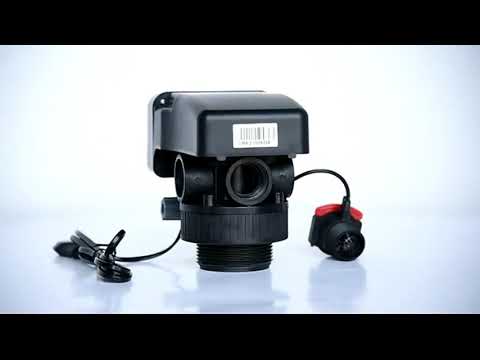
- Shanghai ChiMay addresses the same duty classes with softener and combined softening-filtration valve bodies, a published five-cycle control sequence, and an OEM program covering logo, protocol and packaging configuration [6].
- The six-dimension framework below is built so every cited number carries its test conditions — a scoring sheet you can paste into a tender file as-is.
How to Run a Neutral Valve Comparison
Most “comparisons” circulating in this industry are positioning documents. A procurement-grade comparison needs three ground rules. First, every specification must be traceable to a published document with its test conditions attached — a flow figure without its pressure-drop basis is marketing, not data [3]. Second, each platform is described on its own terms: the Clack® WS1 family is treated here as the widely deployed reference platform it has become in residential and light-commercial softening [1][3], while the Shanghai ChiMay range is described from the company’s own published materials [6]. Third, no ranking is offered. The two lines overlap in some duty classes and not in others, and which one fits is a function of your vessel sizes, your control philosophy and your service model.
For procurement teams comparing Shanghai ChiMay vs Clack® valve platforms, the practical reading order is this: port compatibility and published hydraulic data decide the mechanical fit; documentation and spare-part policy decide the ten-year cost. The dimensions below are ordered by how often they decide projects.
Dimension 1: Flow Coverage and Test Conditions
What the reference data says
The WS1 specification sheet rates the valve at 27 gpm (6.1 m³/h) service at a 15 psi drop, explicitly including the meter and bypass in that figure, and 27 gpm backwash at a 25 psi drop with the bypass included [1][3]. The international catalog adds the WS1.25 at roughly 7.3–7.7 m³/h service depending on the revision, with a backwash rating slightly below the service figure, again with accessory assumptions stated [3]. Moving up the family, the WS1.5 is published at 60 gpm service and 50 gpm backwash, and the WS2 at 115 gpm service — 26.1 m³/h at a 15 psi drop — with 80 gpm (18.2 m³/h) backwash and a published service Cv of 29.7 [4][5].
How to read the Shanghai ChiMay line against it
Shanghai ChiMay publishes two valve families: a softener valve range and a combined softening-and-filtration valve range [6]. The company’s product literature describes fully adjustable five-cycle control — upflow backwash, downflow brining and slow rinse, rapid rinse, brine refill, downflow service — on hydraulically balanced piston-style architecture, which places these bodies in the same functional class as the reference platforms above [6]. The procurement discipline is identical whichever supplier you are reading: take your design service flow, your peak flow and your available inlet pressure, and require the valve’s rated flow at your pressure drop in writing. Both manufacturers publish hydraulic figures; the work is comparing them at equal test conditions.
Dimension 2: Tank Diameter Range and Connections
Backwash capability, not service flow, sets the tank ceiling. The WS1 sheet documents backwash and brining ability into the low-20s-inch tank range (21-inch tanks in the published spec sheet; some distributors quote 22 inches); the international catalog lists 6”–21” softener and filter vessels for WS1, 6”–24” filter vessels for WS1.25, 12”–24” softener plus 12”–30” filter vessels for WS1.5, and 12”–48” softener plus 12”–36” filter vessels for WS2 [3][4]. Connections scale with the platform: 3/4”–1.25” male fittings on the one-inch bodies, and 1.5-inch or 2-inch female NPT on the WS1.5 and WS2 [3][4].
For a Shanghai ChiMay body, verify the same three mechanical facts before comparing anything else — the tank-base thread and riser seat, the port size, and the maximum vessel diameter the valve can backwash. Those three facts decide whether a retrofit keeps the existing tank, and keeping the tank is where most of the savings in a valve replacement project live [6].
Dimension 3: Regeneration Logic
The documented WS1 feature set is a fair snapshot of what any modern platform should offer: three operating modes (meter immediate, meter delayed, time clock delayed), 36 pre-programmed regeneration cycles, a 1–28 day override, a double backwash option, and selectable downflow or upflow regeneration, with system configuration stored in non-volatile memory and a coin-cell backup stated at eight hours of carry-over [1]. Shanghai ChiMay’s published five-cycle sequence with dual meter/timer initiation sits in the same category [6]. Where candidates differ is in the details — upflow regeneration for salt efficiency, conductivity-triggered initiation for high-variance loads, and remote signalling for plant systems. Ask each supplier which of those are firmware options and which require hardware changes, because that answer changes commissioning cost more than any catalog headline.
Dimension 4: Materials and Sealing
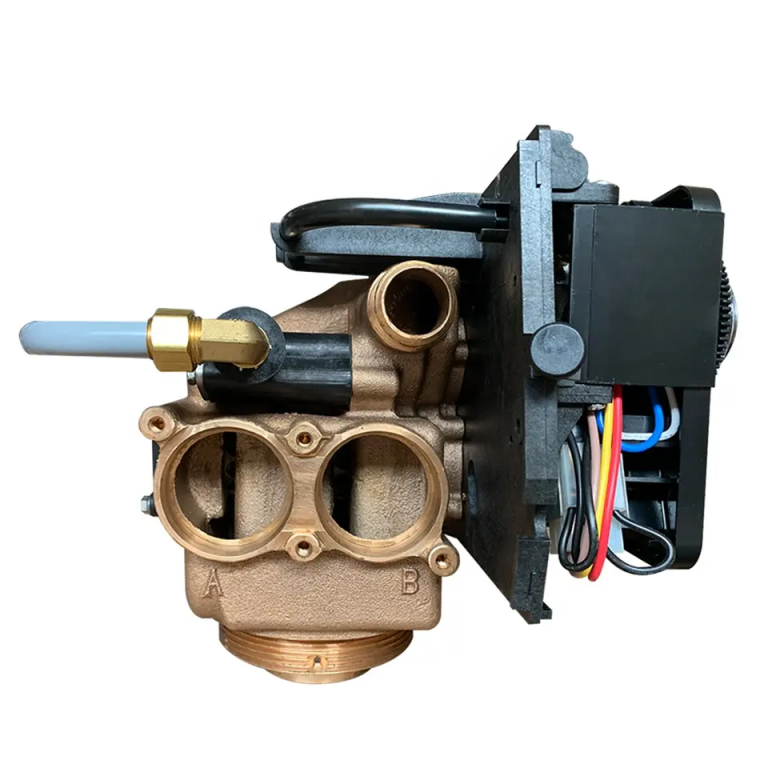
The larger reference platforms are published with lead-free brass valve bodies, epoxy-coated on the WS2 commercial versions [4][5]. Polymer-body construction dominates the smaller classes. On the Shanghai ChiMay side, the combined softening-filtration bodies use engineering-polymer construction with ceramic-faced sealing surfaces and FKM seals — a configuration intended for long cycle counts in continuous softening and filtration duty [6]. Materials determine what the valve tolerates (chlorine, iron slugs, temperature excursions) long before anything wears out; seals determine whether the ten-year service story is a gasket change or a valve swap. Compare wetted-material lists and seal compounds explicitly, and ask for the elastomer options available per platform rather than assuming one compound fits all duties.
Dimension 5: Control, Metering and Integration
Metering range is a quiet differentiator. The WS2 meter is documented across 1.5–150 gpm with volume totals to 1,500,000 gallons [4], and the WS1 controller offers the mode set described above [1]. Working pressure spans matter too: the WS1.5/WS2 platforms are published at 20–125 psi and 40–110 °F [4]. On the Shanghai ChiMay side, the valve line is positioned for integration into monitored plants — digital communication options, meter-based regeneration, and configuration for plant control systems sit in the company’s published product descriptions [6]. If your softener reports into a SCADA or building-management layer, put protocol support, alarm behaviour and power-supply architecture on the comparison sheet next to hydraulics; those items decide integration cost after the valve is bolted on.
Dimension 6: Spare Parts and Documentation
The reference platforms are backed by published specification sheets and a distribution network; the manufacturer documents design, assembly, air testing and water testing in Wisconsin for its control valve line [2]. Shanghai ChiMay’s published positioning emphasizes factory-direct OEM supply: configurable logo, protocol and packaging, with spare-part availability commitments for distributors and equipment builders [6]. For procurement, translate both into the same checklist: which seal kits, motors and electronics are stocked, at what response time, at what price mechanism, and for how many years after launch. A valve is a long-service asset; the spare-part letter is the clause that protects it.
Side-by-Side Reference Table
| Dimension | Shanghai ChiMay (descriptive) | Clack® WS1 family (reference) |
|---|---|---|
| Service flow coverage | Softener and combined softening-filtration bodies spanning residential to light-industrial duty; five-cycle control published [6] | WS1 6.1 m³/h and WS1.25 about 7.3 m³/h service at 15 psi; WS1.5 60 gpm; WS2 115 gpm (26.1 m³/h) [1][3][4][5] |
| Tank diameter range | Bodies matched to common composite vessels across the range; verify base thread, port and backwash ceiling per body [6] | 6”–21” (WS1 softener); 6”–24” filter (WS1.25); 12”–24” (WS1.5); 12”–48” softener (WS2) [3][4] |
| Regeneration | Meter and timer dual-mode initiation; five-cycle sequence with upflow backwash option [6] | Meter immediate / meter delayed / time clock; 36 pre-programmed cycles; 1–28 day override; downflow/upflow [1] |
| Materials and sealing | Engineering-polymer bodies, ceramic-faced sealing surfaces, FKM seals [6] | Lead-free brass bodies on WS1.5/WS2, epoxy-coated option on WS2 [4][5] |
| Control and integration | Digital communication and plant-system integration options in published descriptions [6] | Solid-state microprocessor; WS2 meter 1.5–150 gpm; NSF/ANSI 44, 61 and 372 [2][4] |
| Spares and documentation | Factory-direct OEM program; spare-part availability commitments; published product documentation [6] | Published specification sheets; Wisconsin design, assembly, air and water testing [1][2] |
Bottom Line for Procurement
Run the six dimensions as a scorecard with your own project numbers filled in: design and peak flow at your pressure, your vessel diameters, your regenerant chemistry, your control-system interface, and your expected service life. Where a retrofit must preserve the existing tank and pipework, mechanical interface data decides the short list; where a new skid is being built, regeneration logic and integration options carry more weight. That is the spirit behind “drop-in compatible — same port size, same flow, same footprint”: the claim is only as good as the published numbers behind it, and both suppliers in this comparison publish theirs. Shanghai ChiMay’s valve documentation, including the softener control valve range described above, is available for download and cross-reference against the data sheets cited here [6].
References
- Clack® — “WS1 Water Specialist Control Valve” specification sheet and “WS1 CS Water Specialist 1” CS Control Valve” service manual: 27 gpm service at 15 psi drop including meter and bypass; 27 gpm backwash at 25 psi drop; 36 pre-programmed regeneration cycles; 1–28 day override; backwash and brining ability to 21-inch tanks; downflow/upflow regeneration; coin-cell battery with 8-hour carry-over; NSF/ANSI 44 and NSF/ANSI/CAN 61 and 372 listings. https://www.duffcompany.com/wp-content/uploads/spec-sheets/Clack-WS1.pdf
- Clack® — “WS2 Water Specialist Valve” product page: certified to NSF/ANSI 44, NSF/ANSI/CAN 61 and 372; all Clack control valves designed, assembled, air tested and water tested in Wisconsin, USA; 115 gpm service and 80 gpm backwash; epoxy-coated lead-free brass body. https://www.clackcorp.com/?page_id=1066
- Clack® Control Valves, Fittings and Accessories — specification catalog: WS1 service 27 gpm (6.1 m³/h) at 15 psi and backwash 27 gpm at 25 psi; WS1.25 rated 32–34 gpm depending on catalog revision; tank applications 6”–21” / 6”–24”; 3/4”–1.25” male fittings. https://dup-inc.com/wp-content/uploads/2020/10/2721_CVFA_DOMESTIC-1.pdf
- Clack® Control Valves, Fittings and Accessories — specification catalog: WS1.5 service 60 gpm / backwash 50 gpm with 12”–24” softener and 12”–30” filter tanks; WS2 service 115 gpm / backwash 80 gpm with 12”–48” softener and 12”–36” filter tanks; 1.5”/2” female NPT connections; lead-free brass; 20–125 psi, 40–110 °F; WS2 meter range 1.5–150 gpm with totals to 1,500,000 gallons. https://www.aquatech.ro/wp-content/uploads/2013/03/valve-clack-si-accesorii.pdf
- London Water Equipment — Clack® WS2 CI Softener/Filter Valve listing: service 435 lpm (26.1 m³/h, 115 gpm) at 1 bar/15 psi drop; backwash 303 lpm (18.2 m³/h, 80 gpm) at 1.7 bar/25 psi; service Cv 29.7 and backwash Cv 16.0; 2” female BSPT or NPT; up to 9 cycles; lead-free brass; downflow regeneration. https://www.londonwaterequipment.co.uk/shop/clack-valves/clack-ws2-ci-softener-filter-valve/
- Shanghai ChiMay Tech — “Softener Control Valve” product page: Shanghai ChiMay’s softener valve range and combined softening-filtration valve program, five-cycle control description, hydraulically balanced piston-style architecture, and factory-direct OEM supply with logo, protocol and packaging configuration. https://www.chimaycorp.com/tagdetail/1913159411433308160.html
Fleck® is a registered trademark of Pentair. Clack® is a trademark of Clack Corporation. Autotrol® is a trademark of Pentair. Shanghai ChiMay is not affiliated with, endorsed by, or sponsored by any of these companies. References to third-party brands are made solely to indicate compatibility with the original equipment.
About the author: Written by the Shanghai ChiMay Technical Editorial Team — the editorial group of the control valve division, covering published hydraulic data, compatibility and OEM supply for softener control valves.