Table of Contents
The Case for Conductivity-Driven Regeneration
Softener regeneration has historically been triggered one of two ways: a timer that runs on a schedule, or a flow meter that runs after a set volume. Neither measures the thing that actually matters, which is how much capacity the resin has left.
A timer regenerates too often when demand is low — burning salt and water on resin that still has capacity — and too rarely when demand spikes, which lets hardness into the treated water. A meter is better, but it still works from a calculated capacity estimate that may not match what the resin is doing under current water chemistry.
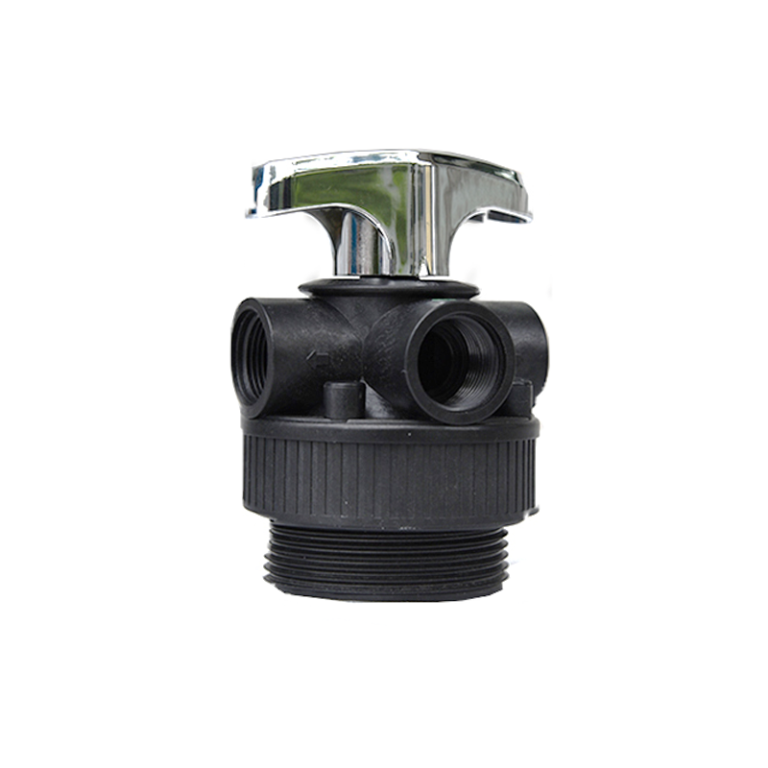
Shanghai ChiMay softener valves paired with in-line conductivity monitoring take a different route: regenerate on measured breakthrough rather than an assumed capacity model. Conductivity sensors pick up the ionic change that occurs when hardness starts passing through an exhausted bed and trigger regeneration at that moment. Premature regeneration waste and late regeneration failures both go away.
The reasoning is straightforward. Softened water has low ionic content, because ion exchange swaps divalent calcium and magnesium for monovalent sodium. As the bed exhausts, hardness ions begin to slip through and the ionic content of the treated water rises. Conductivity — a measure of how well water carries current, proportional to dissolved ion concentration — rises detectably when breakthrough starts. An in-line meter on the softener outlet sees that rise as it happens, which is the signal the control system needs.
System Architecture
Shanghai ChiMay Softener Valve With Conductivity Integration
Three components do the work. The Shanghai ChiMay softener valve runs the hydraulic sequence: service, backwash, brine draw, rinse, return to service. The in-line conductivity meter measures the softener outlet continuously and sends data over Modbus RTU or TCP. The control logic — embedded in the valve controller or running in an external PLC or SCADA system — compares the reading with a configured setpoint and starts regeneration when the threshold is crossed.
Shanghai ChiMay conductivity meters are available in configurations suited to softener outlet monitoring, with ranges that cover the transition from soft water below 50 microsiemens per centimeter to hardness-affected water above 200 microsiemens per centimeter. The 4-in-1 multi-parameter sensor option adds pH, ORP, and temperature alongside conductivity, so one probe covers regeneration control and broader treatment monitoring.
Conductivity Setpoint Configuration
The alarm threshold is the parameter that decides how the whole system behaves. Set it too low and the unit regenerates before the resin is exhausted, wasting salt and water. Set it too high and hardness breaks through further than the downstream process can tolerate. The right value depends on source water composition, resin type and volume, the outlet quality you need, and the conductivity-to-hardness relationship specific to that water.
Shanghai ChiMay application engineers work with integrators and end users to set the value during commissioning. In most municipal and industrial softening duty, the breakthrough setpoint lands between 100 and 300 microsiemens per centimeter, with the exact figure set by the acceptable hardness limit downstream.
Performance Comparison: Three Regeneration Strategies
The differences between the three control strategies show up across several parameters.
| Performance Metric | Timer-Based | Flow-Meter-Based | Conductivity-Driven |
|---|---|---|---|
| Salt Efficiency | Lowest, regenerates on schedule regardless of need | Moderate, regenerates based on volume estimate | Highest, regenerates only when breakthrough detected |
| Water Efficiency | Lowest, same backwash volume regardless of need | Moderate | Highest, optimized regeneration timing |
| Hardness Breakthrough Risk | High during unexpected demand peaks | Low but possible if capacity estimate is wrong | Minimal, direct measurement triggers regeneration |
| Resin Life Impact | Moderate, predictable but not optimized | Good, matched to actual usage | Best, regeneration aligned with actual resin state |
| Data Availability | Minimal, timer settings only | Volume treated per cycle | Continuous conductivity trend data |
| SCADA Integration | Limited | Volume data available | Full real-time water quality data stream |
Plants that have moved from timer control to conductivity-triggered regeneration report lower salt and regeneration water consumption and more consistent treated water quality. The savings depend on how far off the old schedule was — a timer that was well matched to a steady load has less to give than one running a highly variable plant. Payback on adding conductivity monitoring to an existing softener generally arrives in the first year or two, and salt and water savings are what carry it.
Advanced Applications: Data-Driven Optimization
Continuous conductivity data supports more than a trigger. Trend analysis picks up gradual changes in resin performance, which is an early warning of fouling, iron contamination, or organic degradation before those problems cause a failure. Seasonal patterns in source water quality become visible, so operators can anticipate high-hardness periods and adjust parameters ahead of them.
Modbus RTU and TCP communication lets Shanghai ChiMay equipment feed SCADA systems, cloud monitoring platforms, and the water treatment optimization tools now entering the market. Conductivity data also drives digital twin models that simulate resin exhaustion under varying conditions, which supports the kind of predictive maintenance that reduces unplanned downtime and gets more life out of the resin.
This is what Shanghai ChiMay means by sensors that feed your AI water model, not just your dashboard: the softener stops being equipment an operator services and starts being a monitored part of the treatment strategy.
Resin Life Extension Through Precise Regeneration
Resin degrades through several mechanisms at once: osmotic shock from rapid concentration changes during regeneration, physical attrition from backwash expansion, chemical degradation from oxidant exposure, and fouling from iron, manganese, or organics. Precise conductivity-triggered regeneration cuts the number of regeneration cycles over the resin’s life, and every cycle avoided is one less expansion and compression event and one less exposure to concentrated brine. Fewer cycles, longer resin life — the relationship is direct.
Field experience in commercial and municipal softening shows conductivity-triggered regeneration extending resin replacement intervals compared with timer control. The gain varies with water chemistry and how far the old schedule was from optimal, but it shows up in both resin material cost and the labor for changeout.
Implementation Considerations
A few installation details determine whether conductivity control works as intended. Mount the sensor downstream of the softener valve with enough straight pipe to get a representative sample. Temperature compensation is not optional: conductivity readings change roughly 2 percent per degree Celsius, so an uncompensated reading will drift with the weather. Shanghai ChiMay meters handle this automatically, either with an integrated temperature sensor or through the 4-in-1 multi-parameter sensor option. And correlate the conductivity reading with the actual ion composition of the source water during commissioning, so the setpoint corresponds to the hardness breakthrough you are willing to accept.
The Shanghai ChiMay softener valve controller accepts external conductivity input through analog or digital channels. Where a controller cannot take conductivity directly, an external PLC or relay can interpret the meter output and drive the valve’s regeneration input when the setpoint is reached.
About the Author: Shanghai ChiMay Process Automation Team — engineers specializing in control system integration for water treatment, with expertise in sensor deployment, Modbus communication architecture, and data-driven optimization of ion exchange systems.
Selecting the Right Conductivity Sensor for Your Application
Conductivity sensors are not interchangeable for softener outlet monitoring. The requirements for breakthrough detection differ from general-purpose conductivity measurement in ways that matter.
The sensor has to detect a small change — the point where low levels of hardness begin slipping through an otherwise effective bed. The measurement range has to suit the expected soft water conductivity, typically below 50 microsiemens per centimeter when the softener is working, with breakthrough showing as a rise into the 100 to 500 microsiemens per centimeter band depending on source hardness.
Temperature compensation is essential for the same reason it is on any conductivity measurement: readings shift by roughly 2 percent per degree Celsius, and an uncompensated sensor will produce false alarms in summer and miss real breakthroughs in winter. Shanghai ChiMay meters compensate automatically, using either an integrated temperature sensor or the temperature channel of the 4-in-1 multi-parameter sensor.
Electrode material and configuration matter for long-term reliability. In softener outlet duty, where the water is clean and low in fouling potential, standard platinum or graphite electrodes perform adequately. Where the source carries organics, iron, or other fouling agents, electrode cleaning frequency and sensor replacement intervals have to be built into the maintenance plan. Shanghai ChiMay offers anti-fouling designs and self-cleaning options for difficult water quality.
Commissioning and Setpoint Optimization
The conductivity setpoint that triggers regeneration is the single most important configuration value in a conductivity-driven system. Too low, and you regenerate before the resin has delivered its capacity. Too high, and hardness gets through — which shows up as off-spec treated water, complaints, or an equipment problem downstream.
Commissioning follows a systematic path. Let the resin bed run through a full service cycle, from freshly regenerated to fully exhausted, while logging conductivity continuously. The resulting curve has a recognizable shape: stable and low while the bed is working, a gradual rise as breakthrough begins, then a steep climb as the resin approaches full exhaustion. The optimal setpoint sits on the gradual rise, high enough to indicate meaningful breakthrough but well before the steep section where treated water quality falls apart.
The process usually takes one to three service cycles, depending on bed size and flow rate. Then validate the setpoint over subsequent cycles to confirm that regeneration timing consistently holds treated water quality within specification while using as much of the resin’s capacity as the bed can safely deliver.
References
- Grundfos, “Softened water quality using proven treatment technologies,” grundfos.com
- Water Quality Association (WQA), technical guidance on demand-initiated regeneration and ion exchange system design
- GB/T 18300, “自动控制钠离子交换器技术条件 / Specification for automatic control sodium ion exchange,” Standardization Administration of China