Table of Contents
Introduction: The Monitoring Challenge
Pharmaceutical wastewater represents one of the most complex matrices in environmental monitoring. Several thousand pharmaceutical compounds are in use globally, and a few hundred are routinely detected in wastewater influents. These compounds—including antibiotics, analgesics, hormones, and antidepressants—create significant treatment challenges.
Conventional laboratory analysis (LC-MS/MS, GC-MS) provides compound-specific detection, but each sample costs hundreds of dollars and results can take days to weeks. This approach cannot support real-time treatment optimization or rapid contamination response.
Inline sensor technology offers practical solutions for pharmaceutical wastewater monitoring. Seven sensor types provide complementary capabilities for comprehensive surveillance.
Type 1: Inline Conductivity Sensors
Detection Principle
Conductivity measures water’s ability to conduct electrical current, reflecting total dissolved ion concentration. Pharmaceutical compounds—particularly ionic antibiotics and their metabolites—contribute to conductivity signals.
In practice, sustained departures from baseline conductivity are often the first indication of an industrial pharmaceutical discharge event. Continuous conductivity monitoring from ChiMay detects these anomalies instantly, triggering detailed sampling protocols.
Practical Applications
Industrial discharge monitoring: Pharmaceutical manufacturing facilities discharge waste streams with conductivity ranging from 2,000-10,000 μS/cm, far exceeding domestic wastewater (500-1,500 μS/cm).
Treatment process control: Conductivity indicates ionic loading on biological treatment, guiding aeration rate adjustments and hydraulic retention time optimization.
Leak detection: Spills of liquid pharmaceutical formulations create localized conductivity spikes detectable by monitoring networks.
Performance Specifications
| Parameter | Specification |
|---|---|
| Range | 0-20,000 μS/cm |
| Accuracy | ±1% of reading |
| Response time | <30 seconds |
| Maintenance | Monthly cleaning, annual calibration |
| Cost | $800-1,500 (inline model) |
Type 2: Dissolved Oxygen Sensors
Detection Principle
DO sensors measure dissolved oxygen concentration critical for biological treatment processes. Pharmaceutical compounds—particularly antibiotics and antifungals—inhibit microbial activity, reducing oxygen consumption rates.
Elevated antibiotic loads measurably suppress activated-sludge respiration rates, a clear sign of biological treatment inhibition that shows up in the DO profile before effluent quality degrades.
Practical Applications
Respirometry monitoring: Continuous DO tracking reveals treatment efficiency changes when pharmaceutical loads spike.
Process optimization: DO setpoint adjustments maintain treatment performance despite variable pharmaceutical influent concentrations.
Toxicity detection: Rapid DO decreases following industrial discharge events indicate potential pharmaceutical toxicity requiring treatment adjustments.
Performance Specifications
| Parameter | Specification |
|---|---|
| Range | 0-20 mg/L |
| Accuracy | ±0.1 mg/L |
| Response time | <60 seconds |
| Maintenance | Weekly membrane replacement, monthly calibration |
| Cost | $600-1,200 (inline model) |
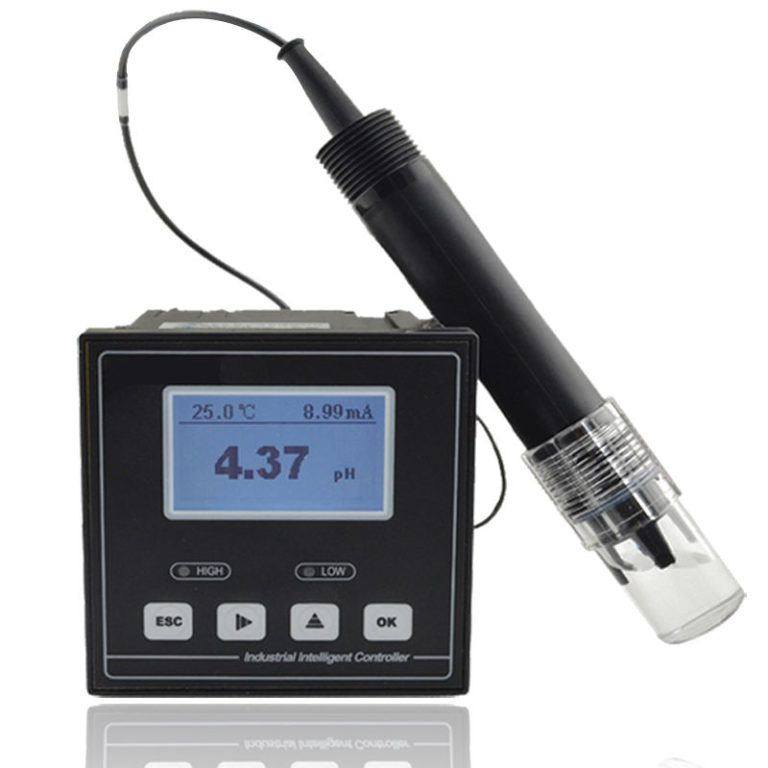
Type 3: pH Sensors
Detection Principle
pH sensors measure hydrogen ion activity, indicating acidic or alkaline conditions in wastewater. Many pharmaceutical compounds—particularly antibiotics and NSAIDs—require specific pH conditions for optimal biodegradation.
pH excursions outside the neutral-to-mildly-alkaline band slow pharmaceutical biodegradation substantially, which is one more reason to hold this parameter close to setpoint.
Practical Applications
Biological treatment optimization: Maintaining optimal pH maximizes microbial activity and pharmaceutical removal.
Chemical precipitation control: pH determines pharmaceutical removal through precipitation or ion exchange processes.
Discharge compliance: pH monitoring ensures effluent meets regulatory limits (6.0-9.0 for most permits).
Performance Specifications
| Parameter | Specification |
|---|---|
| Range | 0-14 pH units |
| Accuracy | ±0.1 pH units |
| Response time | <30 seconds |
| Maintenance | Monthly buffer calibration, quarterly electrode replacement |
| Cost | $400-900 (inline model) |
Type 4: Turbidity Sensors
Detection Principle
Turbidity measures light scattering by suspended particles, reflecting total suspended solids (TSS) concentration. Particle-bound pharmaceutical fractions—including microplastics, precipitated compounds, and biomass—contribute to turbidity signals.
Turbidity correlates with particle-associated pharmaceutical transport, which makes it useful for identifying transport pathways through a collection system.
Practical Applications
Particle-bound contaminant tracking: Turbidity spikes during rainfall events indicate surface runoff carrying particle-associated pharmaceuticals.
Treatment efficiency monitoring: Declining turbidity removal efficiency signals treatment process problems.
Filter backwash optimization: Turbidity breakthrough curves optimize filter backwash timing, reducing filter media losses.
Performance Specifications
| Parameter | Specification |
|---|---|
| Range | 0-10,000 NTU |
| Accuracy | ±2% of reading or 0.3 NTU |
| Response time | <5 seconds |
| Maintenance | Monthly wiper cleaning, quarterly calibration |
| Cost | $700-1,400 (inline model) |
Type 5: Oxidation-Reduction Potential Sensors
Detection Principle
ORP sensors measure the tendency of water to accept or donate electrons, indicating oxidation conditions. Advanced oxidation processes (AOPs) for pharmaceutical destruction require specific ORP levels for optimal radical generation.
ORP tracks hydroxyl radical availability during electrochemical and other advanced oxidation processes, which is what makes it a practical control input for treatment optimization.
Practical Applications
AOP process control: ORP monitoring optimizes ozone, hydrogen peroxide, and UV-based oxidation processes for pharmaceutical destruction.
Disinfection monitoring: ORP indicates chlorine or chloramine availability for pathogen inactivation.
Redox condition tracking: ORP reveals whether biological treatment operates under aerobic, anoxic, or anaerobic conditions.
Performance Specifications
| Parameter | Specification |
|---|---|
| Range | -1,000 to +1,000 mV |
| Accuracy | ±5 mV |
| Response time | <60 seconds |
| Maintenance | Quarterly electrode cleaning, annual calibration |
| Cost | $500-1,000 (inline model) |
Type 6: UV-254 Absorbance Sensors
Detection Principle
UV-254 sensors measure light absorption at 254 nm wavelength, correlating with aromatic organic compounds including many pharmaceuticals. This parameter provides continuous tracking of organic loading without laboratory analysis.
UV-254 correlates reasonably well with common pharmaceutical compound classes, including antibiotics and beta-blockers, though the relationship is compound-specific and worth verifying against lab data for a given stream.
Practical Applications
Organic loading monitoring: UV-254 tracks bulk organic matter changes indicating pharmaceutical load variations.
AOP efficiency tracking: UV-254 decreases during oxidation processes indicate pharmaceutical destruction progress.
Online TOC estimation: UV-254 provides proxy measurements for total organic carbon (TOC) at a fraction of the cost.
Performance Specifications
| Parameter | Specification |
|---|---|
| Range | 0-2 AU (absorbance units) |
| Accuracy | ±0.01 AU |
| Response time | <10 seconds |
| Maintenance | Monthly lamp cleaning, quarterly calibration |
| Cost | $1,500-3,000 (inline model) |
Type 7: Flow-Weighted Samplers with Sensor Triggers
Detection Principle
While not traditional sensors, automated samplers triggered by sensor thresholds provide representative samples for laboratory analysis. Flow-weighted sampling ensures sample volumes proportionally represent actual contaminant loads.
ISO 5667-10 provides guidance on sampling of wastewaters, including flow-proportional composite sampling for accurate load determination.
Practical Applications
Contamination event sampling: Sensor-triggered samplers collect event samples when conductivity, turbidity, or DO exceed thresholds.
24-hour composite collection: Continuous flow-weighted sampling provides representative daily composite samples for regulatory compliance.
Source identification: Sequential sampling during contamination events enables source tracking through collection system networks.
Performance Specifications
| Parameter | Specification |
|---|---|
| Sample volumes | 100-1,000 mL per sample |
| Sampling intervals | 15 minutes to 24 hours |
| Flow proportionality | ±5% accuracy |
| Maintenance | Quarterly pump inspection, annual certification |
| Cost | $3,000-8,000 (automated sampler) |
Integrated Sensor Networks for Pharmaceutical Wastewater
Network Architecture
Comprehensive monitoring combines multiple sensor types in hierarchical networks:
- Screening level: Conductivity, pH, turbidity sensors provide continuous screening at 5-minute intervals
- Process level: DO, ORP sensors monitor treatment process performance
- Compliance level: UV-254 and triggered samplers verify treatment efficiency and regulatory compliance
Data Integration
Modern monitoring platforms integrate sensor data streams:
– SCADA integration: Real-time sensor data feeds treatment process control
– Cloud platforms: Remote monitoring and alert notification
– Machine learning: Pattern recognition identifies contamination events from multi-parameter signatures
Cost Comparison
| Monitoring Approach | Relative Annual Cost | Detection Capability |
|---|---|---|
| Laboratory only | Highest | Compound-specific |
| Sensor network only | Lowest | Screening-level |
| Integrated approach | Moderate | Both screening and specificity |
Conclusion
Seven sensor types provide comprehensive pharmaceutical wastewater monitoring capabilities. Conductivity sensors offer cost-effective contamination screening. DO sensors track biological treatment performance. pH, turbidity, and ORP sensors monitor process conditions. UV-254 sensors estimate organic loading. Triggered samplers collect event samples for definitive laboratory analysis.
This integrated sensor approach reduces pharmaceutical contamination detection time from days to minutes, enabling rapid treatment optimization and regulatory compliance. For wastewater treatment facilities serving pharmaceutical manufacturing regions, ChiMay inline sensor networks provide the monitoring foundation for effective emerging contaminant management.