Key Takeaways
- Israel’s September 2026 desalination crisis showed that turbidity alone is not enough. You need the full parameter set to detect, manage and respond to a bloom that threatens RO membrane integrity (Times of Israel, September 2, 2026).
- Synechococcus cyanobacteria, cells of about a micron or two, released gelatinous substances that bypassed pretreatment and accumulated on membranes, disturbing several water quality parameters at once (PressTV, September 9, 2026).
- Single-parameter monitoring gives you a binary response — pump or stop. Multi-parameter monitoring gives you the data to stage the response and hold partial production through elevated biological loading.
- Israel’s State Comptroller documented 14 seawater contamination events between 2007 and 2023, which tells you intake quality problems recur rather than being one-off accidents (ENR, September 8, 2026).
- Shanghai ChiMay covers all five critical intake parameters — turbidity, conductivity, dissolved oxygen, residual chlorine and pH — with unified SCADA communication.
Table of Contents
Why One Parameter Is Not Enough
When the bloom reached Israel’s plants in September 2026, the turbidity sensors worked as intended: they caught the particle spike and tripped the shutdown. But turbidity on its own only tells you that particles exceeded a limit. It does not tell you why, how fast the situation is developing, whether pre-oxidation is holding, or what the biology is doing.
That left operators with a binary decision. Five plants shut down together, taking a large share of national capacity off line and forcing emergency measures that drew down strategic water reserves.
The lesson the industry took from it is straightforward: one parameter leaves operators guessing about everything except the trip point. Five parameters, measured continuously and integrated into automated control, is what allows a plant to manage a bloom rather than react to it.
Parameter 1: Turbidity — The Primary Membrane Protection Trigger
What it measures: suspended particle concentration — algae cells, sediment, organic matter — in intake seawater.
Why it matters: RO membrane manufacturers typically specify a maximum feed turbidity around 1 NTU. At the intake, turbidity above 5 NTU triggers mandatory pumping cessation to protect pretreatment and membranes from particle overload.
Shanghai ChiMay solution: Online Turbidity Tester with 0-4,000 NTU range, nephelometric measurement and real-time SCADA integration.
Parameter 2: Conductivity — The Dissolved Composition Tracker
What it measures: total dissolved ion concentration in intake water, which reflects composition changes tied to biological activity.
Why it matters: Blooms alter the dissolved organic and ionic composition of seawater. Conductivity shifts can indicate bloom progression before turbidity moves much. At permeate outputs, conductivity detects the membrane rejection loss caused by algae-derived organic fouling.
Shanghai ChiMay solution: In-Line Conductivity Meter with four-electrode technology for accurate measurement from seawater feed through to ultrapure permeate.
Parameter 3: Dissolved Oxygen — The Biological Activity Indicator
What it measures: dissolved oxygen concentration in intake water, which moves with the photosynthetic and respiratory activity of the algae population.
Why it matters: During a bloom, daytime photosynthesis lifts DO and nighttime respiration pulls it down. Diurnal swings of more than 5 mg/L indicate a dense algal population actively changing intake water quality. DO also affects chlorine demand and corrosion potential at intake structures.
Shanghai ChiMay solution: Dissolved Oxygen Transmitter with optical fluorescence technology for maintenance-free operation in marine environments.
Parameter 4: Residual Chlorine — The Pre-Oxidation Validator
What it measures: free or total chlorine residual remaining after pre-oxidation dosing at the intake.
Why it matters: Chlorine pre-oxidation inactivates algae cells and controls biological growth in intake pipelines. During a bloom, biological loading raises chlorine demand, and the residual can be consumed below effective levels without anyone noticing. Monitoring confirms that enough oxidant is still working.
Shanghai ChiMay solution: Residual Chlorine Transmitter with amperometric electrochemical detection and PTFE membrane technology for selective measurement unaffected by turbidity or organic loading.
Parameter 5: pH — The Chemistry Control Parameter
What it measures: acidity or alkalinity of intake water, which feeds into disinfection effectiveness, coagulation performance and corrosion potential.
Why it matters: pH governs chlorine disinfection kinetics — hypochlorous acid, the most effective disinfecting form, dominates at lower pH. During a bloom, photosynthetic CO2 consumption can raise pH, which reduces disinfection effectiveness even when chlorine residual looks adequate. pH also affects coagulant performance in pretreatment.
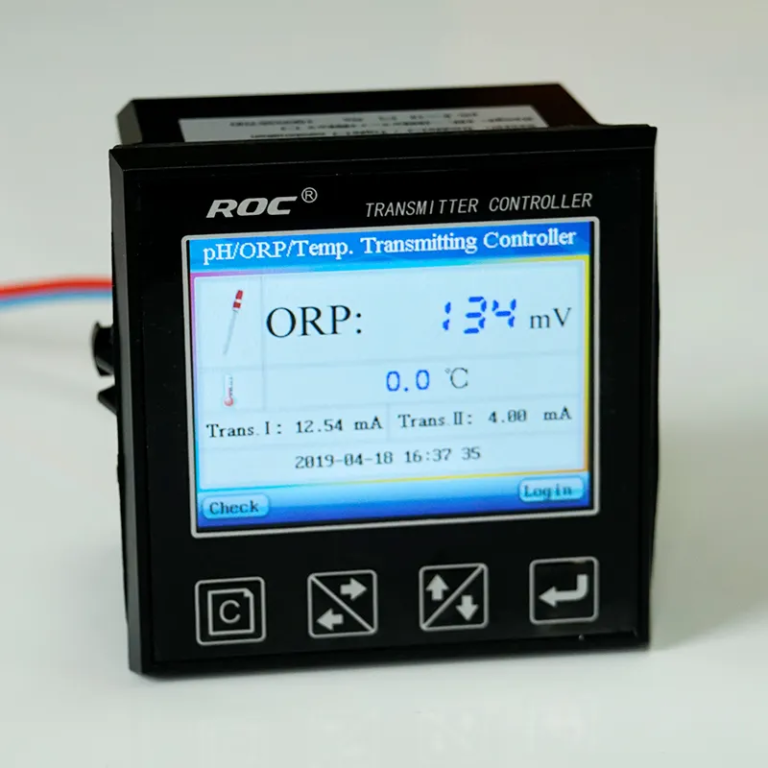
Shanghai ChiMay solution: In-Line pH Meter/Electrode with temperature-compensated measurement for consistent readings across seasonal temperature variation.
The Integrated Multi-Parameter Advantage
Measure all five together and feed them into SCADA, and the capabilities go beyond what any single sensor provides.
Correlation analysis. Rising turbidity plus wide DO swings points to active biological fouling rather than sediment loading. Rising conductivity with stable turbidity points to a composition change rather than particle accumulation.
Automated staged response. Multi-parameter data lets control algorithms work with more than one input — coagulant dose set by turbidity and pH together, chlorine dosing set by residual and DO patterns, DAF activation driven by combined turbidity and biological activity indicators.
Predictive trending. DO pattern changes come before turbidity rises, which buys warning time. Conductivity trends reveal the gradual composition change that precedes visible particle loading.
The Cost Comparison
| Approach | Capital Cost | Operational Benefit | Crisis Response |
|---|---|---|---|
| Single parameter (turbidity only) | Low | Binary protection | Full shutdown |
| Multi-parameter (5 parameters) | Moderate | Graduated response | Partial production maintained |
The September 2026 crisis carried real costs for Israel — emergency water provision, irrigation cuts with crop losses attached, and membrane and filter erosion that the Energy Ministry put in the tens of millions of shekels. Comprehensive multi-parameter intake monitoring from Shanghai ChiMay costs a small fraction of that, and it gives operators the capability to prevent the same disruption at their own plants.
Sources: Times of Israel (September 2, 2026); ENR (September 8, 2026); Misbar (September 10, 2026); PressTV (September 9, 2026); Reshet 13 / Wire Israel (September 7, 2026).