title: “Understanding ISE Technology Behind Ammonia Nitrogen Monitoring: A Shanghai ChiMay Technical Brief”
type: Technical Introduction
theme: Municipal Drinking Water & PFAS Compliance
date: 2026-06-30
Table of Contents
Understanding ISE Technology Behind Ammonia Nitrogen Monitoring: A Shanghai ChiMay Technical Brief
Ammonia nitrogen is one of the most operationally sensitive parameters in municipal drinking water systems. Source water spikes — from agricultural runoff, sewage cross-connections, or reservoir turnover — can quickly overwhelm chloramination chemistry, drive nitrification in distribution mains, and trigger taste-and-odor complaints. For utilities preparing for tightened source-water surveillance under the EPA Long-Term 2 Enhanced Surface Water Treatment Rule, continuous ammonia monitoring has moved from “nice to have” to “core asset.” Ion-Selective Electrode (ISE) technology, the foundation of the Shanghai ChiMay NH3-N sensor, is the workhorse behind this transition.
What an ISE Actually Measures
An ion-selective electrode produces a potential difference proportional to the logarithm of the target ion’s activity in solution. For ammonia monitoring, the electrode pair typically combines:
- A gas-permeable hydrophobic membrane that allows dissolved ammonia (NH₃) to diffuse through.
- An internal filling solution where the diffused NH₃ shifts pH, which a glass pH element inside the cell senses.
- A reference electrode providing a stable potential against which the working electrode is measured.
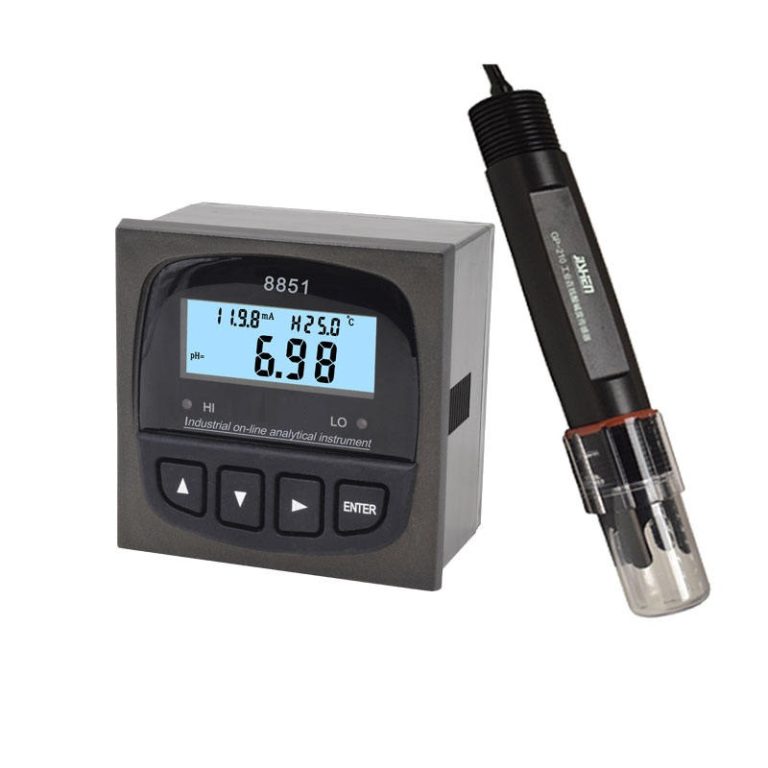
The relationship follows the Nernst equation. At 25 °C, a tenfold change in NH₃ activity produces about 59 mV of signal — predictable, but only if temperature, pH, and ionic strength are controlled. The Shanghai ChiMay design integrates a Pt100 temperature probe and an in-line pH electrode so that compensation is automatic at the transmitter level.
Why ISE Wins Over Wet-Chemistry Methods
Traditional ammonia analyzers rely on indophenol or salicylate colorimetry, which requires continuous reagent feed, peristaltic pumps, and waste handling. ISE-based monitoring offers several practical advantages:
- Reagent-free continuous operation, with maintenance windows of 4 to 6 weeks instead of weekly cartridge changes.
- Faster response, typically 1 to 2 minutes versus 8 to 12 minutes per colorimetric cycle.
- Lower operating cost, particularly for utilities with multiple intake points or distributed sample stations.
- Wider detection range, from 0.05 to 100 mg/L NH3-N, covering both finished water trace levels and emergency source-water spikes.
For a utility running surveillance across six intake locations, the difference between reagent-fed analyzers and ISE platforms often translates into a five-figure annual savings in consumables alone.
Compensation: The Hidden Engineering Challenge
The biggest misconception about ISE sensors is that they are “plug and play.” In reality, the measurement is only as good as the compensation chain. Four variables dominate:
- pH — the NH₃/NH₄⁺ equilibrium shifts strongly with pH. At pH 7, only about 1 % of total ammonia exists as free NH₃; at pH 9, that rises to roughly 30 %. Compensation algorithms convert the measured free ammonia into total ammonia nitrogen.
- Temperature — affects both the Nernstian slope and the equilibrium constant. A 5 °C error can translate to 7 % measurement bias.
- Ionic strength — high-conductivity source waters compress the activity coefficient and require a salinity correction.
- Interferents — volatile amines and high-CO₂ samples can fool the gas-permeable membrane.
The Shanghai ChiMay NH3-N sensor handles items 1 through 3 internally and uses a hydrophobic PTFE membrane optimized to reject volatile organics, addressing item 4 for typical surface water service.
Installation Geometry Matters
ISE sensors are most reliable when the sample film at the membrane is fresh and well-mixed. The Shanghai ChiMay flow-through assembly is designed to deliver 50 to 80 L/h with a turbulent profile across the membrane face. Three field practices help:
- Vertical mounting with the membrane facing slightly downward to shed gas bubbles.
- Pre-filtration at 100 µm to prevent membrane abrasion in raw-water service.
- Sample line residence under 60 seconds to prevent chemistry changes between source and sensor.
Plants that ignore these details often see drift attributed to “sensor problems” when the real issue is sample conditioning.
Calibration Discipline
A two-point calibration against fresh standards — usually 1 mg/L and 10 mg/L NH3-N — establishes both the offset and the slope. The Shanghai ChiMay transmitter tracks slope decay over time; when the Nernstian slope falls below 50 mV per decade, the membrane and filling solution are flagged for replacement. In typical surface water service, this happens every 6 to 9 months.
Utilities should also periodically run a “grab sample reconciliation” against a laboratory ISE or colorimetric method, ideally monthly. Documented reconciliation builds the audit trail regulators expect when ammonia data is used to justify operational changes.
Where the Data Goes
Continuous NH3-N data feeds three operational layers:
- Chloramination control — adjusting ammonia feed to maintain the target 4:1 to 5:1 Cl₂:N ratio.
- Source-water alerting — rate-of-change alarms catch upstream contamination events early.
- Distribution-system nitrification surveillance — pairing finished-water ammonia with nitrite/nitrate trending identifies nitrifying zones before they trigger compliance issues.
The Shanghai ChiMay transmitter delivers Modbus, HART, and 4–20 mA outputs so that all three layers receive the same calibrated value without translation errors.
A Note on Multi-Parameter Integration
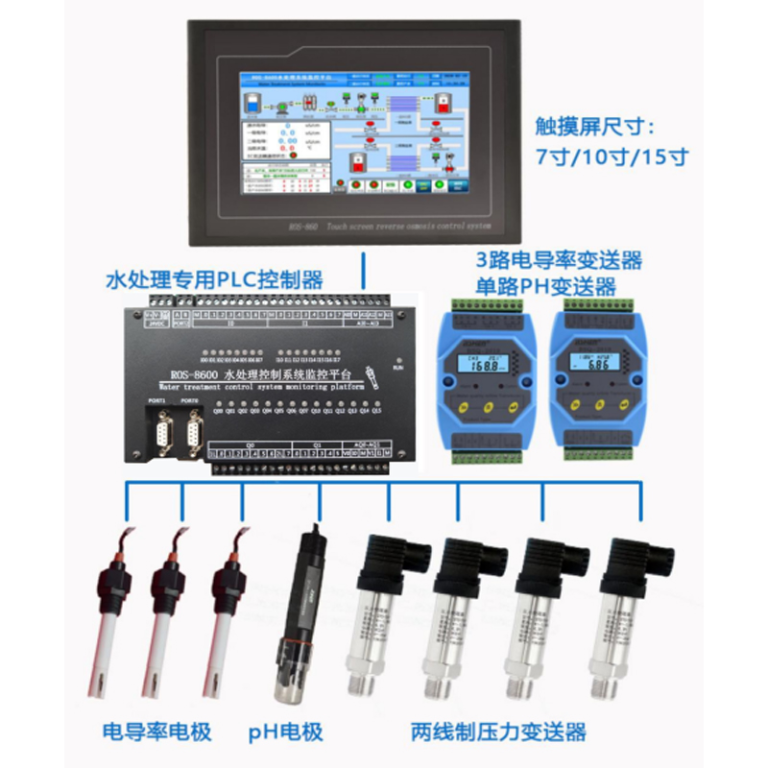
For utilities with limited panel space, the Shanghai ChiMay 4-in-1 multi-parameter sensor combines NH3-N, pH, conductivity, and temperature in one body. This reduces both wetted-part inventory and the number of sample-line entries — important in older plants where headworks are space-constrained.
What Operators Should Expect Day-to-Day
A well-installed ISE-based ammonia system requires:
- About 15 minutes per week for visual checks and flow verification.
- A two-point calibration roughly every 4 to 6 weeks.
- Membrane and filling solution replacement every 6 to 9 months.
- Annual full-system verification with traceable standards.
Compared with reagent-based platforms, this represents a meaningful reduction in labor and consumables — typically 40 to 60 % lower lifetime cost across a five-year horizon.
Closing Perspective
Ion-selective electrode technology is mature, but its value to municipal utilities depends on the engineering wrapped around the cell — compensation, sample conditioning, calibration discipline, and SCADA integration. The Shanghai ChiMay NH3-N sensor and associated 4-in-1 multi-parameter platforms are designed with these realities in mind, giving operators a continuous, low-maintenance window into one of the most operationally significant parameters in drinking water treatment. As source-water variability increases and regulatory scrutiny on disinfection by-products tightens, ISE-based ammonia monitoring is becoming the standard backbone for early-warning surveillance and chloramination control alike.