Industry Briefing · Decision-Maker Perspective · Published: November 17, 2026
A hotel is several water businesses sharing one building. The hot water loop, the pool deck, the laundry, the kitchens and the plant room each carry their own water-quality targets, their own monitoring points, and their own way of charging you for neglect — a legionella notice, yellowed towels, a boiler burning more fuel than its duty requires. What follows walks through each subsystem, the numbers that govern it, and where automated monitoring actually earns its keep.
Table of Contents
Key Takeaways
- Three temperatures hold legionella down: cold water below 20 °C, hot water stored at 60 °C or above, and delivery at 50 °C or above within one minute at the outlet (55 °C in healthcare premises) [1]. US operators frame the same discipline through a documented water management program of the kind described in ASHRAE Standard 188.
- The growth window sits inside comfortable temperatures: legionella multiplies between roughly 20 °C and 45 °C, and case fatality for Legionnaires’ disease is commonly put at 5–10%, higher in outbreaks affecting vulnerable patients [2]. That is why return-line temperature and dead-leg control matter as much as the calorifier setpoint.
- Pool chemistry only runs itself when ORP drives the dosing: free chlorine 1.0–8.0 ppm (ideal 2–3 ppm), pH 7.2–7.6, and ORP in the 650–750 mV band are the working setpoints for a commercial pool [3].
- Laundry water quality is priced in linen: in a study sponsored by the Water Quality Association and run at a Chicago YMCA laundry, softening the wash water extended the life of sheets and towels by 20–40% [5].
- Scale is an energy bill before it is a maintenance item: a quarter-inch of deposit on heat-transfer surfaces cuts efficiency by 20–40% [6].
- The monitoring architecture is the product: storage and return temperatures, pool ORP/pH, and wash-water hardness are the signals that decide whether the rest of the plant behaves.
One Property, Six Water Systems
Engineering departments that run hotel water well treat each subsystem as a small utility with its own control loop. The table is the whole briefing in one view; the sections after it explain the reasoning behind each row.
| Subsystem | Water-quality target | Monitoring points | Control moves |
|---|---|---|---|
| Hot water loop | Store ≥60°C; deliver ≥50°C within 1 min at outlets [1]; return line held at 55°C or above [2] | Calorifier outlet, return leg, farthest tap | Recirculation pump duty, thermostatic mixing valves, periodic flush of low-use outlets |
| Domestic cold | Below 20°C where practical [1] | Tank, incoming main, remote washrooms | Insulation, turnover of low-use fixtures |
| Pool | Free chlorine 1.0–8.0 ppm (ideal 2–3) [3]; pH 7.2–7.6 [3]; ORP 650–750 mV ideal [3] | Main return, skimmer line, make-up water | Automated ORP/pH dosing; combined chlorine watch; dilution schedule |
| Spa | Higher disinfectant residual and faster turnover than pools [3] | Jet loop, filter return | Tighter setpoints, more frequent drain-and-fill |
| Laundry | Softened wash water; hardness removed before the washer inlet | Softener outlet, washer feed | Softener sized to peak wash load; regeneration tied to volume |
| Boiler & cooling | Corrosion- and scale-controlled circuits | Feedwater, condensate, tower basin | Softening, chemical dosing, conductivity-based blowdown |
The Hot Water Loop: Temperature Is the Control Strategy
Legionella is controlled by keeping water out of the band where it breeds. The UK Health and Safety Executive states the regime plainly: cold water below 20 °C, hot water stored at no less than 60 °C, and delivered at 50 °C (55 °C in healthcare premises) within one minute at the outlets [1]. Between roughly 20 °C and 45 °C the organism multiplies happily, so a calorifier that drifts below 60 °C in storage recreates the breeding ground the whole design exists to avoid [2].
Three operational details decide whether a property actually holds that regime.
The return leg is the weak point. Circulation lines should stay at 55 °C or above [2]. A loop that cools between the calorifier and the far guest floor quietly re-establishes the growth zone every night. Continuous return-temperature monitoring turns that from a surprise into an alarm.
Dead legs do the damage. Industry guidance limits dead-leg length to about 1.5 times the pipe diameter, precisely because stagnant sections cool down and harbour bacteria [2]. Renovations that add fixtures are the classic way dead legs appear, and nobody inspects them afterwards.
Scald control lives at the outlet. Since storage must stay hot enough to suppress legionella, thermostatic mixing valves deliver safe tap temperatures. The hot inlet at each TMV is where distribution temperature should be verified — not at the calorifier.
The monitoring consequence is modest: one temperature sensor on the storage outlet, one on the return, and periodic outlet checks. Continuous measurements with alarms attached, in other words, not weekly clipboard rounds.
Pools and Spas: Let ORP Drive the Dosing
Pool chemistry fails in a predictable sequence. Chlorine drifts, pH follows bather load, combined chlorine builds up, and the water alternates between stinging and cloudy. State and provincial health codes define the envelope. The Texas public-pool code, for instance, requires free available chlorine from 1.0 ppm minimum to 8.0 ppm maximum with an ideal of 2–3 ppm, pH in the 7.2–7.6 band, and ORP from a 600 mV minimum with 650–750 mV as the working ideal; combined chlorine caps at 0.4 ppm and cyanuric acid is held between 30 and 50 ppm [3]. Québec’s indoor pool regulation sets free chlorine at 0.8–2.0 mg/L, limits chloramines to 0.5 mg/L and requires turbidity no greater than 1.0 NTU [4].
The operational point is that ORP is what makes automation possible. A chlorine ppm reading tells you how much disinfectant is present; ORP tells you how oxidative the water actually is at that pH, which is the quantity a dosing controller needs. That is why commercial pools pair an ORP probe and a pH probe with automatic chemical feed — the controller trims dosing continuously instead of relying on manual correction after a busy bathing day. For the engineering team, the checklist is short: probes placed in the main return where circulation is representative, a defined cleaning cadence, and alarms wired to both high and low limits.
Laundry: Water Quality You Can Price
Laundry is where water quality lands directly on the P&L. Hard wash water wastes detergent, dulls whites and grinds down fibre. The evidence is old and solid: the Water Quality Association–sponsored study at a Chicago YMCA laundry found that softening the supply increased the lifespan of frequently washed items — sheets, pillow slips, bath towels — by 20–40% [5]. Soft water also improves detergent performance, so chemical spend per wash falls alongside the linen replacement budget [5].
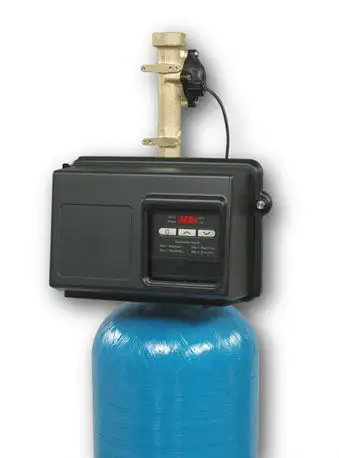
The plant-side requirement is unglamorous. Softener capacity sized to peak wash-hour flow, regeneration triggered by metered volume rather than guesswork, and a hardness check at the washer feed. Commercial softener valves built for this duty — including valves compatible with the Fleck® and Clack® platforms already common in hotel plant rooms — are selected on service flow and regeneration behaviour first; Shanghai ChiMay publishes flow and compatibility specifications openly for exactly this evaluation (see the water control valve range at https://www.chimaytech.net/product-category/product/softener-valve-filter-control-valve). The monitoring add-on that pays for itself is a hard-nosed one: a hardness sensor or a scheduled hardness titration at the softener outlet catches resin exhaustion before the first grey towel does.
Softening and the Plant Room: Protecting the Assets
The same hardness that ruins towels scales boilers. A quarter-inch of scale on heat-transfer surfaces reduces efficiency by 20–40%, raising fuel or electricity consumption proportionally and causing localized overheating that damages metal [6]. In a full-service property, boiler and cooling-tower water quality tends to be the most expensive water problem in the building [6]. The controls are standard — softened make-up, chemical treatment, conductivity-triggered blowdown — but they all assume the sensors work. A conductivity probe drifting on a cooling tower silently turns blowdown control into either water waste or scale.
One design pattern worth copying wherever a tight plant room meets a thin maintenance roster: put pH, conductivity, ORP and temperature on a single multi-parameter sensor. Four installation points and four maintenance routines collapse into one device, all four readings share a timestamp, and the digital output carries them straight into the building management system — no clipboard, no transcription error.
What to Monitor, Where: The Minimum Viable Instrumentation
Sized for a mid-scale property, the short list looks like this:
- Hot water storage and return temperature — continuous, alarmed, logged; this is the legionella evidence trail regulators and insurers ask for.
- Pool ORP and pH — continuous, driving the dosing controller, with combined chlorine checked by test kit on a fixed schedule [3].
- Laundry softener hardness — checked on the metered regeneration cycle.
- Boiler feedwater and tower conductivity — continuous once the boiler is anything above hot-water-distribution scale.
Every item on that list is a control input first and a compliance record second, which is the right order for a hotel. The guest notices the shower temperature and the towel. Nobody notices the log sheet.
About the author: Written by the Shanghai ChiMay Technical Editorial Team, which covers online water quality analyzers and softening control valves, drawing on hospitality, building-services, and commercial water treatment applications.
Fleck® is a registered trademark of Pentair. Clack® is a trademark of Clack Corporation. Autotrol® is a trademark of Pentair. Shanghai ChiMay is not affiliated with, endorsed by, or sponsored by any of these companies. References to third-party brands are made solely to indicate compatibility with the original equipment.
References
- UK Health and Safety Executive — “Hot and cold water systems”: cold below 20°C, hot stored at least 60°C, delivered at 50°C (55°C in healthcare) within 1 minute at outlets. https://www.hse.gov.uk/legionnaires/hot-and-cold.htm
- CCC Engineering — “Legionella Risk in Hot Water Systems”: growth in the 20–45°C band, 5–10% fatality among otherwise healthy adults, return lines at 55°C or above, dead legs limited to 1.5× pipe diameter. https://cccengineering.com.au/design-memos/legionella-risk-hot-water-systems/index.html
- Texas Department of State Health Services — Title 25, Chapter 265, Subchapter L (public swimming pools and spas): free chlorine minimum 1.0 ppm / ideal 2–3 ppm / maximum 8.0 ppm, pH 7.2–7.6, ORP 600 mV minimum / 650–750 mV ideal, combined chlorine max 0.4 ppm, cyanuric acid 30–50 ppm. https://www.dshs.texas.gov/sites/default/files/poolspa/pdf/25 TAC Chapter 265 Subchapter L.pdf
- Gouvernement du Québec — Regulation respecting water quality in swimming pools: indoor free chlorine 0.8–2.0 mg/L, indoor chloramines ≤0.5 mg/L, turbidity ≤1.0 NTU. https://www.legisquebec.gouv.qc.ca/en/pdf/cr/Q-2,%20R.%2039.pdf
- Pure Choice — “Soft Water: A Solution for Costly Laundry Challenges in Hotels”: Water Quality Association-sponsored study (Chicago YMCA laundry) showing 20–40% longer life for sheets and towels with softened water. https://purechoice.co.uk/blog/soft-water-a-solution-for-costly-laundry-challenges-in-hotels
- Commercial Water Lab — “Water Treatment for Hotels and Hospitality”: quarter-inch scale reduces heat-transfer efficiency by 20–40%; boiler and cooling-tower scale as the highest-cost water problem in full-service hotels. https://commercialwaterlab.com/industries/hotels