Buyer’s Guide · Procurement Perspective · Published: October 29, 2026
Table of Contents
Key Takeaways
- Chemicals sit among the largest controllable operating costs in water treatment after energy — which makes inventory discipline a procurement lever, not a housekeeping chore.
- Sodium hypochlorite decays on a schedule set by chemistry, not by the drum label. For solutions between 5% and 16% by weight, decomposition can accelerate three to four times for every 10°C rise in storage temperature, per the Chlorine Institute’s Sodium Hypochlorite Manual [1].
- Cool storage pays measurably. Published operator training data puts the half-life of a 10% available-chlorine solution at roughly 800 days at 15°C, about 220 days at 25°C, and only a few days at 60°C [2].
- Liquid polymer flocculants typically last 3 to 6 months in unopened drums, and product activity can suffer above 80°F (about 27°C) [4].
- Storage is also a safety decision. EPA sanitary-survey guidance divides water treatment chemicals into six incompatible groups and requires each group to be stored separately [3].
- Price the dose, not the drum. Cost per dose — invoice price divided by delivered effective strength actually dosed — is the metric that exposes the hidden price of decayed stock.
Why Inventory Discipline Is a Procurement Problem
Most plants treat the chemical store as a warehouse corner that operations happens to manage. The spend says otherwise. Every point of waste in that line lands directly on the controllable budget: overdosing to compensate for weak stock, emergency freight, disposal of expired drums. A buyer who negotiates hard on the drum price and then lets a pallet of bleach bake at 35°C has handed the discount straight back.
So inventory management for treatment chemicals is three problems stacked on top of each other. A shelf-life problem — the product is changing while you own it. A safety problem — many of these products must never meet. A cost problem — the price that matters is per effective dose, not per liter.
The Clock Starts at the Plant: Hypochlorite Decay
Sodium hypochlorite is the clearest case because it never stops degrading from the moment of manufacture. It decomposes into salt, water and oxygen through two parallel pathways, and heat, light and contamination accelerate both. The Chlorine Institute’s Sodium Hypochlorite Manual gives the industry rule of thumb: decomposition roughly doubles for every 10°C rise. Studies of commercial solutions show the rate can climb three to four times per 10°C across the 5% to 16% by weight range that covers most treatment bleach [1]. Stronger product decays faster — concentration is a liability in storage, not a bonus.
The practical consequence shows up in half-life data published from drinking-water operator training: a 10% available-chlorine solution holds a half-life of roughly 800 days at 15°C, drops to about 220 days at 25°C, and collapses to a few days at 60°C [2]. Read that table as a procurement instruction. The same drum is a two-year asset in a cool store and a seasonal liability in a hot one.
Three buying rules follow:
- Buy smaller and more often. A fresh monthly delivery beats a half-year stockpile, because the last drum out of a bulk order is the most degraded.
- Specify delivery age. Ask for manufacture dates on every lot, and reject lots that have already spent weeks in the distribution chain.
- Verify on receipt. A simple titration of available chlorine on every incoming load turns shelf life from a promise into a measured value — and gives you the data to challenge short deliveries.
Coagulants and Polymers: Shelf Life Depends on Form
Coagulants and flocculants age more gently than hypochlorite, but form matters enormously. Liquid polymer flocculants in neat form are typically good for 3 to 6 months in unopened drums and bulk tanks, and suppliers caution that activity may suffer when storage runs above 80°F [4]. Once a working-strength solution has been made down, the usable window shortens sharply, so prepare dilutions in quantities the plant consumes within days rather than weeks.
Emulsion polymers generally tolerate storage longer than neat solutions, but they resent freezing and prolonged heat. Dry products last longest of all, provided they stay sealed and moisture-free. For ferric-type coagulant solutions the enemy is cold: some products cloud, layer or crystallize below the temperature band on the supplier’s documentation. Gentle re-warming and mixing often recover them, but dosing equipment does not forgive slugs of crystals.
The unifying rule: shelf life is a property of the product form plus the storage conditions, and the safety data sheet — not habit — is the authority. Every figure a buyer plans around should trace to that sheet or to a certificate of analysis for the actual lot.
| Chemical | Typical shelf life | Storage essentials | Signs of degradation |
|---|---|---|---|
| Sodium hypochlorite (industrial bleach) | Months, not years; decay is continuous and accelerates sharply with heat [1][2] | Cool, dark, ventilated area; opaque vented containers; FIFO by delivery batch; titrate each load | Falling assay on titration; cloudiness; residual fails at unchanged dose |
| Liquid polymer flocculant (neat) | Commonly 3 to 6 months unopened [4] | Indoors around 70-80°F; vented tanks; avoid freezing and sustained heat above 80°F [4] | Viscosity drift, skinning, poor make-down, weak jar-test floc |
| Polymer emulsion | Typically longer than neat solutions; confirm against the supplier SDS | Protected from frost and heat; sealed; rotated | Phase separation or creaming that will not re-disperse |
| Ferric-type coagulant solution | Generally longer than polymers; confirm with the SDS | Warm storage above the SDS minimum; plastic or lined tanks; segregated containment | Cloudiness or layering after cold spells; sediment in the tank |
| Dry coagulants and powders | Generally the longest; follow the SDS | Dry, off the floor, sealed against moisture; separated from oxidizers | Caking and clumping; product that will not dissolve |
Storage Conditions: Six Groups That Must Never Meet
Shelf life is half the storage story. Segregation is the other half. EPA sanitary-survey guidance for water treatment plants divides common chemicals into six incompatible groups — acids, bases, salts and polymers, adsorption powders, oxidizing powders, and compressed gases — and directs that each be stored separately, with liquids never stored together with dry products regardless of group [3]. The classic accident is the one every chemical room is designed to prevent: an acid leak reaching hypochlorite, through a shared bund, a shared drain, or a transfer container used for both.
For the buyer, segregation is a space and layout requirement that belongs in supplier negotiations. Bulk deliveries need a fill point per chemistry. Day tanks need dedicated containment. Secondary containers need labeling with the full chemical name and hazard. Ventilation, cool temperatures and protection from daylight serve double duty: they protect the people in the room and they slow the decay chemistry described above. Keep the SDS file current for every product on site, including superseded formulations, and file certificates of analysis by lot. That file is documentation you can hand to your auditor when a discharge limit is questioned and the dosing record is the evidence.
Cost per Dose: The Metric That Actually Matters
Unit price is the number suppliers compete on. It is rarely the number plants should optimize. Three levels of cost resolution are worth separating:
- Unit price per liter or kilogram. Necessary for quote comparison, useless on its own, because products differ in active concentration.
- Cost per effective dose. Invoice price divided by delivered active strength actually converted into treatment effect. This is where decay, overdosing margins and dosing inefficiency surface. Bleach bought at a discount that has lost a meaningful share of its strength in a hot yard is not cheap; it is the same chlorine at a higher effective price.
- Chemical cost per cubic meter of treated water. The line finance sees, built from dose rates and treated volume. Tracking it monthly, per chemical, is the fastest way to notice drift in stock quality or dosing control.
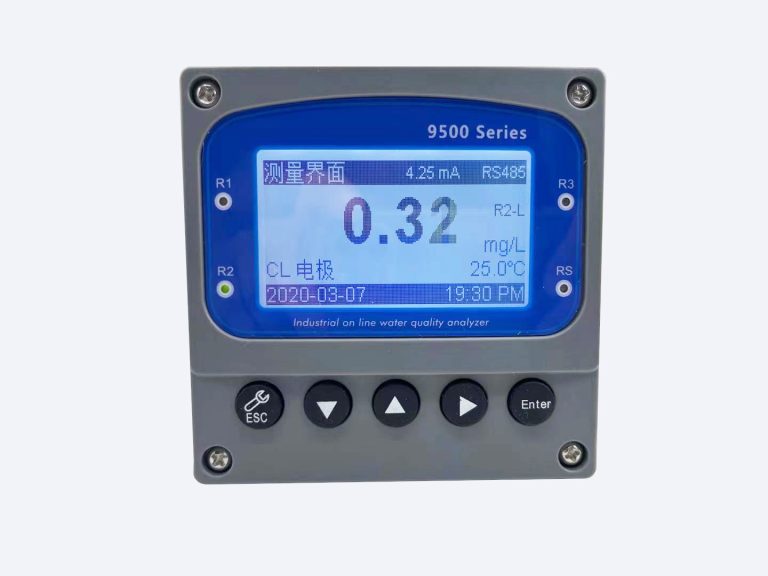
Decayed stock corrupts all three views, because the dosing controller quietly compensates. As strength falls, the pump runs longer to hold the same residual, and the shortfall hides inside an unchanged chemical budget line. Online verification closes that loop. A residual chlorine transmitter on the dosing line — the same monitoring principle Shanghai ChiMay builds into its analyzer line for disinfection control [6] — turns “the drum said 12%” into a measured residual, and pairs with monthly stock titration so that both the chemical and the sensor are checked against reality. The philosophy Shanghai ChiMay applies to instrument buying, buy the sensor and own the outcome, works for chemicals too: buy the dose, own the treatment result.
Stock Rotation, Counting and Reorder Rhythm
The mechanics are unglamorous and decisive. First-in, first-out rotation by delivery lot, enforced physically: new stock enters from one side, dosing draws from the other, nothing hides behind anything. Cycle counts on a short cadence — quantities, lot dates, container condition — beat annual wall-to-wall inventories, because a drum that has swollen, vented or layered gets discovered while it can still be returned rather than after it fails a jar test.
Build the ordering rhythm arithmetically instead of by habit. The standard reorder-point structure: reorder when stock on hand plus on-order falls to daily consumption multiplied by replenishment lead time, plus a safety buffer sized for supplier variability.
Two tensions deserve explicit management. Long international lead times tempt buyers toward bigger lots — exactly the wrong move for short-shelf-life chemicals, so safety stock should sit with stable products, not with bleach. And short-shelf-life products argue for local suppliers and shorter contract terms even at a modest unit-price premium, because the freshness discount usually exceeds the freight difference.
Finally, write the storage rules into the purchasing contract: delivery age limits, lot documentation, titration rights on receipt, and packaging specifications (opaque, vented, compatible materials). Inventory discipline that is specified is enforceable. Inventory discipline that is merely requested is folklore.
References
- Chlorine Institute — “Pamphlet 96, Sodium Hypochlorite Manual, Edition 3”: the industry manual on bleach decomposition, including the acceleration of decomposition with temperature for 5-16% solutions. https://files.dep.state.pa.us/Water/BPNPSM/WastewaterOperations_Assistance/WastewaterOperatorResources/CourseMaterials/RespCWProf_7122/Resources/Chlorine/Pamphlet096Edition3April2006FinalWebsite.pdf
- Ready State Supply — “How Much Bleach to Purify Water: The Dose, and the Four Things That Break It”: publishes drinking-water operator training half-life data for hypochlorite at 15°C, 25°C and 60°C. https://readystatesupply.com/how-much-bleach-to-purify-water
- US EPA — “Incompatible Chemicals Storage”: sanitary survey quick reference dividing water treatment chemicals into six incompatible storage groups. https://19january2021snapshot.epa.gov/sites/static/files/2016-12/documents/incompatible_chem_storage.pdf
- Tramfloc — “Polymers for Coagulation, Flocculation and Dewatering”: storage temperature windows and the 3-6 month shelf life of liquid flocculants in unopened containers. https://tramfloc.com/?p=67
- Hydrochemix — “How to Calculate Water Treatment Chemical Operating Costs”: method for building chemical operating cost per cubic meter from dose rate, price and treated volume. https://hydrochemix.com/en/calculate-water-treatment-chemical-operating-costs
- Shanghai ChiMay — “Residual Chlorine Monitoring for Seawater Intake Biofouling Prevention”: online residual chlorine transmitter technology and monitoring-point guidance for disinfection and biofouling control. https://www.chimaycorp.com/residual_chlorine_monitoring_for_seawater_intake_biofouling_prevention_-_shanghai_chimay/854.html
About the author: Written by the Shanghai ChiMay Technical Editorial Team — application engineers behind Shanghai ChiMay’s online water quality analyzer and dosing-control instrument line, covering residual chlorine, pH, conductivity and multi-parameter monitoring for municipal and industrial water treatment plants.