Board briefing · Decision-maker perspective · Published: October 12, 2026
A facilities director with softeners at ten sites usually has ten regeneration philosophies. One site regenerates every Sunday at 2 a.m. because that is how the original installer set it. Another regenerates on a meter installed years ago by a technician who has since moved on. A third runs a valve nobody can find documentation for. The equipment works — hard-water complaints are rare — but the salt invoices, the water bills, and the emergency calls tell a messier story. This briefing makes the case for converging the whole fleet on metered (demand-initiated) regeneration: what the published evidence supports, what standardization returns beyond the utility bill, and a rollout path that doesn’t require a shutdown season.
Table of Contents
Key Takeaways
- Timed (clock) regeneration ignores actual water use. It flushes salt and water through beds that may not need it, and it can leave a bed exhausted between scheduled cycles [1][4].
- Metered regeneration tracks gallons and regenerates only when softening capacity is actually depleted — the trigger moves from the calendar to the resin [4].
- Published savings when converting from timer-only control: 30–50% less water and 40–60% less salt in one operator-facing summary; 30–50% salt and water in a plumbing-reference glossary; up to 60% on salt and water costs in a dealer sizing guide [1][2][3].
- A full regeneration cycle runs roughly 60–90 minutes through five stages — every avoided cycle returns that water, that salt, and that operator attention to the plant [5].
- Softeners typically regenerate every 2–10 days in residential-scale service. Across a multi-site fleet, the arithmetic of avoided cycles compounds quickly [2].
- Standardization converts scattered savings into governance: one spare-part list, one training package, one data vocabulary — and an audit trail that maps regeneration events to metered volumes.
The Problem: Ten Sites, Ten Philosophies
Mixed fleets are not an edge case; they are the default outcome of organic growth. Equipment arrives with buildings, gets replaced in emergencies, and inherits whatever control philosophy the replacement vendor preferred. The result is a portfolio where the same hardness load is managed by calendar clocks in one building and flow meters in another.
The finance team sees aggregated salt and water spend. The operations team sees site-level anecdotes. Nobody sees the counterfactual — what the fleet would spend if every valve regenerated on need rather than on schedule — because no two valves record the same data in the same way.
Timed vs Metered: A One-Page Refresher
A timed valve regenerates on a fixed schedule regardless of how much water has passed. A metered valve contains a flow measurement, tracks the gallons treated, and triggers regeneration when the resin’s remaining capacity hits its reserve [1][4]. Demand-initiated variants extend the idea with pressure-differential or sensor-based triggers for larger systems [4]. Industry comparison tables frame the trade-off bluntly: metered control rates high on salt efficiency because it regenerates only when needed, while timed control regenerates too often or not enough depending on usage [4].
| Dimension | Timed (clock) regeneration | Metered (on-demand) regeneration |
|---|---|---|
| Trigger | Calendar schedule at a fixed interval, regardless of usage [4] | Actual gallons treated; reserve capacity exhausted [4] |
| Low-usage period | Regenerates anyway — salt and water spent on a clean bed [1] | Skips unnecessary cycles; capacity conserved [1] |
| High-usage period | Can run out of soft water before the next scheduled cycle [1] | Regenerates when capacity demands it; quality holds [1] |
| Salt and water per unit of duty | Higher consumption for the same softening load [2] | Published conversions report 30–60% savings across summaries [1][2][3] |
| Audit trail | Interval-based records, hard to tie to production volumes | Volume-based records that map to water metering and billing |
What the Published Numbers Support
Three independent summaries converge on the same band. An operator-facing guide to demand-initiated regeneration reports water waste reduced by 30–50% and salt use cut by 40–60% versus timer-based regeneration [1]. A plumbing-reference glossary states that demand-initiated systems save 30–50% salt and water against timer-only control [2]. A dealer sizing guide puts it in procurement language: metered systems that track actual usage save up to 60% on salt and water costs, with a higher upfront price that typically loses to lifetime savings [3].
A board doesn’t need to adjudicate the exact decimal. The band — roughly one-third to three-fifths of salt and water spend, depending on how badly the old schedules were set — is wide enough to justify a program and narrow enough to underwrite it.
The mechanism is visible in the cycle itself. A regeneration runs roughly 60–90 minutes through five stages — backwash, brine draw, slow rinse, fast rinse, and brine-tank refill [5] — and softeners typically cycle every 2–10 days in service [2]. Multiply a site’s regenerations per year by the salt and water each cycle consumes, apply the published reduction band, then price salt, brine disposal, and water at local tariffs. Where timed schedules were set conservatively — the usual case, since installers guard against hardness breakthrough — the avoided cycles concentrate in low-occupancy, low-production periods, which is exactly where waste stings most.
There is also a quiet second effect. Because a metered valve records the volume between regenerations, the fleet gains a per-site hardness-load series it never had under calendar control. That series feeds the sizing decisions, the salt contracts, and the next capital request.
What Standardization Buys Beyond the Bill
The utility savings justify the first valve conversion; the governance returns justify the program. Standardizing a fleet on metered regeneration delivers four compounding benefits:
- One spare-part list. Fleet spare-parts inventory exists to absorb variance. Every divergent valve platform adds SKUs, shelf space, and the risk that the needed rebuild kit is at the wrong site. Convergence collapses the list.
- One training package. Technicians trained on one regeneration logic diagnose one class of faults. Training hours drop, and the emergency call a site makes is one the nearest technician can already answer.
- One data vocabulary. Metered valves speak in gallons between regenerations — a number that maps directly onto production volumes, water bills, and ESG reporting. Calendars do not. The audit trail that follows (regeneration events tied to metered volumes) satisfies both internal review and external audit without custom paperwork.
- Consistency of soft-water quality. Demand-triggered control regenerates when capacity is depleted rather than when the calendar permits, which removes the seasonal hardness-breakthrough incidents that timed schedules produce during usage spikes [1].
The Rollout Path
Stage 1 — Audit the installed base. Walk every site and record: tank diameter and opening, valve platform and age, whether regeneration is timed or metered, whether a functioning flow meter exists, and what documentation survives. Mixed commercial fleets seat valves on Fleck®-style, Clack®-style, and Autotrol®-style bases alongside others, so the audit is also the moment to photograph nameplates and measure necks. The output is a one-page fleet matrix — the artifact every later decision references.
Stage 2 — Pilot one site, measure both sides. Convert a representative site (not the best-run one; the median one) to metered control. Log salt deliveries, water usage, and regeneration counts for a defined baseline period before and after. The pilot’s purpose is not the savings number — the published band already supports the program — but the calibration of your own fleet’s baseline and the discovery of site-specific surprises (undersized drains, missing underbedding, glycol loops) before they multiply.
Stage 3 — Convert in waves and unify spares. Schedule conversions in waves grouped by valve class and tank geometry, so installation crews build repetition. At each wave, consolidate spares onto the standardized platform and retire orphaned rebuild kits. Replacement valves for the conversions should be selected as drop-in conversions for the platforms the audit found — for Fleck®-series and Clack®-style installations in particular, the replacement must preserve port size, flow, and footprint rather than trigger tank re-purchases.
Stage 4 — Governance. Put the standard in writing: regeneration mode, reserve setting, salt quality, brine-tank refill cadence, and the reporting format. Where sites report into a central system, metered valves with digital outputs let regeneration data flow into the same historian as production data — the difference between governance and folklore.
Risks and How to Retire Them
Four objections surface in every standardization review. Each has a routine answer.
- “Some sites run equipment we cannot match.” Proprietary interfaces and odd tank geometries are the audit’s job to find in Stage 1, not the installer’s job to discover in Stage 3. The wave plan should route unmatched hardware to a compatibility review — replacement valves engineered to fit the dominant Fleck®-series and Clack®-style connections cover most of a typical fleet, and the remainder either waits for tank replacement or is retired on economics.
- “The pilot will look cherry-picked.” Select the median site by water volume and regeneration count, define the baseline window before any hardware ships, and publish the before/after regardless of outcome. A slightly disappointing pilot that surfaces two real site problems is worth more to the program than a flattering one that hides them.
- “Salt quality will corrupt the comparison.” Metered control changes when regeneration happens, not how well the brine is made. Standardize salt grade and brine-tank housekeeping in the same wave as the valve, or the data will measure two variables at once.
- “The data goes nowhere.” A metered valve whose counts are transcribed by hand loses most of its governance value. Where central reporting matters, specify digital output and historian integration in the valve purchase itself, so Stage 4 inherits a data stream instead of a clipboard.
Investment and Payback Frame
A board-level appraisal needs three numbers, each obtainable before committing:
- Retrofit cost per site — replacement valve or meter retrofit kit, installation hours, and any tank-geometry corrections the audit surfaced.
- Annual consumable savings per site — regenerations per year × salt and water per cycle × the conversion band (30–60% from the published comparisons [1][2][3]) × local salt, water, and sewer tariffs.
- Avoided incident cost — the hardness-breakthrough events, emergency calls, and re-softening cycles that demand-triggered control removes [1]. Conservative fleets count these at zero and treat anything booked as upside.
Payback equals the first number divided by the sum of the other two. Fleets whose timed schedules were set conservatively — most of them — will find the consumable line alone carries the program; the incident line is the dividend standardization pays after the invoices stop arguing with it.
A Note on Procurement
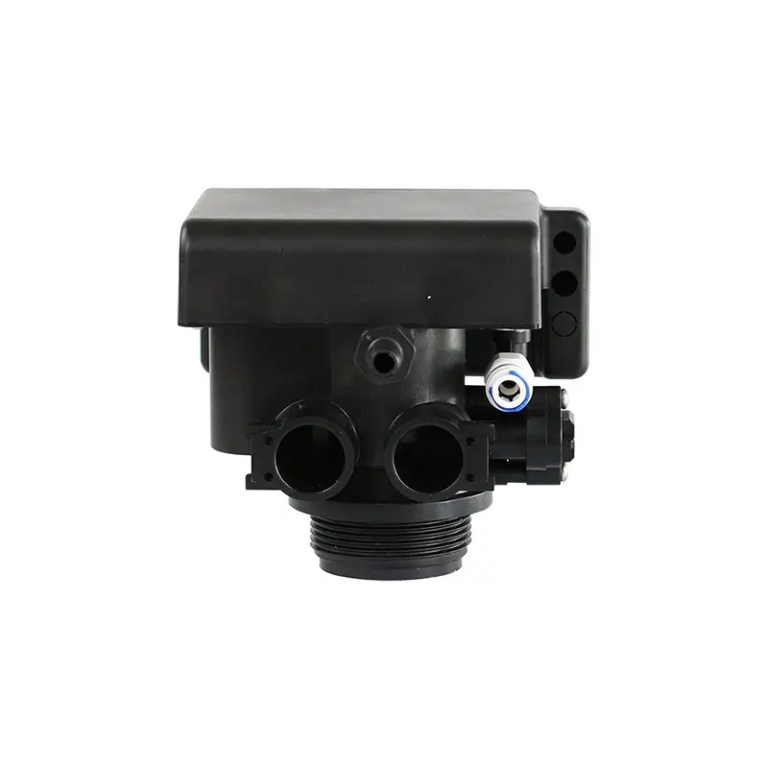
Standardization succeeds when the replacement valve is the easy part of the conversion. Shanghai ChiMay builds its softener control valve line around that requirement: valves designed to fit Fleck®-series and Clack®-style installations, published flow and pressure specifications, and factory customization — “your logo, your protocol, your packaging — MOQ 1” — so a fleet that brands equipment per client site can standardize function without rebranding assets site by site. For a multi-site operator, the procurement question is not which valve is cheapest per unit; it is which platform makes the tenth site as simple as the second.
References
- Home Water Softener guide — “Demand Initiated Regeneration Water Softener”; reports water waste reduced 30–50% and salt use reduced 40–60% versus timer-based regeneration. http://www.home-water-softener.com/demand-initiated-regeneration-water-softener.htm
- Washington Plumbers glossary — “Regeneration cycle”; notes that demand-initiated systems save 30–50% salt and water versus timer-only, with typical regeneration every 2–10 days. https://washingtonplumbers.net/glossary/regeneration-cycle
- SoftPro Water Systems — “Should I Buy a Metered or Timed System” sizing guide; metered systems track actual usage and save up to 60% on salt and water costs. https://www.softprowatersystems.com/pages/should-i-buy-metered-or-timed-system-for-sizing-accuracy
- Crystal Quest blog — control valve comparison covering metered, timed and demand-initiated regeneration, with efficiency ratings for each trigger method. https://crystalquest.com/blogs/water-softeners-conditioners/water-softener-control-valves
- SubcontractorHub — water softener regeneration calculator; a full cycle runs roughly 60–90 minutes in five stages, with on-demand regeneration preferred over timed control. https://www.subcontractorhub.com/tools/water-softener-regeneration-calculator
- Shanghai ChiMay — softener and filter control valve product line; replacement valves with metered regeneration options and published flow specifications for compatibility-based conversions. https://www.chimaytech.com/
Fleck® is a registered trademark of Pentair. Clack® is a trademark of Clack Corporation. Autotrol® is a trademark of Pentair. Shanghai ChiMay is not affiliated with, endorsed by, or sponsored by any of these companies. References to third-party brands are made solely to indicate compatibility with the original equipment.
About the author: Written by the Shanghai ChiMay Technical Editorial Team — the editorial group behind Shanghai ChiMay’s softener and filtration control valve line, covering regeneration control, fleet standardisation and valve compatibility for commercial and industrial water systems.