Technical Deep Dive · Engineering Perspective · Published: September 29, 2026
Table of Contents
Key Takeaways
- Water hammer is a pressure transient created whenever flowing water is forced to stop or change direction suddenly — most often by a fast-closing valve or a stopping pump — and the resulting shock wave travels through the pipe, deflecting everything in its path [1].
- The Joukowsky equation predicts the surge: pressure wave speed is roughly 4,000 ft/s in steel pipe and 1,200–1,300 ft/s in PVC, so stopping a 5 ft/s flow in a 12-inch steel main can generate about 610 ft of head, roughly 266 psi of added pressure [3].
- Closure speed is decisive. A valve that closes faster than the critical time 2L/a experiences the full instantaneous surge, while slower closure attenuates it dramatically [3].
- Motorized valves with adjustable closing times, typically 30–90 seconds, are one of the most practical retrofits for transient-prone systems [4].
- In softening and filtration skids, regeneration cycle transitions are a recurring closure event; high inlet pressure makes it worse, and troubleshooting guidance recommends a pressure-reducing valve above 80 psi and a hammer arrestor on the softener inlet [5].
- Mitigation is a package deal. Slow-closing valve design, cushioned check valves, surge vessels or standpipes, and ramped pump control each remove one trigger, and most systems need more than one.
What Water Hammer Actually Is
Every plant operator knows the sound: a single heavy bang from the pipe gallery when a valve snaps shut, or a rattling chase of noises when a pump trips. The formal name is hydraulic transient, or surge. Water flowing in a pipe carries momentum; when a valve closes quickly, that moving column of water is decelerated almost instantly, and its kinetic energy converts into pressure energy. Water is barely compressible, so the pressure spike can be very large [1]. The shock wave then travels back and forth through the pipeline, reflecting off valves, dead ends and the source, creating complex pressure patterns that can take several seconds to decay [2].
The same physics applies on the low-pressure side. Rapid opening, pump starts and column separation can pull the line below atmospheric pressure, collapsing vapor cavities that slam shut with equal violence. Transient analysis is therefore not just about overpressure: both the positive spikes and the vacuum events stress joints, supports and equipment [2].
The Joukowsky Equation, in Plain Numbers
The classical relation for an abrupt velocity change is ΔP = ρ · a · ΔV, where a is the wave speed in the specific pipe. Wave speed depends on the fluid and the pipe’s elasticity: approximately 4,000 ft/s in steel and 1,200–1,300 ft/s in PVC [3]. The numbers make the stakes concrete. Stopping a 5 ft/s flow in a 12-inch steel main produces about 610 ft of surge head, approximately 266 psi, on top of whatever static pressure the system already carries [3]. A Class 150 assembly that is comfortable at 60 psi steady state is suddenly seeing several times its design margin.
Timing matters as much as magnitude. Close the valve faster than the critical time 2L/a — the round trip of the pressure wave to the pipe inlet and back — and the full Joukowsky surge develops. Close it more slowly and the reflected wave returns before the valve is seated, partially cancelling the rise, so the surge is reduced [3]. That single fact drives most of the mitigation playbook below.
Why Fast-Closing Valves Are the Main Trigger
Valves are usually the culprit because they are the only devices in the line that change flow area on command. Rapid closure of a shut-off valve builds pressure upstream of the disc and sends the wave front back toward the source at wave speed [2]. The classic offenders are solenoid valves, quarter-turn ball valves driven by fast actuators, and swing check valves that slam shut when flow reverses after a pump stop.
Check valve slam deserves its own note. When a pump stops, the reversing column slams a conventional swing check shut, converting the entire reverse velocity into a transient. The behavior is severe enough that many industrial plants prohibit swing check valves on critical services, preferring dual-plate or axial designs with softer closing action [2] — a lesson that applies equally to skid-mounted treatment equipment.
The Damage: Piping, Valves, Tanks, and Everything Between
Transient pressure is an equal-opportunity destroyer:
- Piping and supports. Repeated surges fatigue pipe walls, crack cement-lined joints, and shake loose hangers and clamps. The noise in a rattling residential wall is the same mechanism that eventually fractures a main [1][6].
- Valve internals. The shock passes straight through the valve trim. Seats, seals, gaskets and stems see impact loading they were never rated for, and packing or gasket failure follows [2].
- Tanks and vessels. Pressure vessels and tank nozzles see oscillating peaks measured in milliseconds — peaks that ordinary relief valves respond to far too slowly [2].
- Instrumentation. Gauges, switches and sensors mounted close to the closure point take the first hit, which is why pressure instruments near fast valves fail disproportionately often.
- Pumps. Reverse rotation and shock loading after a pump trip damage impellers, seals and couplings.
The table below maps the most common causes to their consequences and the mitigation options that address each.
| Cause | Typical consequence | Mitigation |
|---|---|---|
| Fast solenoid or actuated valve closure (faster than 2L/a) | Full Joukowsky surge; pipe and trim damage [3] | Slow-closing actuation, typically 30–90 s adjustable [4]; two-stage closing |
| Check valve slam after pump stop | Reverse-velocity impact, seat damage, pipe shake | Spring-assisted, cushioned, or nozzle-type check valves [2] |
| Pump start/stop without ramping | Startup surge and stop-column separation | Soft starters and variable frequency drives with controlled deceleration |
| High static inlet pressure | Every transient stacks on top of an elevated baseline [5] | Pressure-reducing valve recommended above 80 psi [5] |
| Long mains with high velocity | Large 2L/a critical time window; big momentum to stop | Larger diameter or lower velocity; surge vessel or standpipe |
| Trapped air pockets | Spring-like amplification of surges | Automatic air release valves at high points |
Closing Conditions in Softener and Filtration Systems
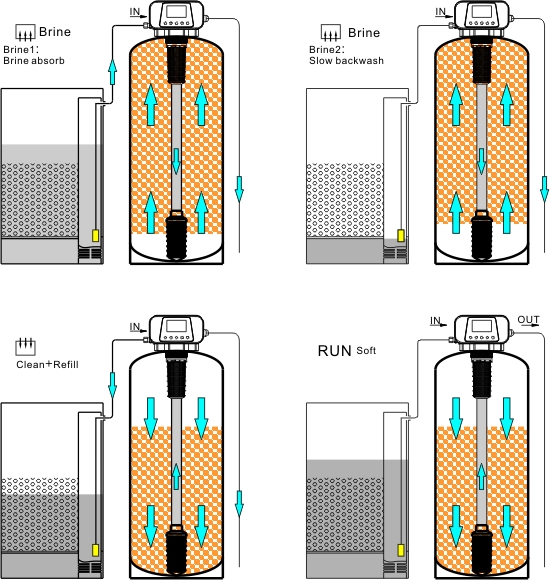
Skid-mounted ion exchange and filtration equipment has a characteristic closure profile of its own. During service, the control valve holds a steady flow path. During regeneration, the valve steps through backwash, brine draw, slow rinse and fast rinse positions in sequence, and each transition re-ports the flow. A transition that shuts the service port while the downstream loop is still demanding flow is exactly the rapid-closure event described above — and in compact residential and light-commercial plumbing, the pipe runs are short, so reflections come back fast and loud.
Field troubleshooting lists for softeners confirm the pattern: banging at the start or end of regeneration is attributed to high inlet pressure, rapid closing of the valve ports, missing hammer arrestors, and undersized or loose plumbing [5]. The same sources give a practical prescription: measure the static pressure and install or adjust a pressure reducing valve above 80 psi, secure the piping near the softener, and fit a water hammer arrestor on the inlet line where banging occurs during cycle shifts [5]. Upstream equipment matters too — a booster pump ahead of the softener that trips on a pressure switch multiplies every one of these effects.
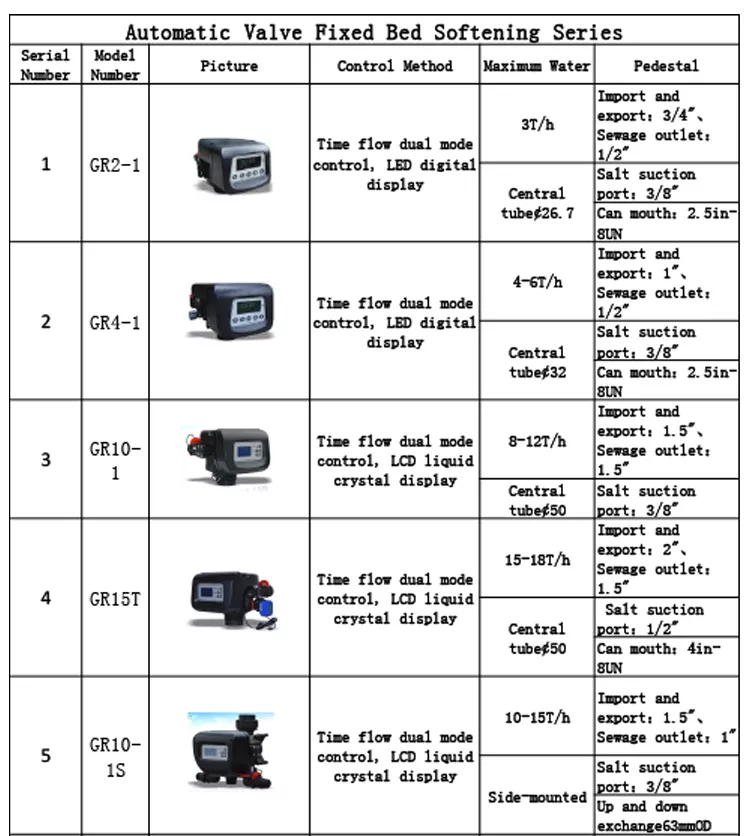
For equipment builders, the design lesson is to specify valve platforms and actuators whose closing behavior is documented, not discovered on site. Shanghai ChiMay publishes Cv values, flow rates and pressure loss figures for its softener and filtration valves openly — we publish the numbers other suppliers make you ask for — because matching the closure characteristic to the hydraulic profile is impossible when the only datum on the datasheet is port size.
The Mitigation Toolkit
Slow-Closing Valve Design
The most direct fix for valve-generated surge is to slow the closure down. Motorized valves with adjustable closing times, typically in the 30–90 second range, let the water column decelerate gradually; on zone valves, choosing a 60-second actuator over a 30-second version materially reduces the pressure rise [4]. Where a control valve throttles toward the seat, a uniform rate-of-change closure — rather than a characteristic that snaps shut in the last few degrees — keeps the effective closure time long [2]. On multiport softener valves, review the transition timing in the controller so no cycle step closes a port faster than the downstream demand can absorb.
Cushioned and Nozzle-Type Check Valves
Against check-valve slam, the fix is a check valve whose disc is guided, spring-biased or damped so it seats before the reverse column reaches full velocity. Dual-plate and axial (nozzle) check valves provide this softer closing action and are the standard substitution where swing checks have caused trouble [2].
Surge Arrestors, Air Chambers, and Surge Vessels
When the source of the transient cannot be slowed — fast-cycling equipment, long mains, critical processes — the system has to absorb the energy instead. Sealed hammer arrestors with a captive air or gas cushion placed near the offending fixture absorb valve-closure shock; larger surge vessels and standpipes do the same energy-absorption duty on pumped mains [4]. Air release valves at high points remove the trapped air that otherwise amplifies the shock.
Variable Speed Pump Control
Where pumps set the rhythm of the system, ramped starting and controlled deceleration through a variable frequency drive remove the start and stop transients entirely, and pressure-control loops can hold the baseline steady so every transient lands on a predictable, lower operating point [4].
Selection and Installation Recommendations
- Compute the critical time first. With pipe length and wave speed known, 2L/a tells you whether a given valve is a “fast” or “slow” closer in that specific system [3].
- Specify closing behavior, not just Cv. Two valves with identical capacity can have very different effective closure times depending on their characteristic curve; ask for closure data [2].
- Control the baseline. A pressure-reducing valve on high-pressure inlets lowers the plateau every transient rides on [5].
- Protect the softener inlet. An arrestor at the inlet, secure supports, and a correctly sized drain line prevent the most common field complaints on regeneration equipment [5].
- Prefer documented, replaceable internals. Valves with published material and sealing specifications are easier to maintain after years of transient exposure; Shanghai ChiMay builds its softener and softening-filtration valves around ceramic-seated, engineered-polymer internals precisely so that long-term cycling remains predictable.
- Retest after changes. Any pump, valve or piping change shifts the reflection pattern; transient effects should be rechecked whenever the line is modified.
Water hammer is not an exotic phenomenon reserved for long transmission mains. It is an everyday byproduct of closing valves in ordinary systems — which means it is an everyday design problem with an established, affordable set of answers.
References
- Engineering ToolBox — “Water Hammer”: reference page on surge created by rapidly closing or opening valves and starting or stopping pumps, with the energy conversion that produces the pressure spike. https://engineeringtoolbox.com/water-hammer-d_966.html
- KSB Know-how — “Exact transient flow analyses can prevent immense damage”: pump manufacturer’s engineering article on surge generation by rapid valve closure, wave propagation and reflection, check-valve behavior, and transient analysis. https://www.ksb.com/en-rs/know-how/magazine/tips-and-tricks/transient-flow-analysis-helps-avoid-risks-of-surge-pressure
- PE-Calc — “Water Hammer Calculator — Joukowsky Surge Pressure”: calculation reference giving the Joukowsky equation, wave speeds of about 4,000 ft/s in steel and 1,200–1,300 ft/s in PVC, the worked example of ~266 psi surge for 5 ft/s in a 12-inch steel main, and the 2L/a critical closure time. https://pe-calc.com/tools/water-hammer
- National Pumps and Boilers — “Understanding Water Hammer: How to Prevent Pump Damage from Pressure Surges”: mitigation guidance covering motorized valves with 30–90 second adjustable closing times, arrestors, and pump protection methods. https://nationalpumpsandboilers.co.uk/blog/understanding-water-hammer-how-to-prevent-pump-damage-from-pressure-surges
- TechFaultFix — “Softener causes water hammer or banging pipes when starting or ending regeneration”: field troubleshooting guide attributing softener banging to high inlet pressure, rapid port closing, missing arrestors and undersized plumbing, with the 80 psi pressure-reducing-valve recommendation. https://techfaultfix.com/water-softeners/marlo/softener-causes-water-hammer-or-banging-pipes-when-starting-or-ending-regeneration
- American Society of Plumbing Engineers — “Plumbing 101: Breaking Down the Water Hammer Phenomena”: explainer on kinetic and potential energy exchange in piping and how shock waves deflect everything in their path. https://aspe.org/pipeline?p=7606
About the author: Written by the Shanghai ChiMay Technical Editorial Team — engineers who design softener and softening-filtration control valves, support OEM equipment builders on valve selection and installation, and publish the hydraulic specifications behind every valve they ship.