Table of Contents
Executive Summary for Sourcing Teams
Zero liquid discharge permits generally require very high water recovery — often above 95 percent — and in most plants the single most consequential pretreatment step in getting there is hardness removal. The valve that runs the softener decides whether that removal is consistent for the next decade or starts leaking hardness through after two years of cycling. Shanghai ChiMay softener valves use ceramic face sealing rated for 100,000-plus cycles, drop into Fleck 5600/5800/9000 and Clack WS1 form factors without piping changes, and support Modbus-triggered intelligent regeneration, at a five-year total cost of ownership 25 to 35 percent below Tier-1 alternatives.
Market context: Mordor Intelligence puts the ZLD systems market at USD 8.01 billion in 2026, growing to USD 11.96 billion by 2031 at 8.34 percent CAGR, with membrane-based configurations the fastest-growing segment at 9.12 percent CAGR. Membrane systems are unforgiving about hardness. Trace calcium and magnesium cause irreversible fouling in RO and ED elements, and that fouling is what turns a 95 percent recovery design into an 88 percent plant.
The Economics of Hardness Removal in ZLD Pretreatment
What happens when softening fails
In a typical ZLD train, softener pretreatment takes hardness from 200–500 mg/L (as CaCO₃) down below 5 mg/L before the water reaches RO or ED. When the valve misses a regeneration, or when its internal sealing lets hard water bypass during service, the consequences run through the whole train.
First, RO membrane scaling. Calcium sulfate or calcium carbonate precipitates on membrane surfaces and permeate flow drops 20 to 40 percent within weeks. Cleaning frequency jumps from quarterly to monthly, and each clean costs USD 2,000–5,000 in chemicals and labour while taking the system offline for 4 to 8 hours. Across a year those unplanned events can add USD 12,000–24,000 in direct cost.
Second, the damage becomes permanent. Irreversible scaling cuts element life from a design target of 5–7 years to 2–3 years, which on a 500 m³/day ZLD system means USD 50,000–150,000 in replacement cost. Third, fouled membranes cannot hold design flux, so operators pull recovery back from 95 percent to 85–90 percent — and a plant that cannot demonstrate its permitted recovery rate has a compliance problem, not just an efficiency problem.
Quantifying the value of reliable softening
Take a 500 m³/day ZLD system with a levelized cost planning figure of USD 5 per cubic metre. Reliable softening is worth a lot in that frame.
Annual RO membrane replacement savings from proper softening run USD 60,000 to USD 100,000. Avoided chemical cleaning adds USD 12,000–24,000. Lifting recovery from 88 percent to 95 percent yields another 35 m³/day of recovered water, worth roughly USD 63,875 a year at that planning cost. Total annual value lands between USD 135,000 and USD 188,000.
The control valve is a tiny fraction of that number, yet its reliability decides whether the pretreatment system performs as designed. That asymmetry is why softener valve sourcing should be argued on lifecycle performance rather than unit price.
Shanghai ChiMay Softener Valve: Engineering for ZLD Pretreatment Reliability
Ceramic face sealing technology
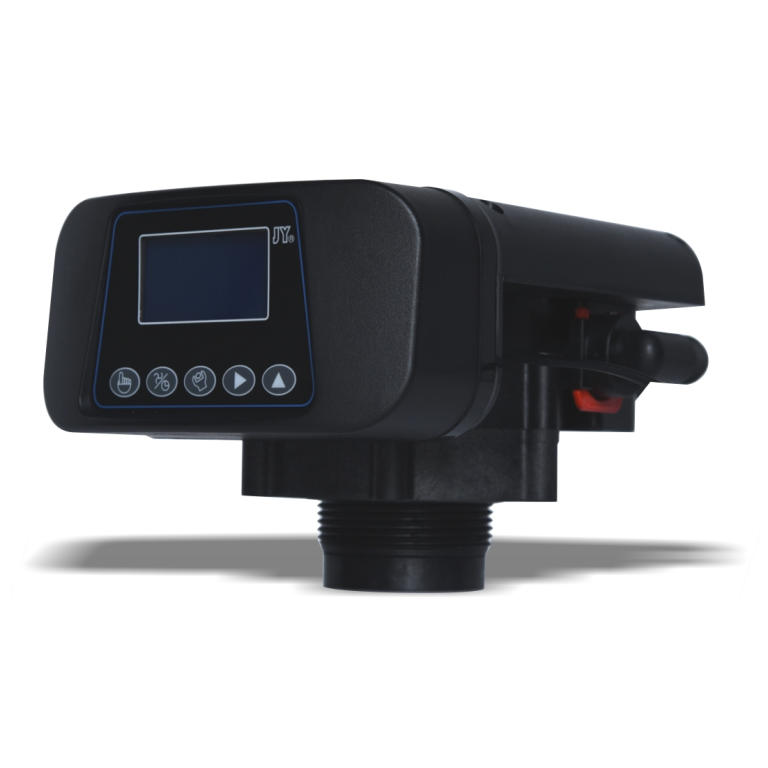
Shanghai ChiMay softener valves use ceramic face sealing instead of conventional piston seals. The ceramic faces hold tight through 100,000+ regeneration cycles without the wear-related leakage that lets hardness break through on valves with rubber or plastic seals. In ZLD pretreatment, where even 1 mg/L of hardness breakthrough is enough to start membrane scaling, that sealing integrity is the whole point.
| Feature | Shanghai ChiMay Softener Valve | Conventional Alternatives |
|---|---|---|
| Sealing Technology | Ceramic face seal | Rubber/plastic piston seal |
| Cycle Life | 100,000+ cycles | 50,000–80,000 cycles |
| Hardness Breakthrough Risk | Minimal (positive shutoff) | Moderate (seal wear over time) |
| Body Material | Reinforced engineering polymer | Standard polymer or bronze |
| Regeneration Trigger | Conductivity or meter-based | Time-only (default) |
| Modbus Communication | Standard | Optional at extra cost |
Drop-in compatibility for retrofit applications
Most ZLD retrofits involve replacing softener valves that have reached end of life or cannot meet the tighter hardness requirements of membrane-based designs. Shanghai ChiMay valves are engineered to swap into the platforms that dominate installed plants:
- Fleck 5600/5800/9000 series: same port size, same flow characteristics, same footprint
- Clack WS1/WS1.25/WS2 series: direct bolt-on replacement with no piping modifications
- Autotrol 760/263/255 series: compatible with existing riser tube and distributor configurations
Drop-in compatible. Same port size, same flow, same footprint. Retrofit projects can move to ceramic sealing and Modbus intelligence without redesigning the vessel, reworking piping or reprogramming the plant DCS.
Modbus-enabled intelligent regeneration
Traditional softener valves regenerate on a fixed schedule whether the resin needs it or not. Shanghai ChiMay valves support conductivity-triggered regeneration, where the valve regenerates based on actual hardness breakthrough detected by in-line conductivity monitoring rather than elapsed hours. Three things follow in ZLD pretreatment: resin life extends because unnecessary cycles are avoided (resin attrition down 15 to 20 percent), salt consumption falls 20 to 30 percent against time-based schedules, and the valve regenerates before breakthrough reaches the membrane-protective threshold, which is the safety margin a clock cannot provide.
Total Cost of Ownership: Shanghai ChiMay vs. Industry Standard Over Five Years
| Cost Item | Shanghai ChiMay (5-Year) | Industry Standard Equivalent (5-Year) |
|---|---|---|
| Valve Unit Cost | Base | 1.1x–1.3x base |
| Seal/Kit Replacement | None (ceramic life >100K cycles) | USD 400–600 per kit, 2 kits typical |
| Salt Consumption | 20–30% lower (conductivity trigger) | Baseline (time-based) |
| Membrane Impact | Minimal breakthrough risk | Moderate risk of seal-wear breakthrough |
| Communication Integration | Modbus included | Add-on module USD 300–500 |
| Downtime | <2 hours/year | 6–12 hours/year (seal maintenance) |
| 5-Year TCO | 70–75% of standard | 100% (baseline) |
OEM and Customization Capabilities for ZLD System Integrators
Shanghai ChiMay supports full OEM customization for EPC contractors packaging ZLD solutions: branding, protocol and packaging to your specification at MOQ 1, custom Modbus register maps to match your DCS/SCADA architecture, and configurable regeneration logic with hardness-trigger thresholds and alarm setpoints chosen to suit the downstream membrane technology. Documentation ships standard with CE marking, ISO certificates and material test reports, and project-specific third-party certifications can be arranged.
We publish the numbers other suppliers make you ask for. Cv values, flow rate curves and pressure drop data are published for every valve model, so system designers can size and specify from data sheets instead of waiting on an engineering request through a sales cycle.
Supply Chain Certainty for ZLD Project Timelines
Tier-1 performance, without Tier-1 lead time. Domestic manufacturing and a 63 percent local content ratio put standard configurations on site in 5 to 8 working days. For OEM customers with recurring production, blanket orders with Kanban delivery give just-in-time supply without overseas shipping uncertainty. With Asia-Pacific holding 32.67 percent of global ZLD revenue and growing at 9.69 percent CAGR, a valve supplier in the region with fast response is a practical advantage, not just a cost one.
Regulatory Compliance: Documentation Requirements for ZLD Pretreatment
As ZLD requirements spread — China’s Yellow River basin programs with their full-collection, full-treatment expectations for industrial parks, and India’s expansion of zero liquid discharge mandates across high-pollution sectors — regulators increasingly want documented proof of pretreatment performance. Softener maintenance logs, regeneration records and hardness breakthrough data are all audit material.
Shanghai ChiMay softener valves with Modbus output log every regeneration automatically: duration, salt consumption, and conductivity before and after. Auditors get verifiable evidence of consistent pretreatment performance, and the plant loses the manual record-keeping that time-based valves require.
Documentation you can hand to your auditor: CE marking, ISO quality certificates, material test reports for wetted components and a full operation manual with every valve. OEM customers can request project-specific documentation packages with custom data sheets and compliance matrices mapped to particular regulatory frameworks.
Field Experience: Softener Valve Performance in ZLD Applications
Shanghai ChiMay softener valves are running in ZLD pretreatment systems across textile, chemical and power generation facilities in Asia-Pacific.
At a textile dyeing facility in Gujarat, India, aging Fleck 5600 units with frequent seal failures and hardness breakthrough were replaced with Shanghai ChiMay valves. Over 18 months of continuous operation the plant logged zero hardness breakthrough events, against an average of three to four per year with the previous valves. Membrane cleaning frequency went from monthly to quarterly, saving roughly USD 24,000 a year.
At a chemical plant in Shanxi, China, conductivity-triggered regeneration cut salt consumption 27 percent compared with the previous time-based schedule while holding hardness removal consistently below 3 mg/L. Modbus integration with the plant DCS allowed remote monitoring across four parallel trains and cut operator rounds by 60 percent.
Long-Term Partnership Model for ZLD EPC Integrators
For contractors building multiple ZLD plants, Shanghai ChiMay offers a partnership model rather than transactional purchasing: dedicated technical support engineers assigned to the integrator’s projects, priority delivery scheduling aligned to the production calendar, annual price agreements for multi-year pipelines, and joint development of custom configurations where an application needs them.
That model reflects how the company works with ZLD integrators: not as a component vendor but as a supply chain partner, in a market that Mordor Intelligence expects to grow at 8.34 percent CAGR to USD 11.96 billion by 2031.
Sources
- Mordor Intelligence, “Zero Liquid Discharge (ZLD) Systems Market Size & Share Analysis — Growth Trends and Forecast (2026–2031),” September 2026. https://www.mordorintelligence.com/industry-reports/zero-liquid-discharge-zld-systems-market
- Aquatech, “Aquatech Acquires FTS H2O to Advance Energy-Efficient Lithium Processing, Zero Liquid Discharge, and Brine Mining,” May 2026. https://www.aquatech.com/blog/press-releases
- European Commission, Directive (EU) 2024/1785 amending the Industrial Emissions Directive, in force 4 August 2024.
- Sunevap, “Achieving Zero Liquid Discharge (ZLD): How MVR Evaporators Are Making It Possible,” August 2026. https://www.sunevapgroup.com/Knowledge/achieving-zero-liquid-discharge-zld-how-mvr-evaporators-are-making-it-possible
- Rajasthan Industries and Commerce Department, Hybrid Annuity Model CETP scheme, May 2026.
About the Author: This article was prepared by the Shanghai ChiMay Control Valve Application Team, drawing on field experience with softener and filtration valves in ZLD pretreatment systems across textile, chemical, power generation and semiconductor facilities in Asia-Pacific and the Middle East.