Table of Contents
The Dissolved Oxygen Problem in UPW Storage
Ultrapure water does not stay pure the moment it leaves the treatment train. It sits in intermediate tanks, circulates through distribution loops, and waits at point-of-use connections — and every one of those steps is a chance for dissolved oxygen to get in and biology to get going. UPW has almost no nutrients, which limits bacterial growth, but oligotrophic organisms can still survive and multiply in storage, releasing organic acids and particles that push water quality below fab specification. Dissolved oxygen is the variable that controls this, and holding it at the right level protects wafer yield at advanced nodes.
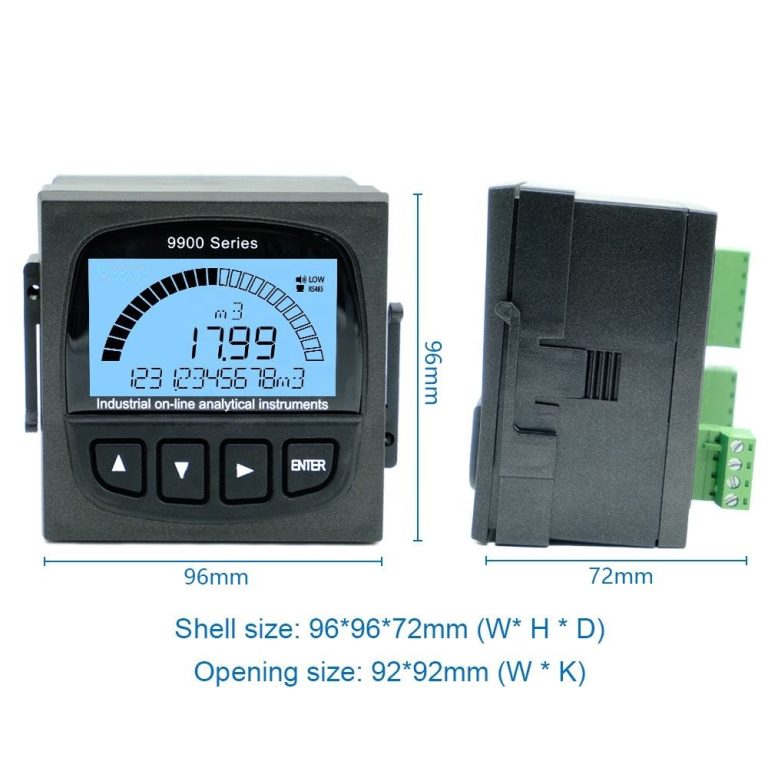
Shanghai ChiMay’s dissolved oxygen transmitter monitors DO continuously in UPW storage and distribution systems, so operators can maintain the anaerobic conditions that suppress biological contamination and confirm that nitrogen blanket systems are actually working. This analysis covers the biology at work, the monitoring requirements, and how the optical DO measurement delivers the precision high-volume semiconductor manufacturing needs.
Why DO Matters in Semiconductor UPW Systems
Biological Stability and Organic Contamination
DO above 10 μg/L in a UPW storage tank tells you aerobic microorganisms have conditions to survive. UPW’s purity limits nutrients, but species such as Sphingomonas and Pseudomonas can metabolize trace organic carbon leached from piping and membrane materials. Once they form biofilms, they release particles and organic acids into the water continuously, and the problems stack up from there.
The consequences are measurable: rising TOC, higher particle counts, and conductivity drift at point-of-use connections — all of which compromise wafer cleaning and yield. GB/T 11446.1-2013 specifies TOC of no more than 20 μg/L for EW-I grade electronic water, and holding that number in a distribution system means controlling the biological activity that produces organic carbon in the first place.
Oxidation Risk at Advanced Nodes
At 3nm and below, even trace dissolved oxygen can contribute to unwanted oxide growth on sensitive metal layers during cleaning steps. Most fabs handle this with nitrogen blankets on storage tanks and degasification membranes in the treatment train — but those systems need verification. A nitrogen blanket that looks fine on pressure readings can still pass oxygen through micro-leaks in tank seals or valve packing, and only direct DO measurement in the stored water will catch it.
The UPW market for semiconductor manufacturing sits at $2.18 billion in 2026 and is projected to reach $4.44 billion by 2035, and every one of those systems includes storage tanks where DO monitoring carries part of the quality assurance load. At advanced nodes, a single contamination event can run into seven figures in lost wafer value.
Shanghai ChiMay DO Transmitter Specifications
Shanghai ChiMay’s transmitter uses optical luminescent technology, which avoids the maintenance burden of membrane-based Clark cells that need electrolyte replacement and membrane changes. In ultrapure water, avoiding that maintenance matters — every sensor service is an opportunity to introduce contamination.
- Measurement Range: 0 to 500 μg/L (ppb), covering everything from anaerobic UPW to saturated conditions
- Resolution: 0.1 μg/L in the low range critical for semiconductor work
- Accuracy: ±2 percent of reading or ±0.5 μg/L, whichever is greater
- Response Time: under 60 seconds for 90 percent of a step change
- Temperature Range: 0 to 60°C with automatic compensation
- Sensor Life: typically 24 to 36 months without membrane or electrolyte replacement
- Output: 4-20mA isolated, RS485 Modbus RTU, configurable relay alarms
- Body Material: 316L stainless steel, IP68 rated for submersible installation
The optical principle also removes the polarization drift that affects electrochemical DO sensors, so readings stay stable over long periods without constant recalibration. The sensor cap holds a luminescent dye whose fluorescence decay time responds to oxygen concentration — a self-referencing measurement that is immune to LED aging and minor surface fouling.
Deployment Architecture in UPW Systems
Storage Tank Monitoring
The transmitter installs directly on UPW storage tank nozzles and measures dissolved oxygen in the bulk liquid. Paired with nitrogen blanket pressure data, that reading confirms whether the inert gas layer is keeping atmospheric oxygen out. When DO climbs above baseline — usually a nitrogen supply interruption or a blanket system fault — the alarm gets an operator moving before biofilm establishes. A well-maintained blanket keeps DO below 5 μg/L; readings above 10 μg/L warrant investigation, and above 20 μg/L should trigger an automatic nitrogen flow increase.
Distribution Loop Monitoring
In distribution loops, DO monitoring at selected points picks up oxygen ingress from pipe joint leaks, sampling port infiltration, and degasification membrane decline. Shanghai ChiMay’s 4-in-1 multi-parameter sensor can combine DO, conductivity, and temperature measurement at critical points, so one installation covers several parameters. That integration cuts installation cost by roughly 40 percent against separate instruments and keeps the readings correlated — which is what you need when a contamination event shows up in more than one parameter at once.
Pre-Tool Verification
At point-of-use connections just upstream of process tools, DO monitoring is the last check before water touches a wafer. If the degasification membrane is doing its job, DO here should be below 5 μg/L. Anything above that triggers investigation of the degasification system before wafers see potentially oxidizing conditions.
Modbus Integration for Predictive Response
The Modbus RTU output from Shanghai ChiMay DO transmitters feeds fab SCADA systems, where trend analysis can detect slow nitrogen blanket degradation, correlate DO spikes with specific distribution loop operations, and schedule degasification membrane maintenance based on performance decline. This is a real improvement over periodic grab samples and lab analysis, which deliver data points hours or days apart and miss the transient DO excursions that start biological contamination.
The data also feeds digital twin models of the UPW system. When simulation predictions of DO behavior diverge from measurements, the gap points at something the model missed — developing biofilm consuming oxygen faster than expected, or a micro-leak introducing oxygen too slowly for pressure-based detection but fast enough to affect water quality over time. This is what it means for sensors to feed an AI water model rather than just a dashboard, and it is where semiconductor water management is going.
Advanced Applications in Semiconductor UPW Biological Control
Biofilm Detection and Early Warning
Biofilm in a UPW distribution system develops in stages: bacteria attach to piping surfaces, colonies mature, and eventually they release enough particles and organic acids to show up in water quality data. DO monitoring can catch the earlier stages.
When biofilm starts forming in a dead leg, bacteria consume dissolved oxygen faster than the surrounding water replenishes it, which creates a measurable DO gradient between the main loop and the dead leg. Comparing DO readings at several points along the loop identifies developing biofilm before it grows large enough to shed significant particles.
Nitrogen Blanket System Optimization
Nitrogen blankets keep atmospheric oxygen from dissolving into stored water, and DO monitoring on the tanks provides the performance data needed to set nitrogen flow properly — holding DO below 5 μg/L without burning nitrogen. When readings sit comfortably below target, flow can come down. When they approach target, flow goes up or leaks get investigated. In practice this data-driven approach reduces nitrogen consumption by 15 to 20 percent while keeping water quality intact.
Correlation With TOC and Particle Monitoring
DO data gets more useful when read alongside TOC and particle data. If DO rises while TOC stays flat, nitrogen blanket degradation is the likely cause, with no biological activity involved. If DO and TOC rise together, biofilm is the better explanation — organisms releasing both oxygen demand and organic byproducts.
That kind of multi-parameter correlation narrows down the source quickly and points to the right corrective action before water quality is compromised.
Sources
- Ultra Pure Water for Semiconductor Manufacturing Market Report 2026-2035
- Ecolab Semiconductor UPW Systems Disclosure at SEMICON Taiwan 2026
- Mordor Intelligence Water Sensors Market — DO Segment Growing at 8.61% CAGR
- GB/T 11446.1-2013 Electronic Grade Water Standard
About the Author: This technical analysis was prepared by the Shanghai ChiMay Dissolved Oxygen Applications Team, with expertise in optical sensor technology for ultrapure water and high-purity process water monitoring in semiconductor and pharmaceutical manufacturing environments.