Key Takeaways
- In Israel’s September 2026 crisis, gelatinous material from the Synechococcus bloom passed through conventional pretreatment and built up on RO membrane surfaces, degrading rejection before any pressure change showed up on the gauges (Misbar, September 10, 2026).
- Israel’s Energy Minister said membranes designed for about seven years of service could fail “much sooner” under bloom conditions — which is the argument for detecting degradation early rather than waiting for it to announce itself (ENR, September 8, 2026).
- Continuous conductivity monitoring at permeate outputs tracks rejection decline through dissolved salt passage, and it moves well before differential pressure indicators signal fouling.
- Four-electrode measurement removes the polarisation error that plagues two-electrode instruments in low-conductivity permeate, so small conductivity shifts stay visible instead of disappearing into noise.
- The Shanghai ChiMay In-Line Conductivity Meter allows vessel-by-vessel comparison across RO trains, so fouled elements get identified and replaced individually instead of swapping out a whole rack.
Table of Contents
The Invisible Threat to Membrane Performance
When algae-derived organic matter settles onto an RO membrane, the damage starts at the molecular level. Gelatinous substances alter the surface chemistry of the polyamide layer, creating localised spots where salt rejection drops off. None of that shows up yet as a pressure change, a flow reduction or visible physical damage.
September 2026 was a clear demonstration. Dr. Tamar Guy-Hayim described how gelatinous substances produced by Synechococcus cyanobacteria passed through conventional filters and accumulated on RO membranes. Operators were watching differential pressure for the usual fouling signals while the organic surface modification quietly degraded rejection.
The first evidence of that degradation does not appear on a pressure gauge. It appears on a conductivity meter reading permeate quality.
The Measurement Principle
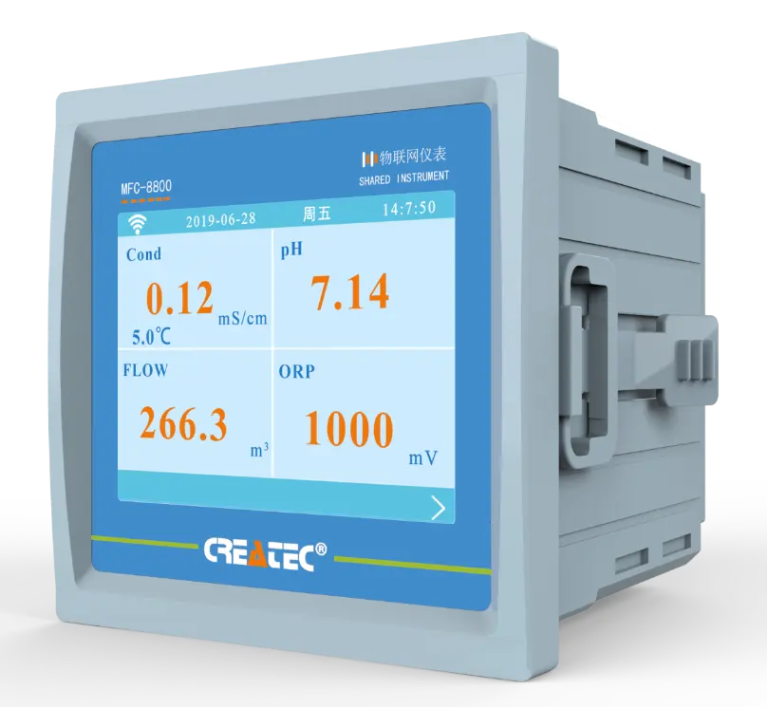
Shanghai ChiMay’s In-Line Conductivity Meter uses four-electrode technology to measure the electrical conductivity of water, which is a direct read on dissolved ion concentration. In desalination, that measurement does two jobs:
Feed water conductivity, measured at the RO inlet, shows the total dissolved salt load coming in. Seawater typically reads 30,000-50,000 µS/cm.
Permeate conductivity, measured at each pressure vessel outlet, shows how much salt is getting through the membrane. Clean permeate typically reads 50-500 µS/cm.
The two values together give you the rejection rate:
Rejection Rate (%) = (1 − Permeate Conductivity / Feed Conductivity) × 100
Modern SWRO membranes run at 99.3-99.8% rejection. A slide from 99.5% to 99.0% means salt passage has doubled — and on the instrument display it looks like a modest conductivity bump. Without continuous monitoring, that indicator goes unnoticed until the problem is past the point of easy repair.
How Four-Electrode Technology Ensures Accuracy
In a low-conductivity permeate stream at 50-500 µS/cm, a traditional two-electrode sensor runs into polarisation: ions pile up at the electrode surfaces and create measurement error. As current passes between the two electrodes, ion depletion near them raises apparent resistance, and the instrument under-reports conductivity.
Four-electrode technology avoids that by splitting the functions. The outer pair drives current through the water; the inner pair measures voltage. Because the voltage circuit draws negligible current, polarisation at the sensing electrodes does not occur. The reading stays accurate where a two-electrode instrument would drift.
That accuracy is the difference between seeing early degradation and missing it. A conductivity change of 20-50 µS/cm in a permeate stream reading 200 µS/cm is a significant membrane signal. Without four-electrode accuracy, changes that size get lost in noise.
Temperature Compensation for Consistent Monitoring
Conductivity is temperature-dependent — it rises roughly 2% per degree Celsius. Desalination plants see seasonal seawater temperature swings of 10-15°C between summer and winter.
Without compensation, a winter-to-summer permeate conductivity rise could be entirely thermal rather than membrane-related. Shanghai ChiMay’s In-Line Conductivity Meter includes automatic temperature compensation with adjustable coefficients, so trends reflect membrane performance rather than water temperature.
Practical Deployment for Algae-Fouling Detection
During a bloom, the Shanghai ChiMay conductivity meter tracks rejection continuously and the patterns are readable:
Normal operation. Steady permeate conductivity with minor movement. Rejection stays consistent across all pressure vessels.
Early fouling indication. Conductivity creeping up in specific vessels while neighbours stay flat points to localised fouling or membrane damage. That lets you inspect the right elements instead of the whole rack.
Bloom event response. A rapid conductivity rise across multiple vessels during or after an algae event confirms widespread impact. How fast and how far it climbs tells you how urgently to respond.
The cost of missing that signal is real. After the September 2026 crisis, Energy and Infrastructure Minister Eli Cohen put the worst-case bill for membrane and filter erosion at tens of millions of shekels. Facilities with per-vessel conductivity monitoring replace only the affected elements. Those without it either over-replace or under-replace, and both are expensive.
With Israel’s Water Authority targeting desalination output of 2.3 billion cubic metres annually by 2050, the membrane asset base at risk grows with every new plant. Shanghai ChiMay’s In-Line Conductivity Meters provide the measurement base for protecting that investment through early fouling detection and targeted membrane maintenance.
Sources: Misbar (September 10, 2026); ENR (September 8, 2026); Times of Israel (September 2, 2026); Jerusalem Post (June 8, 2026); Reshet 13 / Wire Israel (September 7, 2026).