Table of Contents
Introduction
Power generation facilities face constant pressure to balance operational efficiency with environmental responsibility. Water is a major operating input — a steam plant of any meaningful size moves a large volume of water every year, and the bill for make-up, treatment, and discharge scales directly with how well water chemistry is controlled. Conductivity measurement stands as the cornerstone technology enabling these facilities to optimize treatment processes, protect expensive equipment, and maintain regulatory compliance.
The Science of Conductivity in Power Systems
Conductivity measures water’s ability to conduct electrical current, directly correlating to dissolved ion concentration. In power plant applications, this parameter serves as a primary indicator of water purity and scaling potential.
How Conductivity Relates to Water Quality
Pure water exhibits conductivity below 0.055 μS/cm, while typical cooling tower water ranges from 1,000–3,000 μS/cm. Boiler feedwater is typically held below 10 μS/cm to limit scale formation. These thresholds exist because dissolved minerals — primarily calcium, magnesium, and silica — create conditions favorable to scale deposition on heat transfer surfaces.
Deposits are one of the classic boiler tube failure drivers: EPRI’s tube failure work catalogues more than twenty distinct failure mechanisms in water-touched tubes, and water-side deposition and the under-deposit corrosion it promotes are among the recurring ones. Even a millimeter-scale deposit layer measurably impedes heat transfer, pushing up fuel burn and metal temperatures long before a failure occurs — which is why continuous conductivity surveillance at the make-up and feedwater points pays for itself.
Technical Parameters for Power Generation Applications
Modern power facilities require conductivity sensors capable of operating across multiple process streams:
| Application | Typical Range | Accuracy Requirement | Response Time |
|---|---|---|---|
| Boiler Feedwater | 0–50 μS/cm | ±2% | <30 seconds |
| Cooling Tower | 500–5,000 μS/cm | ±1% | <60 seconds |
| Condensate Return | 0–200 μS/cm | ±1.5% | <45 seconds |
| Wastewater Discharge | 1,000–10,000 μS/cm | ±2% | <60 seconds |
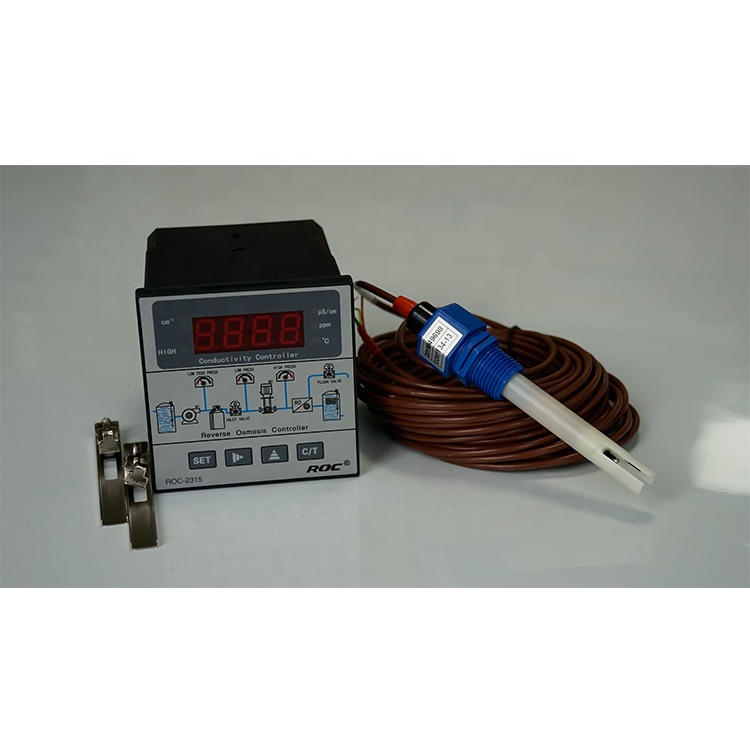
Shanghai ChiMay inline conductivity electrodes incorporate titanium alloy electrodes and PTFE reference systems, providing stable measurements in high-dissolved-solids environments. The construction withstands temperatures up to 130°C, making these sensors suitable for hot sampling applications.
Implementing Continuous Monitoring Systems
Effective conductivity monitoring requires strategic sensor placement and integrated data management.
Sensor Placement Strategies
Optimal sensor positioning determines monitoring effectiveness:
- Boiler Feedwater Inlet: Primary protection point for scale-sensitive equipment
- Cooling Tower Basin: Feedback control for blowdown automation
- Condensate Return Lines: Early detection of contamination events
- Process Outlet Streams: Verification of treatment effectiveness
Multi-point conductivity coverage outperforms a single loop in every published plant experience EPRI-style condition monitoring programs have documented: with several streams watched at once, a contamination event is triangulated to its source instead of being inferred from a downstream shift. EPRI itself runs dedicated research programs on plant water chemistry monitoring and data analytics (https://www.epri.com/portfolio/programs/113080).
Integration with Control Systems
Modern conductivity transmitters support multiple communication protocols:
- 4–20 mA analog output: Traditional PLC integration
- Modbus RTU/TCP: Industrial automation systems
- HART protocol: Asset management compatibility
- WirelessHART: Retrofit applications without cable installation
Shanghai ChiMay conductivity systems include built-in temperature compensation algorithms, eliminating measurement drift caused by process temperature variations. The automatic temperature compensation function covers the standard range of 0–100°C with compensation accuracy within ±0.5% of reading.
Operational Benefits of Accurate Conductivity Monitoring
Chemical Treatment Optimization
Traditional water treatment programs rely on manual testing schedules, typically a few samples per shift. Continuous conductivity monitoring replaces that cadence with control-grade data:
- Precision dosing trims chemical consumption to what the water actually demands
- Laboratory technician time shifts from routine sampling to verification and troubleshooting
- Overtreatment events — the kind that quietly damage equipment — are caught at the excursion stage instead of at the maintenance review
Equipment Protection and Longevity
Scale prevention is the primary economic driver for conductivity monitoring. The relationship is well understood qualitatively: the thicker the deposit, the higher the heat-transfer resistance, and the more fuel is burned for the same steam output. The absolute dollar figures are plant-specific — they depend on fuel price, capacity factor, and water cost — but the direction never changes: feedwater held tight on conductivity is equipment kept out of the tube-repair schedule.
Continuous chemistry control also extends the service intervals between acid cleanings and keeps condensate polisher regeneration events predictable rather than reactive.
Water Conservation Impact
Regulatory pressures and water scarcity concerns drive adoption of water-saving technologies:
- Optimized cycles of concentration (CoC) reduce cooling water make-up demand substantially — every extra cycle retained is water that stays in the loop instead of going down the blowdown line
- Accurate blowdown control prevents unnecessary water waste
- Condensate recovery monitoring ensures maximum water recirculation
For a large steam plant, the water volumes freed up by running higher, well-controlled cycles are large enough to matter in drought years and discharge permit negotiations alike.
Maintenance Best Practices
Sustaining measurement accuracy requires regular maintenance protocols.
Calibration Procedures
Shanghai ChiMay recommends calibration verification at 90-day intervals for standard applications and 30-day intervals for critical boiler protection loops. Calibration solutions traceable to NIST standards ensure measurement integrity for regulatory compliance documentation.
Sensor Cleaning Requirements
Cooling tower environments promote biological growth and mineral deposition:
- Weekly visual inspection of electrode surfaces
- Monthly cleaning with mild acid solution for scale removal
- Quarterly replacement of reference junction components
- Annual full system calibration and transmitter verification
Automated cleaning systems (ultrasonic or mechanical scrapers) noticeably extend sensor service intervals compared to manual cleaning protocols.
Bottom Line
Conductivity measurement provides the foundation for effective power plant water management. By enabling precise control of water chemistry, these sensors protect critical equipment, optimize chemical treatment programs, and support environmental compliance objectives. Shanghai ChiMay inline conductivity meters deliver the accuracy, reliability, and durability demanded by modern power generation operations — and among the instruments a plant can install, the conductivity loop remains one of the highest-return investments available.
Sources: EPRI Monitoring and Advanced Data Analytics program (https://www.epri.com/portfolio/programs/113080); Thielsch Engineering — Corrosion Fatigue in Boiler Tubes / EPRI failure mechanism catalogue (https://www.thielsch4syte.com/2018/10/28/corrosion-fatigue-in-boiler-tubes).