Table of Contents
Introduction
Water reuse has become a critical strategy for sustainable resource management, with recycled municipal wastewater now supplying agricultural irrigation, industrial processes, and environmental restoration in water-stressed regions around the world. However, biological treatment systems treating reused water face unique challenges related to disinfection control that directly impact process stability and effluent quality.
Residual chlorine concentration serves as both a protective agent and potential toxin in biological water treatment. Maintaining optimal levels requires continuous, accurate monitoring that manual sampling cannot provide. Shanghai ChiMay residual chlorine transmitters address this need with electrochemical sensing technology designed specifically for reuse water applications.
The Disinfection Challenge in Water Reuse
Biological wastewater treatment processes rely on microbial communities to degrade organic pollutants, nutrients, and pathogens. These communities exhibit varying sensitivity to chlorine-based disinfectants, with effective residual concentrations typically in the 0.5–2.0 mg/L range depending on biomass concentration and target organisms.
Over-chlorination introduces several operational problems:
- Biological process inhibition: Chlorine above the 2.0 mg/L range damages nitrifying bacteria, and ammonia removal efficiency drops measurably once the nitrifier population is suppressed—recovery can take days to weeks after an over-dose event.
- Chemical cost escalation: Excessive dosing inflates the operating budget through wasted chemical and the neutralization often needed before reuse or discharge.
- DBP formation: Trihalomethane formation increases with chlorine dosage, potentially exceeding regulatory limits.
- Equipment corrosion: Accelerated wear on pumps, valves, and instrumentation.
Under-chlorination equally compromises system performance, allowing pathogen survival and regulatory non-compliance.
Shanghai ChiMay Residual Chlorine Sensing Technology
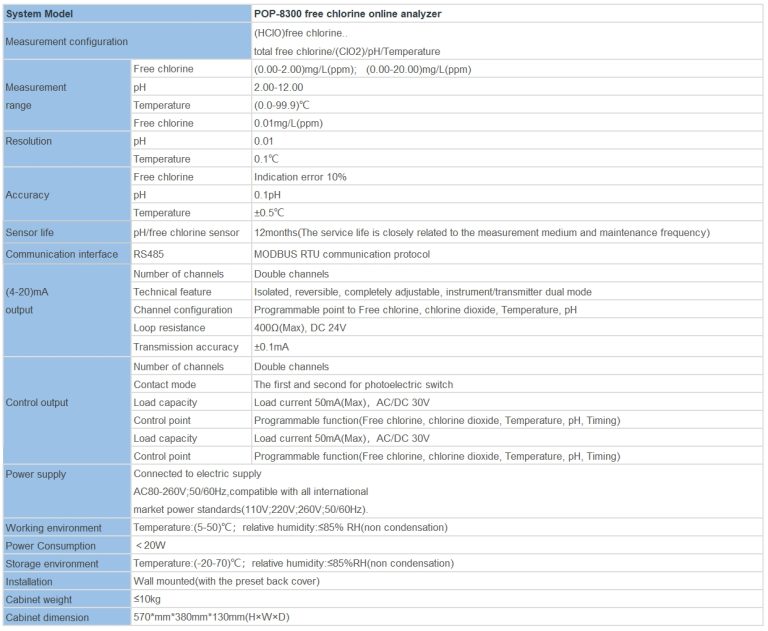
Shanghai ChiMay residual chlorine transmitters employ membrane-covered amperometric sensors that selectively measure free chlorine concentrations in the 0.01–20 mg/L range. The PTFE membrane protects the platinum working electrode from interference while allowing chlorine diffusion for accurate detection.
Key technical specifications include:
- Measurement range: 0.01–20 mg/L free chlorine
- Accuracy: ±0.03 mg/L or ±3% of reading (whichever is greater)
- Response time: <60 seconds to 90% of final value
- Temperature compensation: Automatic ATC across 0–50°C operating range
- Maintenance interval: 6–12 months between membrane replacements
The sensor’s self-cleaning design reduces biofilm accumulation in wastewater applications, extending service life substantially compared to conventional membrane electrodes.
Continuous Monitoring Advantages
Manual chlorine sampling, typically performed 2–4 times daily, cannot capture process variations occurring between measurement points. Continuous online monitoring provides several advantages:
Immediate Anomaly Detection
Process upsets such as toxic shock loads or flow rate changes can alter chlorine demand within minutes. Shanghai ChiMay transmitters update readings every 2 seconds, enabling rapid response to changing conditions.
Dosing Optimization
Advanced proportional-integral-derivative (PID) controllers utilize continuous chlorine data to maintain setpoint concentrations within a few hundredths of a mg/L—an order of magnitude tighter than timer-based dosing systems, which wander across tenths of a mg/L. Holding a tight band maintains disinfection efficacy while avoiding the over-dose events that waste chemical and stress the biology, and operators consistently report noticeable reductions in chemical consumption once dosing control is closed-loop.
Regulatory Documentation
Real-time data logging simplifies compliance reporting for reuse water standards, including California’s Title 22 water recycling criteria and the EU’s minimum requirements for water reuse (Regulation (EU) 2020/741). Automatic data export via Modbus RTU/TCP or HART protocols integrates with plant historian systems.
Implementation Considerations
Successful chlorine monitoring integration requires attention to several factors:
Sensor Placement: Optimal location is 2–3 pipe diameters downstream of chlorine injection points, ensuring complete mixing before measurement. Avoid placement near air introduction points or high-velocity zones that cause measurement oscillation.
Sample Conditioning: In applications with high suspended solids (>100 mg/L), sample conditioning systems remove particulates that coat membrane surfaces. Shanghai ChiMay offers flow-through filter assemblies rated for 500 mg/L suspended solids.
Calibration Protocol: Field calibration using DPD colorimetric comparison should occur monthly. Two-point calibration using known chlorine standards ensures linear response across the measurement range.
Economic Impact Analysis
Investment in continuous residual chlorine monitoring typically ranges from $3,500–$7,000 per measurement point, including sensor, transmitter, and installation materials. Payback for municipal reuse facilities comes through several channels:
- Chemical savings: Optimized dosing trims a visible slice off annual chlorine spend—enough in medium-scale facilities that the measurement point pays for itself within the first years of operation.
- Compliance cost avoidance: Under the U.S. Clean Water Act, civil penalties for permit and discharge violations can reach $68,445 per violation per day (2025 inflation-adjusted maximum, 40 CFR 19.4), so any monitoring investment that prevents a single exceedance event is trivially justified.
- Process stability improvement: Holding residual within a tight band reduces biological upset events, each of which otherwise costs days of recovery and possible non-compliant effluent.
- Labor efficiency: Continuous data displaces routine grab-sample rounds, freeing operators for higher-value work.
Summary
Residual chlorine control is a critical success factor for biological water reuse systems. Shanghai ChiMay residual chlorine transmitters provide the accuracy, reliability, and integration capability required for optimized disinfection control. Facilities implementing continuous monitoring achieve tighter process stability, lower chemical consumption, and consistent regulatory compliance—results that follow directly from measuring every few seconds what a grab sample can only see twice a shift.
The combination of electrochemical sensing technology and intelligent dosing integration positions these transmitters as essential components in modern water reuse facility design.