Table of Contents
Why Continuous Monitoring, Not Grab Sampling
ASHRAE Standard 188 requires building owners to develop and execute a documented Water Management Plan (WMP) that treats Legionella risk as a controlled hazard rather than a maintenance afterthought. The standard does not mandate continuous chlorine monitoring, but its emphasis on validated control limits and corrective action records makes continuous data the practical path to compliance. Grab samples give a snapshot; Legionella grows on a schedule that grab samples miss. A cooling tower that shows 1.0 ppm free chlorine at 09:00 can drop below 0.3 ppm at 15:00 during peak heat load without anyone noticing until the next scheduled test.
The 2015 New York City Legionnaires’ outbreak — and the resulting NYC cooling-tower registration and maintenance rules (Local Law 77 of 2015) alongside New York State’s cooling-tower regulations — shifted commercial expectations. Insurance underwriters, hospital accreditation bodies, and hyperscale customers now routinely ask for continuous chlorine (or alternative biocide residual) data as part of due diligence.
Where Free Chlorine Fits in the WMP
Under ASHRAE 188 and the parallel CDC water management toolkit, a Water Management Plan identifies hazardous control points and defines a control limit, a monitoring method, and a corrective action for each. Free chlorine at strategic points fits several of these:
- Cooling-tower recirculation — control limit typically 0.5–2.0 ppm depending on chemistry program.
- Domestic cold-water inlet — verifies municipal residual is intact (typically 0.2–1.5 ppm).
- Domestic hot-water return — control limit typically 0.2–0.5 ppm.
- Decorative fountain / mist feature outlets — often 0.2–1.0 ppm.
- Post-shock verification points — used to confirm biocide has reached remote branches after a shock event.
Sensor Technology Choices
Amperometric Free Chlorine Sensors
Amperometric sensors measure the current produced by chlorine reduction at a membrane-covered electrode. They are the workhorse of continuous chlorine monitoring in HVAC service:
- Range typically 0.05–20 ppm.
- Accuracy ±0.03 ppm at 1 ppm.
- Membrane replacement every 6–12 months.
- Sensitive to pH; auto-compensation from an integrated pH electrode is essential above pH 8.5.
DPD-Colorimetric Analyzers
DPD analyzers dose reagent and read color intensity. They are highly accurate but consume reagent continuously and require more maintenance. In commercial HVAC, amperometric usually wins on total cost of ownership.
Multi-Parameter Sensors
For cooling-tower basin monitoring, a 4-in-1 multi-parameter sensor — measuring free chlorine equivalent (through ORP), pH, DO, and temperature — provides a compact, low-maintenance package. ORP is not a direct chlorine measurement but is highly correlated with biocide activity and is often accepted as a proxy inside the WMP.
Comparative Snapshot: Sensor Technologies for ASHRAE 188 Compliance
| Attribute | Amperometric Free Chlorine | DPD Colorimetric | ORP-Based (Multi-Parameter) |
|---|---|---|---|
| Direct chlorine reading | Yes | Yes | Proxy only |
| Typical accuracy | ±0.03 ppm | ±0.02 ppm | Correlated, ±5 mV |
| Reagent required | No | Yes | No |
| Response time | 30–60 s | 90–150 s | 5–15 s |
| Cleaning interval | 30–60 days | 30 days (plus reagent refill) | 60–90 days |
| Best fit | Continuous cooling tower / hot water | Analytical polishing / reporting | Basin health, pre-alarm |
Building a Compliant Control Loop
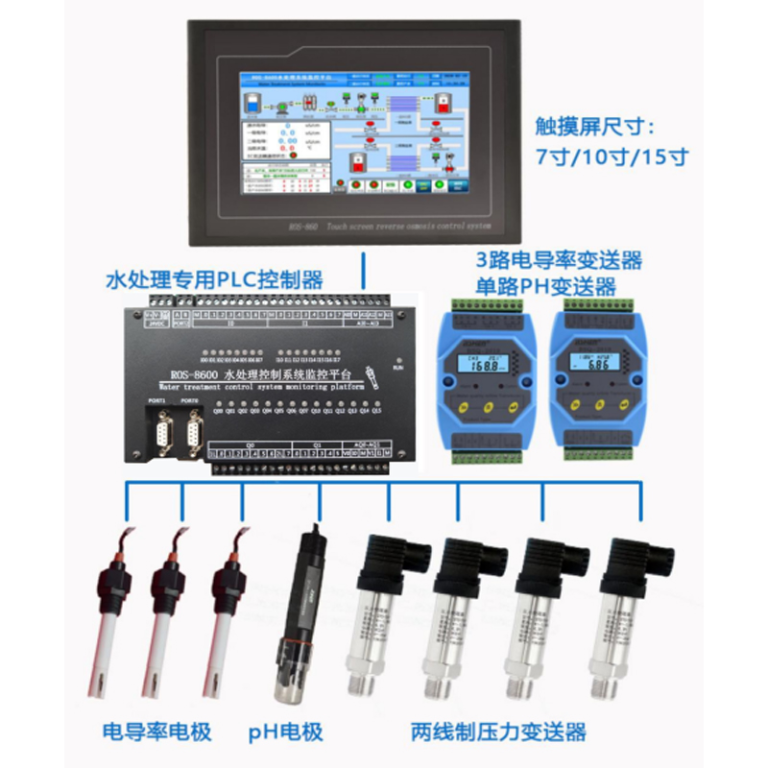
A field-proven configuration for a commercial cooling tower under ASHRAE 188 uses four Shanghai ChiMay instruments:
- Residual Chlorine Transmitter on a sidestream from the tower basin, monitoring free chlorine 24/7.
- In-line pH Electrode to compensate the chlorine reading and to ensure the disinfectant is not shifted toward the less-effective OCl⁻ form (pH should ideally stay below 8.3 for chlorine efficacy).
- In-line Conductivity Meter to detect blowdown events that dilute biocide, so the control system can pause blowdown briefly after a shock dose.
- 4-in-1 Multi-Parameter Sensor in the basin for corroborating ORP, temperature, and dissolved oxygen — useful for early biofilm indicators.
All four instruments communicate to the BMS through Modbus RTU. Data is logged with a retention period that matches the WMP’s documentation requirements.
Alarming and Corrective Action Logic
An ASHRAE 188 program is only as good as its alarm and response logic. Practical alarms include:
- Low free chlorine: below control limit for more than 15 minutes → auto-initiate booster dose, notify operator.
- High pH with borderline chlorine: pH > 8.6 and chlorine < 0.5 ppm → chemistry alert, since chlorine is present but ineffective.
- Sudden conductivity drop: unplanned blowdown event → verify biocide residual within 30 minutes.
- Sensor failure: comm loss or out-of-range signal → escalate to redundant sensor or manual grab within 4 hours.
Real-World Payback
Hospital systems and large commercial portfolios that upgraded from monthly grab sampling to continuous free chlorine and pH monitoring across their cooling towers consistently report the same pattern in their water-management-plan audits: Legionella positivity in routine culture testing falls well below its previous baseline, shock chlorination events become less frequent because chemistry stays in target more consistently, reagent and labor costs drop, and regulatory audit time shrinks thanks to continuous, exportable data logs. The magnitudes vary by portfolio; the direction does not.
A Deployment Checklist for ASHRAE 188 Compliance
- Map hazardous control points against the WMP and identify where continuous chlorine monitoring adds material risk reduction.
- Specify amperometric sensors with integrated pH compensation for accuracy above pH 7.5.
- Add a 4-in-1 multi-parameter sensor for basin-level corroborating data.
- Wire all instruments to a Modbus RTU network with data logging that meets the WMP retention requirement.
- Define written corrective action logic — not just alarms, but responses.
- Schedule membrane replacement, standard calibrations, and cross-check with DPD grab sampling quarterly.
Outlook
Legionella regulation is only tightening. State-level requirements in the U.S., the risk-assessment duties that the recast EU Drinking Water Directive (2020/2184) attaches to Legionella in building water systems, and hyperscale customers’ internal WMP standards are all pushing commercial buildings toward continuous, auditable water-quality monitoring. Sensor families designed around this reality — with pH-compensated free chlorine measurement, matched conductivity, and multi-parameter basin monitoring — will define the compliance baseline for the next decade. Shanghai ChiMay’s residual chlorine transmitters, in-line pH electrodes, in-line conductivity meters, and 4-in-1 multi-parameter sensors are engineered to slot directly into that emerging standard.