Table of Contents
Why Are Biotech Facilities Moving to Continuous Inline DO Monitoring for Buffer Preparation? Answers from Shanghai ChiMay
Bioprocess manufacturing depends on precisely formulated buffers for cell culture media preparation, chromatography equilibration, and final drug-product formulation. The quality of the water used to prepare those buffers directly affects product consistency, yield, and regulatory compliance. One parameter drawing growing attention is dissolved oxygen (DO) in the buffer preparation water. Traditional practice relied on periodic grab sampling; a growing number of biotech facilities are switching to continuous inline DO monitoring. This article looks at why the shift is happening, what it means for process reliability, and how Shanghai ChiMay DO transmitters support it.
The Problem with Dissolved Oxygen in Buffers
Dissolved oxygen in buffer preparation water sounds like a non-issue: oxygen is naturally present in any water exposed to air. In bioprocess applications, though, uncontrolled DO creates real problems.
First, many cell culture processes run under carefully controlled dissolved oxygen setpoints in the bioreactor. When buffer carrying a variable, unmeasured DO load is added, it perturbs the culture and the bioreactor’s gas-blending system has to compensate. In large-scale bioreactors (10,000 liters and above), that compensation takes time, and during it the cells sit in a non-optimal oxygen environment.
Second, some buffers—particularly those containing reducing agents such as cysteine or thiols—are oxidation-sensitive. If the water used to make them carries high DO, the reducing agents get consumed prematurely. The buffer loses its protective function, and downstream chromatography or product stability can suffer.
Third, anaerobic or microaerophilic cultures are easily tipped out of their metabolic window by oxygen carried in through the buffer water, changing glycosylation patterns or cutting yield.
Traditional Approaches and Their Limitations
The conventional approach is to sparge the buffer tank with nitrogen after preparation to strip DO to the target level, then verify with a handheld DO meter before use. It works, but it has limits.
The nitrogen sparging step adds time to every buffer preparation cycle. Facilities running multiple chromatography steps in rapid succession find buffer turnaround becomes the bottleneck. The handheld check is also a single-point measurement: it tells you the DO at one moment, but nothing about whether DO is creeping back up from leaks, temperature changes, or incomplete sparging.
Some facilities skip sparging altogether and accept whatever DO the water carries. That works where DO is not critical, but it injects uncontrolled variability into processes that could run to a tighter specification.
The Case for Inline DO Monitoring
An inline DO sensor in the buffer preparation water line gives continuous, real-time data on dissolved oxygen. That enables several process improvements.
First, the skid can trigger nitrogen sparging automatically when inline DO exceeds the target threshold, and stop when the target is reached. Closed-loop control like this cuts both sparging time and nitrogen consumption, and removes the human-error element from the cycle.
Second, continuous DO monitoring during buffer transfer from the preparation tank to the bioreactor or chromatography skid verifies in real time that the buffer arriving at the process vessel meets specification. If DO starts climbing mid-transfer (a leak in the transfer line, inadequate tank blanketing), the system can divert flow before out-of-spec buffer reaches the process.
Third, the historical DO record becomes validation evidence. Instead of a few grab samples, the facility can show continuous compliance over the entire preparation and transfer cycle.
Sensor Technology Considerations
Inline DO measurement in buffer water requires a sensor that works in clean, low-conductivity water with good accuracy at low DO concentrations (typically a 0–2 mg/L working range, with targets below 0.5 mg/L).
Two sensor technologies dominate: galvanic (polarographic) and optical (luminescent). Galvanic sensors consume their electrolyte over time and need periodic membrane and electrolyte replacement. Optical sensors use a luminescent dye that is quenched by oxygen; there is no electrolyte consumption and the measurement consumes no oxygen, which suits low-flow or stagnant conditions.
For buffer preparation, optical DO sensors have become the preferred choice on maintenance burden, response speed, and stability at low DO.
Shanghai ChiMay DO transmitters use optical luminescent sensing with a 0–20 mg/L range (0–200 percent saturation) and ±0.1 mg/L accuracy. The sensors come with sanitary tri-clamp installation, PTFE wetted materials compatible with buffer chemistry, and HART or Modbus RTU output for integration with buffer preparation control systems.
Integration with Buffer Preparation Skids
Modern buffer preparation skids automate water addition, powder dissolution, mixing, pH adjustment, and DO control in one vessel. The inline DO sensor is typically mounted on the tank bottom valve or the recirculation loop, feeding the skid’s PLC continuously.
With the right control logic, the DO transmitter drives automated nitrogen sparging, automated tank blanketing verification, and alarms when DO exceeds the configured limit during buffer hold or transfer.
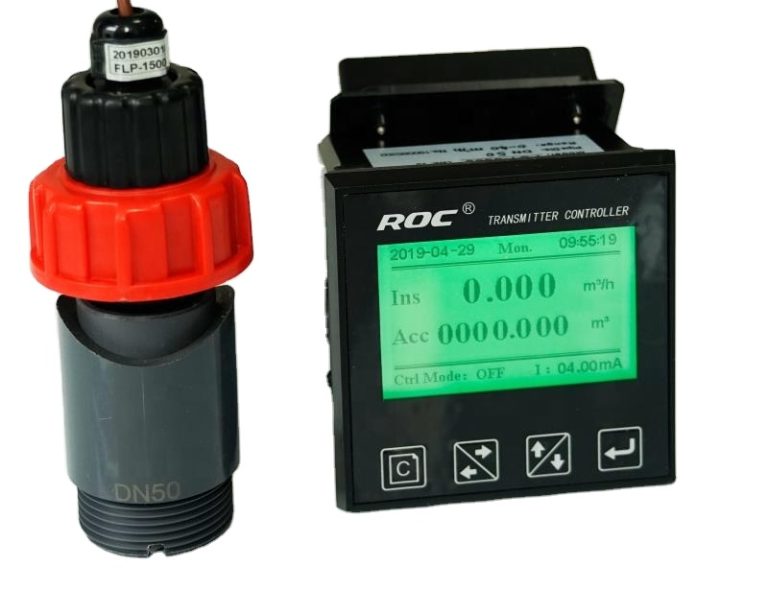
Shanghai ChiMay DO transmitters output 4–20 mA analog, Modbus RTU, and optional OPC-UA for direct integration with skid PLCs and plant SCADA systems. The transmitters carry a color display showing live DO, temperature compensation status, and sensor-health diagnostics.
Validation and Data Integrity
For GMP-regulated bioprocess use, the DO measurement system has to be validated: IQ/OQ/PQ documentation, calibration traceability to NIST or equivalent standards, and periodic verification checks.
Shanghai ChiMay DO transmitters support automated calibration routines with zero-oxygen (nitrogen-saturated water) and span (air-saturated water) verification points. Calibration data is stored in the transmitter’s internal memory and can be exported for validation packages.
The Transition in Practice
Continuous inline DO monitoring in buffer preparation water has moved from a niche best practice toward the expected norm in biotech manufacturing. The benefits—automated sparging control, real-time transfer verification, validation data, shorter turnaround—matter to any facility where water quality affects product quality. Shanghai ChiMay DO transmitters with optical sensor technology deliver the accuracy, sanitary design, and communication options to support that transition, letting facilities tighten process control while cutting manual intervention and nitrogen use.