Mount Polley in Canada (2014), Brumadinho in Brazil (2019) and Jagersfontein in South Africa (2022) changed how the mining industry manages tailings storage facilities (TSFs). Each of those failures killed people, destroyed downstream environments, and cost hundreds of millions to billions of dollars in cleanup, compensation and lost production. The lesson the industry took from them is consistent: the warning signs are usually visible in the data long before the dam moves, and the failures were mostly failures of surveillance rather than of geology.
Table of Contents
How tailings dams fail
Tailings dam failures generally fall into three modes: overtopping, foundation failure, and internal erosion. The third is the one that catches operators out. Where the causes of historical failures have been analysed, internal erosion and piping repeatedly show up as leading mechanisms, and they develop over months or years rather than in a single rainfall event — which is precisely the timescale that instrumented monitoring can cover.
What the structure actually contains
Conventional slurry tailings are impounded at roughly 20–40% solids by weight, with thickened and paste tailings pushed higher. As deposition continues, solids settle and consolidate while supernatant water accumulates toward the centre of the facility. The result is a layered, heterogeneous body with a phreatic surface that moves with deposition, weather and drainage — which is why the water balance has to be measured, not assumed.
Seepage emergence at the toe is the classic early indicator. Water leaving the embankment can carry fine tailings particles with it, and that particle transport is what starts a piping mechanism. Some dam safety guidance treats anomalous seepage as one of the most reliable precursors of embankment failure, which is why flow rate plus turbidity at each seepage collection point matters more than either measurement alone.
Water balance
Safe operation depends on knowing, continuously:
- the location and extent of the supernatant pond;
- the phreatic surface position inside the embankment;
- seepage flow rates and the turbidity that goes with them;
- embankment deformation rates, absolute and differential.
ANCOLD guidelines in Australia specify maximum pond levels and freeboard requirements by dam classification, seismic setting and climate — and they are classification-based, so freeboard and pond limits have to be re-derived whenever the consequence category changes.
Monitoring parameters that matter
Pore water pressure
Pore pressure sensors measure water pressure between soil particles. Rising pore pressure reduces effective stress and can trigger slope instability without any visible surface change. Vibrating-wire piezometers remain the workhorse for long-term installation in tailings, because the signal survives long cable runs and the reading is stable over years. US Bureau of Reclamation practice is to instrument at multiple elevations and plan locations so that the phreatic surface geometry can be reconstructed rather than inferred from one point.
Shanghai ChiMay’s pressure transducers achieve accuracy of ±0.1% full scale with thermal stability better than 0.02% per °C, which keeps the reading meaningful across seasonal temperature swings.
Seepage
Quantitative seepage measurement is the most direct integrity check available. Flow measurement weirs combined with turbidity sensors detect both a change in flow rate and the particle transport that indicates internal erosion. Practical alarm logic looks like this:
- turbidity rising above the normal baseline for that seepage point — a step change is more meaningful than an absolute number, because baseline turbidity varies by site;
- flow rate rising materially over 24 hours without a rainfall explanation;
- temperature anomalies, which can indicate a preferential flow path.
Where seepage monitoring is installed, it is normally continuous at every collection point, with automated alerts on threshold exceedance.
Decant water quality
Return water quality protects downstream receptors and the recovery system:
- pH, where falling values indicate oxidation of exposed sulfide tailings;
- Conductivity, as a proxy for dissolved ion load;
- Dissolved metals — iron, manganese and the target ore metals;
- Total suspended solids, which drive recovery-system efficiency and wear.
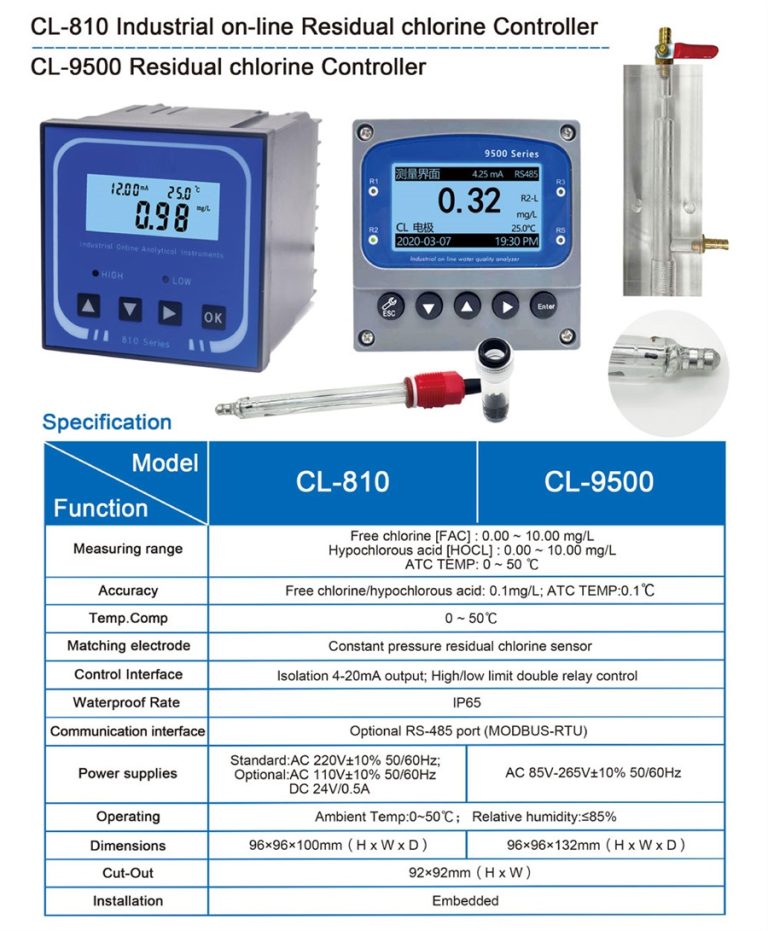
Shanghai ChiMay supplies in-line pH electrodes, conductivity meters and multi-parameter sensors in packages configured for TSF decant and seepage duties.
Instrumentation
Modern TSF monitoring combines several instrument families into one acquisition system.
Geotechnical
Inclinometers measure deformation along vertical casings through the embankment; extensometers track movement relative to a fixed reference. Reading frequency is set by consequence classification and by the phase of the facility — while the embankment is being raised, readings are taken far more often than during quiescent operation.
Surveying
Total stations and GNSS-based deformation monitoring provide surface displacement to millimetre-level precision under good conditions, and they are the practical way to link instrument readings to a site-wide reference frame. Drone-based LiDAR complements the ground network by capturing surface topography at a few intervals per year; change detection then flags settlement, cracking or erosion that deserves a closer look. Dam safety guidelines in Canada, Australia and under FERC in the United States all tie surveillance frequency to consequence classification, with formal inspections at least annually for operating facilities.
Remote sensing
Satellite InSAR detects ground deformation at millimetre-per-year sensitivity over large areas, and the European Space Agency’s Sentinel-1 constellation provides free imagery on a repeat cycle short enough for regular monitoring. Satellite data does not replace ground instrumentation — it tells you where to look, and it does so across areas where no one has installed a piezometer.
Data management and alarms
Real-time platforms
Cloud platforms aggregate multiple sensor types into one facility-wide view, and alarms reach named people rather than a log file. For very high consequence facilities, the GISTM expects monitoring and emergency response arrangements that function around the clock, with escalation that does not depend on who is on site.
Thresholds
Thresholds have to be set from the site’s own operating range and from recognised precursor signatures, usually in three levels:
- Level 1 — awareness: within normal operating range; continue monitoring.
- Level 2 — warning: outside typical range; investigate within 24 hours.
- Level 3 — alert: significant deviation; immediate response.
Calibrating those levels against historical operating data is what prevents both nuisance alarms and slow responses to a real event.
Regulation
The Global Industry Standard on Tailings Management (GISTM), published in August 2020 by ICMM, UNEP and the Principles for Responsible Investment, requires consequence classification for every facility, monitoring system design that matches the consequence level, regular inspection and review, and emergency response planning. Regional rules add their own obligations: the EU Mining Waste Directive, Canadian metal mining effluent and dam safety requirements, and Brazil’s National Dam Safety Policy — Law 12.334/2010, strengthened by Law 14.066/2020 after Brumadinho — each impose specific monitoring and reporting duties on regulated structures.
What the monitoring programme costs against what it protects
Monitoring investment is judged against failure consequences:
- Direct failure costs: remediation, compensation, regulatory penalties.
- Business interruption: production stopped during investigation and rebuilding.
- Reputational damage: long-term effects on social licence.
- Environmental liability: cleanup that can exceed direct damages.
On that comparison, a comprehensive monitoring system is a small fraction — generally under 1% — of facility capital cost, and it is the part of the capital budget that protects the rest.
Implementation practice
- Integration: combine sensor types so that one anomaly can be corroborated by another.
- Automation: continuous collection, no manual intervention required to be safe.
- Redundancy: critical parameters measured twice, by different means.
- Data quality: automated checks that catch a failed sensor before its silence is mistaken for stability.
- Response protocols: written procedures that name who does what when a Level 3 alert fires.
Tailings monitoring has moved from periodic visual inspection to continuous, multi-technology surveillance. That shift came out of failures that killed people, and the operational answer is unglamorous: pore pressure sensors, seepage weirs with turbidity, decant water-quality instruments and geotechnical monitoring, all feeding one record that regulators, communities and lenders can read.