Reclaimed water used for agricultural irrigation typically carries a modest free chlorine residual as a public-health control against pathogen regrowth in distribution. Excess residual chlorine is phytotoxic: sensitive crops show damage when concentrations at the emitter stay above roughly the 1 mg/L mark for extended periods, and most row crops show stress as levels push beyond about 2 mg/L — thresholds that vary with crop species and exposure duration (see, e.g., published studies on residual disinfectant effects on soil and lettuce crops: Science of the Total Environment, 2017). Sensor placement is the technical crux of reuse-chlorine monitoring: one sensor at the reuse plant discharge, one at storage exit, and one at the irrigation manifold cover the compliance and crop-safety zones. Shanghai ChiMay’s residual chlorine transmitter — available in amperometric and DPD colorimetric formats — supports the sub-1 mg/L resolution needed to protect crops without under-disinfecting.
Table of Contents
Why Chlorine Residual Is the Reuse Battleground
The reclaimed-water operator holds two duties simultaneously. First, ensure that pathogens do not survive from the treatment plant through kilometers of pipe to the farm gate. Second, avoid delivering enough oxidant to burn leaves, damage roots, or interfere with beneficial microbiology in the soil. Those two duties collide at the residual-chlorine setpoint.
Practical reuse-water residuals typically target:
| Crop Class | Target Residual at Emitter (mg/L) |
|---|---|
| Root vegetables, drip irrigation | 0.3–0.8 |
| Fruit trees, subsurface drip | 0.3–1.0 |
| Row crops, furrow irrigation | 0.5–1.2 |
| Turf and non-food landscape | 0.8–1.5 |
Delivering the residual within this window across long distribution networks requires continuous measurement, not batch sampling.
Sensor Technology Choice
Two chlorine-measurement technologies dominate reuse service.
Amperometric sensors apply a fixed potential across a working electrode and measure the current produced when chlorine is reduced. They are fast (T90 typically 20–60 seconds), stable, and require no reagents. Range is typically 0–5 mg/L free chlorine with 0.01 mg/L resolution. They are the preferred technology for reuse distribution networks where continuous data at low residual is needed.
DPD colorimetric analyzers add DPD reagent to a metered sample and measure the resulting pink color spectrophotometrically. Slower (2–4 minute cycle) but very accurate at low concentrations. Preferred for the compliance point at the reuse plant discharge, where regulators may require Standard Methods 4500-Cl G traceability.
Most reuse operators use both: DPD at the plant discharge for regulatory reporting, amperometric downstream for real-time control.
Sensor Placement: Three Critical Locations
Location 1: Plant Discharge
This is the compliance point. Residual requirements here depend on the governing regime — EU Regulation 2020/741 sets no minimum chlorine value and instead polices Class A reclaimed water through E. coli limits, while other jurisdictions impose disinfection and residual requirements of their own. In practice, many reuse operators maintain a discharge residual around the 1 mg/L mark to protect the distribution network. Sensor requirements:
- DPD colorimetric analyzer for regulatory traceability.
- Backup amperometric sensor for continuous data.
- Automatic sample conditioning — temperature control to 20–25 °C and pH conditioning to 6.5–7.5 for amperometric accuracy.
- Data logging at 1-minute intervals with tamper-evident storage.
Location 2: Storage Exit
Reuse water often sits in storage reservoirs or tanks for hours to days before dispatch to the field. Chlorine decays during storage — a first-order decay whose rate constant varies widely with temperature, DOC, and sunlight exposure. A sensor at the storage exit catches the decay and triggers boost-chlorination if needed. Amperometric sensor is standard here.
Location 3: Irrigation Manifold
This is the crop-safety point. Chlorine here must be below the crop-specific phytotoxicity threshold. A single amperometric sensor at the main manifold provides adequate coverage for most farm operations. For sensitive crops distributed across zones, add a portable spot-check probe for weekly zone-by-zone verification.
Hydraulic and Chemical Conditions That Fool Chlorine Sensors
Amperometric chlorine sensors are sensitive to three conditions that reuse plants must design around:
pH sensitivity: free chlorine speciates between HOCl (measured) and OCl⁻ (partially measured). Above pH 7.5 the sensor signal falls off noticeably with each further pH increment unless the sensor has automatic pH compensation. Solution: install a matched in-line pH electrode at the same measurement point and enable pH compensation in the transmitter.
Flow sensitivity: amperometric cells require 0.3–0.6 m/s flow across the membrane. Below that, boundary-layer diffusion limits current and the reading drifts low. Solution: pump-driven flow cells maintaining 500 mL/min minimum through the sensor housing.
Interference from other oxidants: if the reuse plant uses chloramine or ClO₂, an amperometric free-chlorine sensor may read cross-signal. Solution: specify a selective free-chlorine sensor with membrane technology that rejects chloramine, or switch to a total-chlorine sensor and calculate free chlorine by difference.
Calibration and Maintenance Discipline
Reuse-service chlorine sensors need more attention than the same sensors in drinking water. The mixed organics and mineral content of reuse water accelerate fouling. Recommended schedule:
- Weekly: single-point calibration against DPD grab sample.
- Monthly: membrane and electrolyte replacement on amperometric cells; reagent refill on DPD analyzers.
- Quarterly: full electrode refurbishment or replacement.
- Annually: sensor housing and flow cell inspection for chemical attack.
Operators who slip the monthly membrane replacement typically see measurable negative drift within weeks, followed by a compensating over-dose event when the operator “corrects” the setpoint on the wrong signal. The right posture is preventive replacement, not corrective.
Control Loop Design
The reuse-plant chlorine control loop typically holds discharge residual at a setpoint through variable-speed chlorine dosing. Field-proven parameters:
- Setpoint: 1.2 mg/L free chlorine (adjusted for expected decay over distribution).
- Proportional band: 0.4 mg/L.
- Integral time: 90–180 seconds.
- Derivative: zero for most installations; the process lags exceed the useful derivative window.
- Output limits: 0–90% of dosing pump stroke.
Downstream sensors feed a feed-forward correction — if storage-exit residual falls below 0.8 mg/L, the plant discharge setpoint automatically increases by 0.2 mg/L for the next 30 minutes. This layered control keeps distribution residual within tolerance without over-dosing the plant discharge.
Where Shanghai ChiMay Fits the Chlorine Control Stack
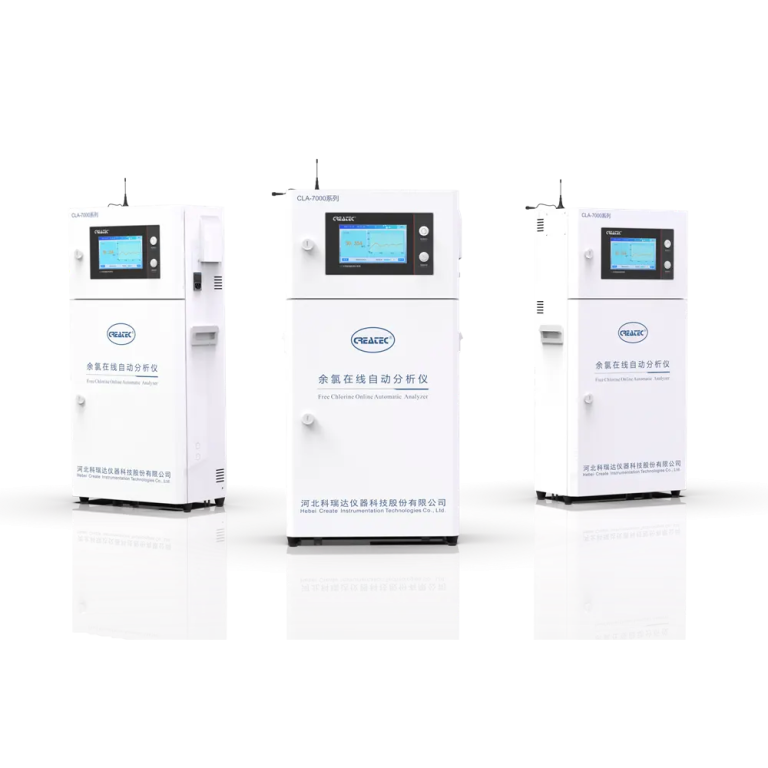
Shanghai ChiMay’s residual chlorine transmitter ships in two variants matched to the plant-vs.-distribution use pattern. The DPD colorimetric analyzer with EPA Method 334.0-compatible response is targeted at plant discharge; the membrane-covered amperometric probe with automatic pH compensation is targeted at storage exit and irrigation manifold. Both connect to the 2-in-1 mini transmitter, offering 4–20 mA and Modbus RTU output for direct integration into reuse-plant SCADA and farm irrigation controllers.
For the pH-compensation requirement, Shanghai ChiMay’s in-line pH electrode with double-junction reference offers the stable pH signal amperometric chlorine sensors need. Installing both at the same measurement point on a shared flow cell reduces piping complexity and cabinet footprint.
Closing Note
Chlorine in reuse water is a control problem, not a chemistry problem. The chemistry is well understood. The control problem — holding residual within a narrow window across long, thermally variable distribution networks — is where reuse plants win or lose. Sensor placement at three points, discipline about calibration, and a compensated control loop combine to deliver reuse water that is safely disinfected at the plant and safely non-toxic at the emitter. That balance is what turns reuse from a policy aspiration into a routine irrigation input.